Short answer: Surface conditioning tools clean metal and prepare it for coating. The main groups are abrasive blasting (sand, grit, glass bead, shot, vapor), hand and power tools (wire brushes, grinders, flap discs, needle guns) and bristle blasting tools such as the Bristle Blaster®. They differ in whether they only clean or also create the anchor profile a coating needs.
Conditioning, machining and cleaning metal surfaces can be done in many ways. All these forms of surface preparation share one purpose: to remove coatings, mill scale, rust and other contamination in order to extend the life of a steel object. Often this is done before applying a (new) coating. To do this properly, the surface must be cleaned and given a profile that the coating can key into. This article covers the main surface conditioning tools, how they work, what result each one gives, and where MontiPower® power tools fit in.
Sandblasting as a surface conditioning tool
One of the best-known and most widely used methods of surface conditioning is abrasive blasting. There are different forms of abrasive blasting, but they broadly work the same way: an abrasive is propelled by compressed air (or by a spinning wheel) at high speed against the surface, and the impact of the abrasive knocks off coatings, rust and dirt. Angular abrasives also cut a profile into the steel.
Originally, the most widely used form of abrasive blasting was sandblasting. Sand cut well and was cheap, so sandblasting was used in many industries. Over time, its disadvantages became clear. Silica sand breaks down into respirable crystalline silica dust, which causes silicosis and lung cancer. As a result, blasting with silica sand has been banned or restricted in a number of countries, and where it is still allowed it is tightly controlled by exposure limits, such as OSHA's respirable crystalline silica standard in the US.
Surface conditioning with other blasting media and techniques
As silica sand was restricted, other abrasives took its place, such as glass beads (bead blasting), corundum (aluminum oxide), steel grit and shot, slags and plastic media. Different blasting techniques also developed, such as wheel blasting for production lines and vacuum blasting, which recovers the media at the nozzle. These media and techniques are still widely used for surface conditioning today.
Although these abrasives avoid the specific silica hazard of sand, abrasive blasting has its own drawbacks, discussed in more detail in the dangers of sandblasting:
- Set-up and containment: blasting needs a compressor, blast pot, hoses, an abrasive supply, containment and a waste route. For small areas, this set-up often costs more than the blasting itself.
- Skill and cost: achieving a consistent finish requires trained operators, which is why blasting is usually carried out by specialist contractors.
- Dust and waste: spent abrasive mixed with removed coating — sometimes containing lead or chromates — must be collected and disposed of.
- Risk of damage: the aggressive action can damage thin or delicate parts.
For more fragile surfaces, vapor blasting, in which water is mixed with the abrasive, is often used. It reduces dust and is gentler, but it is slower on heavy contamination and introduces water to the surface.
Hand and power tools for surface conditioning
Where blasting is impractical, surface conditioning is usually done with hand and power tools. They fall into groups with very different results:
| Tool | What it does | Typical result |
|---|---|---|
| Wire brushes (hand or power) | Rubs off loose rust and paint | SSPC-SP 2 / SP 3 (St 2 / St 3); no new profile and can polish existing scale |
| Grinding and flap discs | Cuts through scale and coating, removing some steel | Bare metal, but a shallow, directional profile |
| Needle guns / needle scalers | Impact of hardened needles chips off scale and rust | Effective on heavy rust and welds; irregular profile that must be measured |
| Bristle blasting (Bristle Blaster®) | Wire bristle tips strike and rebound, removing contamination and leaving micro-craters | Bare metal with an anchor profile; cleanliness comparable to Sa 2½ / SSPC-SP 10 in documented tests |
The difference matters because coating specifications usually ask for both cleanliness and profile. SSPC-SP 3 power tool cleaning is not intended to remove adherent mill scale, rust and paint, and SSPC-SP 11 notes that power wire brushes or sanding discs used alone may not produce the required profile.
The surface conditioning tools from MontiPower
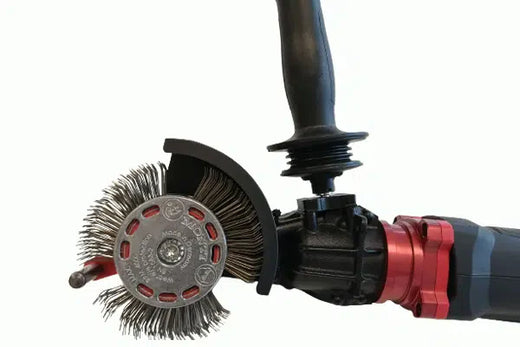
MontiPower's Bristle Blaster® and MBX® are hand-held power tools with patented rotating wire-bristle belts that remove contamination without loose abrasive. Because they are easy to deploy, maintenance teams can remove coatings, paint, rust and mill scale themselves on small and hard-to-reach areas instead of mobilising a blasting contractor. With a range of belts for different substrates and tasks, there is a suitable configuration for most conditioning jobs:
- Bristle Blaster® — for steel surface preparation before coating. It removes corrosion, coatings and mill scale and creates an anchor profile in one pass: 65–85 µm Rz on standard steel, with cleanliness comparable to ISO 8501-1 Sa 2½ / SSPC-SP 10 in documented tests. Results vary with steel grade, rust grade, belt and technique.
- MBX® — for car body panels and thinner substrates. It removes rust, paint, underseal, sealants and adhesives without heat or warping; coarse and medium belts leave a finish similar to sandblasting on such panels. It is not intended for preparing structural steel to a blast-comparable standard.
For coating preparation on smaller areas, this makes the Bristle Blaster® a practical alternative to sandblasting and other methods of abrasive blasting. Large, open new-build areas are still usually faster to blast.
How do MontiPower's surface conditioning tools work?
MontiPower's power tools work with a rotating belt of wire bristles with specially designed, forward-bent tips. On the Bristle Blaster®, an accelerator bar briefly holds the bristle tips back during each rotation. When released, the tips spring forward with high kinetic energy, strike the surface and immediately retract (rebound). This strike-and-rebound action removes coatings, rust, mill scale and other contamination precisely, and the impact leaves micro-indentations that form the anchor profile for a new coating — a texture that resembles a grit-blasted surface.
The MBX® works without an accelerator bar: its flexible bristles spin outward by centrifugal force in a patented housing and work on a cushion of air, which makes it suitable for cleaning thin panels without grinding into the substrate.
Grit-free does not mean dust-free: the rust and coating removed from the surface still become particles, so extraction where available and suitable respiratory protection remain necessary.
Frequently asked questions
What is surface conditioning?
Surface conditioning is the cleaning and texturing of a surface so it is ready for its next step, usually coating. For steel it means removing rust, mill scale, old coating and contamination and, where the coating requires it, creating an anchor profile for adhesion.
Does a wire brush prepare steel well enough for coating?
Only for low-demand coatings. Wire brushing removes loose rust and paint to SSPC-SP 2 or SP 3 but does not remove tightly adherent mill scale or create a new profile, and it can polish the surface. High-performance coatings usually require bare metal with a measurable anchor profile.
What is the difference between the Bristle Blaster® and the MBX®?
The Bristle Blaster® uses an accelerator bar so its bristle tips strike the steel, cleaning and profiling it to a result comparable to Sa 2½ / SSPC-SP 10. The MBX® cleans car body panels and thin substrates without heat or warping and is not designed for blast-comparable steel preparation.
Sources
- OSHA, 29 CFR 1926.1153 — Respirable crystalline silica. osha.gov
- Roadmap on Carcinogens, Respirable crystalline silica. stopcarcinogensatwork.eu
- SSPC-SP 3, Power Tool Cleaning. Copy of standard
- SSPC-SP 11, Power Tool Cleaning to Bare Metal. Copy of standard
- R. Stango et al., Bristle blasting fundamentals, NACE CORROSION 2009. content.ampp.org