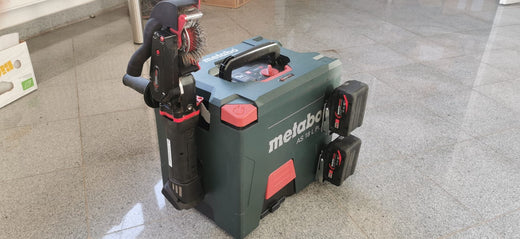
In brief: MontiPower® had the cover story of the April 2020 edition of World Pipelines magazine. The article, "From blast off to landing", describes how the Bristle Blaster® was used for grit-free surface preparation of pipeline field joints on a coating project in Europe, the Slovakia to Poland gas interconnector, before the field joint coating was applied.
This post introduces the April 2020 World Pipelines cover story, explains the surface preparation technology it describes, and points to where you can read more about field joint preparation with the Bristle Blaster®.
The April 2020 cover story
MontiPower® had the cover story in the April 2020 edition of World Pipelines magazine, "From blast off to landing", in which we detail the pipe surface preparation of a field joint coating project in Europe. The article, published online on 7 April 2020, was written by Martin Durcik, Sander Hofstee and Frits Doddema of MONTI-Werkzeuge GmbH. It covers the Slovakia to Poland gas interconnector, a project partly funded by the EU's Connecting Europe Facility.


You can read the full article on the World Pipelines website (link in the sources below). For our own write-up of the same project, see From Blast Off to Landing: bristle blasting on the Slovakia–Poland gas interconnector and the project update Bristle Blaster® on the interconnector pipeline.
Why field joints need special attention
Pipe sections usually arrive on site with a factory-applied coating, but the girth weld area at each joint is left bare so the pipes can be welded together. That field joint has to be cleaned and profiled in the field, often in remote terrain, before the field joint coating is applied. If the preparation is poor, the field joint becomes the weak point in the pipeline's passive corrosion protection.
The traditional method is abrasive blasting. On a pipeline spread it brings compressors, blast pots, abrasive supply, containment, noise, dust and a waste stream of spent abrasive that has to be collected and disposed of. In difficult terrain those logistics take time and money for every joint. For background, see surface preparation for pipeline field joints and corroded welds.
The technology in the article: bristle blasting
The Bristle Blaster® uses a rotating belt of hardened, curved wire bristles. An accelerator bar holds the bristles back and releases them so that the tips strike the steel with kinetic energy comparable to grit blast media, then rebound. Each impact removes rust and coating and leaves a small indentation, so the tool cleans and creates an anchor profile in one pass, without loose abrasive.
According to MontiPower® product data, bristle blasting gives:
- Surface cleanliness comparable to ISO 8501-1 Sa 2½ and Sa 3 (SSPC-SP 10 / SP 5)
- An anchor profile of 65–85 µm Rz (2.6–3.3 mil) on standard steel in documented tests, and up to 120 µm Rz depending on belt and conditions
- A cold-working process with no heat input and no grit to collect
The World Pipelines article reports a cleanliness level of Sa 2½ and roughness up to 120 µm on the interconnector field joints. Results on any job vary with steel grade, rust grade, belt and technique, and acceptance is set by the coating specification and the inspector.
Why it matters for pipeline owners and contractors
- Smaller footprint: a hand-held tool and compressed air or mains power, instead of a full blasting spread.
- Less waste: no spent abrasive mixed with removed coating to collect and dispose of.
- Inspectable result: the prepared joint is checked with the same methods as a blasted one: ISO 8501-1 photographs, replica tape for profile and soluble salt testing.
- Hazardous areas: the Bristle Blaster® Pneumatic is fully pneumatic and ATEX-evaluated for zone 1 explosive gas and zone 21 explosive dust, which matters on live pipeline and gas infrastructure.
Where to learn more
For more on preparing pipelines, field joints and girth welds, see our oil, gas and pipelines page, or contact a MontiPower® specialist to discuss a project.
Sources
- M. Durcik, S. Hofstee, F. Doddema, From blast off to landing, World Pipelines (7 April 2020). worldpipelines.com
- R. J. Stango et al., Fundamentals of Bristle Blasting Process for Removing Corrosive Layer, NACE CORROSION 2009. AMPP abstract
- MontiPower®, Bristle Blaster® product data and Bristle Blaster® Pneumatic ATEX evaluation (2014/34/EU).