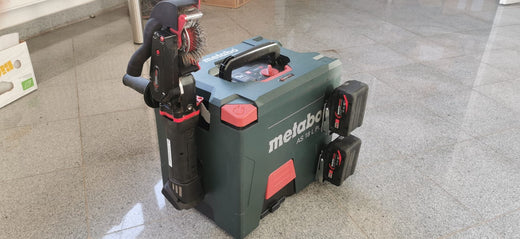
To remove mill scale from a small steel area: confirm the required grade, degrease the area, test whether the scale is tightly adherent, then use an impact power tool such as a bristle blasting tool to remove the scale and create an anchor profile in one pass. Verify cleanliness against ISO 8501-1, measure the profile to ASTM D4417, and prime within the coating manufacturer's window. Wire brushes and grinding discs alone usually leave tight mill scale or too little profile.
Small areas of mill-scaled steel turn up on every project: weld repairs and modifications, field cuts, bolted connections, damaged primer, added brackets, and short lengths of new steel spliced into an existing structure. Each is too small to justify a blast set-up and too important to leave to a wire brush.
This is a step-by-step method for those areas. For the background on what mill scale is, read Mill Scale on Steel: What It Is and How to Remove It.
Why small areas are where mill scale gets missed
Mill scale is a layer of iron oxides (wüstite, magnetite and haematite) formed on steel during hot rolling. It is electrochemically cathodic to steel, so any break in it concentrates corrosion on the exposed steel underneath. A coating applied over it bonds to the scale, not the steel.
On small repairs the usual tools are a grinder and a wire cup brush. SSPC-SP 3 is clear about what those achieve: it removes loose mill scale, and "it is not intended that adherent mill scale, rust, and paint be removed by this process." Wire brushing on intact mill scale often polishes it to a metallic sheen that looks prepared and is not. The repair then becomes the first place the new coating fails.
Step-by-step: removing mill scale from a small area
Step 1 — Confirm the required grade and profile
Check the coating data sheet and the project specification. Repairs to a system originally applied over Sa 2½ / SSPC-SP 10 usually call for SSPC-SP 11 (power tool cleaning to bare metal, minimum 25 µm / 1 mil profile) or a result comparable to the original blast grade. Note the minimum and maximum profile the coating requires.
Step 2 — Assess the steel
Compare the surface with the ISO 8501-1 rust grades. Grade A is "covered primarily with the adhering mill scale, with little rust if any"; Grade B has begun to rust and the scale has begun to flake. Use the SSPC dull putty knife test to separate loose from tight scale: material that cannot be lifted with a dull putty knife is adherent and must be removed mechanically for a bare-metal grade.
Step 3 — Degrease first
Remove oil, grease and cutting fluid by solvent cleaning (SSPC-SP 1) before any mechanical work. Power tools spread oil into the profile rather than removing it.
Step 4 — Mark out and protect the boundary
Mark the repair area and extend it far enough into sound coating to feather the edge. Protect adjacent surfaces, fittings and machined faces. Remove weld spatter, slag and sharp edges first with a grinder or needle scaler where needed. See weld cleaning and post-weld preparation.
Step 5 — Remove the scale and create the profile
Use an impact tool. SSPC-SP 11 names "rotary flap, cutter bundle, needle gun, wire bristle impact, and hammer flail assemblies" as impact media. On small flat and curved areas, a bristle blasting tool removes the scale and builds the profile in the same pass.
With a Bristle Blaster®:
- Choose the belt. 23 mm belts for open areas; 11 mm belts for narrow strips, edges and tight access. Carbon spring steel belts (red inner ring) for carbon steel; stainless belts (white inner ring) with the matching stainless accelerator bar for stainless work. The belt selector helps.
- Start correctly. Switch the tool on before bringing the belt to the surface, and guide it with both hands.
- Use light pressure. MontiPower manuals state that excessive contact pressure limits performance and damages the belt. Let the bristle tips do the work.
- Move steadily. Work towards yourself with oscillating movements, and on edges work only lengthways.
- Watch the belt. If vibration or unusual noise starts suddenly, stop and check the belt for damage or wear. See belt life and wear.
On scale that is heavily rusted or under thick old coating, take off the bulk first with a heavy-removal disc such as Tercoo®, then profile.
Step 6 — Inspect
- Cleanliness: no visible mill scale, rust or coating outside the bottom of pits for SP 11. Compare with ISO 8501-1 reference photographs where the specification refers to them.
- Profile: measure with replica tape or a depth micrometer to ASTM D4417. A profile below the specification minimum on Grade A steel usually means the scale was polished rather than removed. See the anchor profile measurement field guide.
- Salts: where specified, Bresle patch and conductivity to ISO 8502-6 and ISO 8502-9.
Step 7 — Clean off and prime within the window
Remove dust with clean, dry, oil-free air or a vacuum and apply the primer within the time and environmental limits on the coating data sheet. Prepared steel will flash rust if left. See flash rust: causes and prevention.
Which tool for which small-area job
| Job | Tool | Why |
|---|---|---|
| Mill scale on a repair patch, SP 11 required | Bristle blasting (23 mm belt) | Removes adherent scale and creates profile in one pass |
| Narrow strips, edges, around bolts | Bristle blasting (11 mm belt) | Narrower contact width, same impact mechanism |
| Weld spatter, slag, sharp edges | Grinder or needle scaler, then profile | Grinding removes defects but leaves a shallow profile |
| Thick old coating or pack rust over scale | Tercoo® then bristle blasting | Bulk removal first, profiling second |
| Loose scale only, St 3 acceptable | Power wire brush | Adequate where tight scale may remain |
What the field data says
- Profile on shipbuilding steel. In ASC Shipbuilding trials published at Corrosion & Prevention 2018, bristle blasting produced 50–80 µm, consistently above 50 µm, against 30–40 µm for a #36 grit grinder and a #40 flap disc. The authors concluded it could be used for localised and spot repairs.
- Time on a small repair. Wales & West Utilities compared methods on small-area corrosion removal: 45 person-minutes in total with bristle blasting against 260 person-minutes with grit blasting, driven by set-up and clean-up (field trial).
- Documented profile. On standard API 5L steel in documented tests, the Bristle Blaster® produces 65–85 µm Rz (2.6–3.3 mil), with cleanliness comparable to Sa 2½. Results vary with steel grade, rust grade, belt and technique; acceptance is set by the specification and the inspector.
Safety on small-area work
Wear safety glasses, gloves, sturdy footwear and hearing protection. The material removed is harmful to breathe; MontiPower manuals require a dust mask, and respiratory protection should be chosen from the coating, substrate and site risk assessment. Working on steel can throw sparks, so keep combustible material out of the spark zone and work under the site's hot-work rules. See surface preparation safety.
Related reading: Understanding Mechanical Descaling for Mill Scale and Rotating Tools for Blast-Free Steel Preparation.
Repairing mill-scaled steel without a blast set-up?
Tell us the steel, the coating and the size of the repair. We'll recommend the tool, belt and verification.
Frequently asked questions
Can I remove mill scale with an angle grinder?
A grinding disc can cut through mill scale, but it removes steel with it and leaves a shallow, directional profile. Shipyard trials measured 30–40 µm with grinding and flap discs. If the coating needs a deeper profile, follow with an impact tool.
Will a wire brush remove mill scale?
A wire brush removes loose scale only, which meets SSPC-SP 2 or SP 3. Tightly adherent mill scale remains and is often polished. It does not meet SP 11.
What standard should a small repair meet?
Whatever the coating specification requires. For repairs to high-performance systems this is commonly SSPC-SP 11, with a minimum 25 µm (1 mil) profile, or a result comparable to the original blast grade.
How do I know the mill scale is gone?
Visually, the surface should show uniform bare steel with no blue-grey scale. Then measure the profile: a reading below the specification minimum on mill-scaled steel suggests the scale was polished rather than removed.
Sources
- SSPC-SP 3, Power Tool Cleaning. Copy of standard
- SSPC-SP 11, Power Tool Cleaning to Bare Metal. Copy of standard
- ISO 8501-1, rust grades A–D and preparation grades, as summarised by FITZ Coatings.
- R. Dankiw, D. Fosdike, Defining Mechanical Surface Preparation Standards with Power Tools, Corrosion & Prevention 2018, Paper 74. PDF
- MontiPower, Peak Times Moments: Wales & West Utilities field trial.
- MontiPower, Bristle Blaster® Belts Steel and Stainless technical data sheets; accelerator bar data sheets; manuals 52609 and 52615.