Short answer: Performance coatings are industrial coating systems (high-build epoxies, zinc-rich primers, polyurethane topcoats, thermal spray metals, high-temperature and intumescent coatings) designed for aggressive service. Most require blast-grade cleanliness, typically SSPC-SP 10 / Sa 2½, with SP 5 / Sa 3 for thermal spray in immersion or corrosive service, plus the anchor profile and soluble salt limit stated in the coating data sheet.
Performance coatings are coating systems engineered to protect substrates under aggressive service conditions (high corrosivity, immersion, chemical exposure, elevated temperature or demanding mechanical loads) where standard architectural or maintenance paints would fail early. The term covers a broad family of industrial coating technologies, but they all share one dependency: their performance is only as good as the surface preparation beneath them. This guide explains the main performance coating types, where they are used, the surface preparation each typically requires, and how to verify and achieve it, including without abrasive blasting.
What are performance coatings?
Performance coatings is an industry term for coating systems formulated to deliver measurable, long-term protection in service environments that standard coatings cannot withstand. They are distinguished from decorative or general maintenance coatings by their chemistry, their film build, and the stringent surface preparation they require.
Common performance coating technologies include:
- High-build epoxy coatings: the workhorse of industrial corrosion protection. Two-component systems offering excellent adhesion, chemical resistance and barrier protection. Used on offshore structures, pipelines, industrial plant and marine hulls. Typical dry film thickness: 100–400 µm per coat.
- Zinc-rich primers (organic and inorganic): provide galvanic (cathodic) protection of steel by making zinc the sacrificial anode. Organic zinc-rich primers use epoxy or urethane binders; inorganic zinc silicates react chemically with the steel surface. Both typically require near-white metal cleanliness (SP 10 / Sa 2½) or better; check the data sheet.
- Polyurethane and polyaspartic topcoats: applied over epoxy primers for UV resistance, colour retention and a hard, abrasion-resistant surface. Widely used on offshore topsides, bridges and industrial structures where long-term appearance matters alongside corrosion protection.
- Thermal spray coatings (TSA/TSZ): thermally sprayed aluminium or zinc applied by arc or flame spray over bare, anchor-profiled steel. These have the most demanding surface preparation requirement of any protective system: SSPC-SP 5 / Sa 3 white metal for immersion or corrosive service, and at least SP 10 / Sa 2½ for mild atmospheric exposure, under SSPC-CS 23.00/AWS C2.23M/NACE No. 12. See also surface preparation for thermal spraying.
- Silicone and inorganic coatings: for high-temperature service (exhaust systems, heat exchangers, fired equipment). Depending on formulation, silicone-based systems are rated for continuous service in the range of roughly 400–650°C. Surface preparation requirements vary by product but are typically SP 10 minimum.
- Fluoropolymer coatings: PVDF and PTFE-based systems for chemical resistance in highly aggressive environments. Applied in thin films; surface preparation requirements are determined by the primer system used.
- Intumescent coatings: passive fire protection systems that expand under heat to form an insulating char, protecting structural steel in a fire. They are specified by their fire resistance period (for example 30–120 minutes) rather than by corrosion protection alone; see intumescent coatings and their surface preparation.
For the chemistry behind these families, see industrial coatings: types, systems and surface preparation requirements.
Where are performance coatings used?
Performance coatings are the standard of care in industries where asset failure is costly, dangerous, or both:
- Oil and gas: offshore platforms, subsea pipelines, processing equipment, storage tanks. Exposure to marine atmosphere, chloride deposition, hydrocarbon products and H₂S.
- Marine and shipbuilding: hull antifouling and anticorrosion systems, ballast tanks (IMO PSPC compliant), cargo holds, topsides.
- Energy and power generation: wind turbine towers (onshore and offshore), power plant structures, cooling water systems.
- Infrastructure: bridges, port structures, water treatment infrastructure, rail.
- Chemical processing: storage tanks, process vessels and piping in contact with acids, alkalis and solvents.
- Mining and minerals processing: structural steelwork, conveyors and process vessels exposed to abrasive and chemically aggressive environments.
Why does surface preparation determine coating performance?
A performance coating can only reach its formulated potential when it achieves full adhesion to a clean, profiled substrate. Loss of adhesion at the coating-to-steel interface is one of the most common causes of premature coating failure in industrial applications, and inadequate surface preparation is a leading cause of adhesion loss. Two surface preparation parameters directly control adhesion.
Cleanliness
Residual contamination (rust, mill scale, old coating, oil, grease or soluble salts) creates a weak boundary layer between the steel and the applied coating. The coating bonds to the contamination rather than to the steel, and when that contamination fails, the coating fails with it. SSPC blast cleaning standards define the permissible level of residue by grade: SP 6 allows staining on up to 33% of each unit area, SP 10 up to 5%, and SP 5 allows none. The full ladder is in our complete guide to surface preparation standards.
Anchor profile
A mechanical anchor profile, the microscopic peak-and-valley texture created by abrasive blasting or impact preparation tools, increases the contact area between coating and steel and creates mechanical interlocking that improves adhesion. Each coating system specifies a required profile range in µm (or mils; 25.4 µm = 1 mil). Too shallow and the coating cannot interlock properly; too deep and the peaks can protrude through the primer and create unprotected high points.
Surface preparation requirements by performance coating type
The table gives typical values. The coating manufacturer's technical data sheet always governs.
| Coating system | Typical minimum surface prep | Typical anchor profile | Notes |
|---|---|---|---|
| Alkyd / oil-based primer (standard maintenance) | SSPC-SP 6 / Sa 2 (lower grades accepted by some products) | 25–50 µm | Not classified as a performance coating; included for reference |
| Epoxy mastic (surface-tolerant) | From SSPC-SP 2/SP 3 (St 2/St 3) up to SP 6 / Sa 2, per TDS | Per TDS | Formulated to tolerate marginal surfaces; lower performance ceiling |
| High-build epoxy | SSPC-SP 10 / Sa 2½ | 40–100 µm | Standard for offshore, industrial and marine applications |
| Zinc-rich epoxy primer (organic) | SSPC-SP 10 / Sa 2½ | 40–75 µm | Galvanic mechanism requires intimate steel contact |
| Inorganic zinc silicate | SSPC-SP 10 to SP 5 / Sa 2½–Sa 3 | 40–75 µm | Reacts with the steel surface; most manufacturers specify SP 10 minimum |
| Polyurethane / polyaspartic topcoat | Per primer requirement | Per primer requirement | Applied over epoxy or zinc primer; preparation follows the primer |
| Thermal spray aluminium / zinc (TSA/TSZ) | SSPC-SP 5 / Sa 3 (immersion, corrosive); SP 10 / Sa 2½ (mild atmospheric) | 63–125 µm (2.5–5 mil), angular | Bond is purely mechanical; SSPC-CS 23.00 |
| Silicone high-temperature coating | SSPC-SP 10 / Sa 2½ (typical) | 40–75 µm | Verify with TDS; some systems accept SP 6 for lower-temperature service |
| Intumescent (cellulosic / hydrocarbon) | Per approved primer, typically SSPC-SP 10 / Sa 2½ | Per primer TDS | Fire performance depends on the primer and intumescent staying bonded |
How do you verify surface preparation before applying a performance coating?
Specifying the correct surface preparation grade is necessary but not sufficient: the result must be verified before coating application. Three measurements are required.
Visual cleanliness assessment
Compare the prepared surface against the photographic references in SSPC-VIS 1 (abrasive blast cleaned surfaces), SSPC-VIS 3 (hand and power tool cleaned surfaces) or ISO 8501-1. The inspector confirms that the surface meets or exceeds the specified grade.
Anchor profile measurement
Measure the profile using replica tape (Testex Press-O-Film) and a spring micrometer per ASTM D4417 Method C, or a depth micrometer per ASTM D4417 Method B. Record individual readings and the mean across the prepared area; both must fall within the range specified in the coating manufacturer's technical data sheet.
Soluble salt testing
Measure soluble salt contamination using the Bresle patch method (ISO 8502-6 extraction, ISO 8502-9 conductivity measurement). Limits come from the coating data sheet and specification; as examples, IMO PSPC allows 50 mg/m² (5 µg/cm²) NaCl equivalent in ballast tanks, and immersion specifications are generally stricter than atmospheric ones. Salt contamination is invisible and cannot be detected by visual grade assessment; see soluble salt contamination and coating failure.
Can you meet performance coating requirements without abrasive blasting?
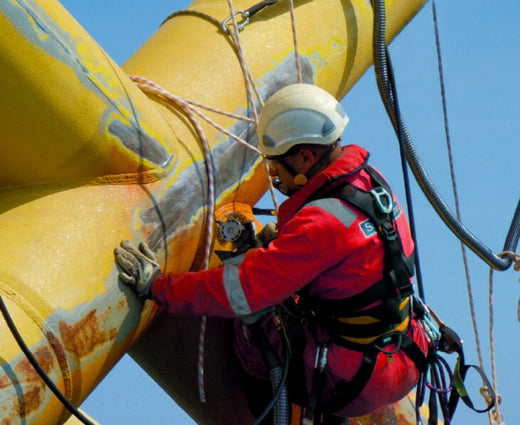
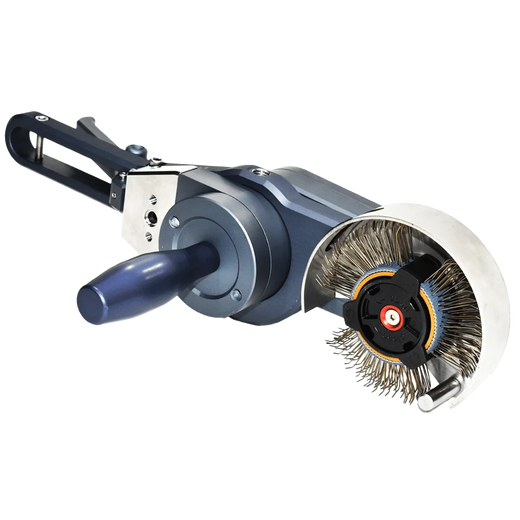
In many maintenance situations (operating assets, ATEX-classified zones, confined spaces, remote locations) conventional abrasive blasting is not logistically viable. The Bristle Blaster® produces surface cleanliness comparable to ISO 8501-1 Sa 2½ / SSPC-SP 10 with a 65–85 µm Rz anchor profile on standard steel in documented tests, without loose abrasive, containment or blasting equipment. Results vary with steel grade, rust grade, belt and technique, so verify every area as described above. Where the coating manufacturer accepts it, this meets the preparation requirements of many high-performance epoxy and zinc-rich systems; Jotun, for example, has published a surface preparation standard for bristle blast cleaning. The Bristle Blaster® Pneumatic has been ATEX-evaluated as Category 2 equipment for zone 1 explosive gas and zone 21 explosive dust atmospheres.
For steel with heavy corrosion or thick existing coatings, the two-step MontiPower® method applies the Tercoo® first to remove bulk corrosion and coating material, followed by the Bristle Blaster® to produce the required cleanliness and anchor profile (see the two-step case study).
Key takeaways
- Performance coatings (high-build epoxy, zinc-rich primers, thermal spray systems and polyurethane topcoats) require surface preparation standards that standard maintenance coatings do not. The typical minimum is SSPC-SP 10 / Sa 2½; thermal spray in immersion or corrosive service requires SP 5 / Sa 3.
- Both cleanliness and anchor profile must be verified before application, together with soluble salts, which are invisible to visual assessment.
- Inadequate surface preparation is a leading cause of premature coating failure and can void manufacturer performance warranties.
- Performance coating preparation requirements can be met without abrasive blasting in maintenance scenarios using impact tools that both clean and profile, where the specification and coating manufacturer accept the method.
- Always verify the exact requirements in the coating manufacturer's technical data sheet; the grades in this guide are typical, and specific products vary.
Frequently asked questions
What surface preparation do performance coatings require?
Most high-performance epoxy and zinc-rich systems call for SSPC-SP 10 / ISO 8501-1 Sa 2½, with an anchor profile and soluble salt limit taken from the technical data sheet. Thermal spray aluminium and zinc need SP 5 / Sa 3 for immersion or corrosive service. Surface-tolerant mastics accept lower grades but have a lower performance ceiling.
What anchor profile do high-performance coatings need?
It depends on the product and film thickness, so the coating data sheet governs. Many epoxy and zinc-rich primers specify a range of roughly 40–75 µm, while thermal spray coatings need a deeper angular profile, 63–125 µm (2.5–5 mil) under SSPC-CS 23.00. Measure with ASTM D4417 replica tape or a depth micrometer.
Can performance coatings be applied over power-tool-prepared steel?
Yes, where the specification and coating manufacturer accept it. SSPC-SP 11 and SP 15 are power tool grades that require bare metal and at least a 25 µm (1 mil) profile. Bristle blasting produces cleanliness comparable to Sa 2½ / SP 10 with a 65–85 µm Rz profile on standard steel, and Jotun has published a bristle blast cleaning standard.
Why does thermal spray need the highest preparation grade?
Thermally sprayed aluminium or zinc bonds to steel mechanically, with no chemical adhesion to fall back on. Any residual contamination or a shallow profile weakens that bond. SSPC-CS 23.00 therefore calls for SSPC-SP 5 white metal for immersion or corrosive service, SP 10 for mild atmospheric exposure, and an angular profile of 63–125 µm.
Related articles
Sources
- KTA-Tator, Industry Standards for Surface Preparation (SSPC/NACE and ISO grade definitions). kta.com
- KTA-Tator, Surface Preparation of Steel for Thermal Spray Coatings (SSPC-CS 23.00 cleanliness and 63–125 µm profile). kta.com
- SSPC-SP 11, Power Tool Cleaning to Bare Metal.
- IMO Resolution MSC.215(82), Performance Standard for Protective Coatings (PSPC), Table 1. PDF
- Jotun, Surface Preparation Code and Standard for Bristle Blast Cleaning and Profiling Process. PDF
- MontiPower, Bristle Blaster® product data and Surface Preparation Safety page (ATEX evaluation of the Bristle Blaster® Pneumatic).