Short answer: Intumescent coatings are passive fire protection coatings that swell when heated, from about 200–250°C, into an insulating char that delays the temperature rise of structural steel for a rated period, typically 30–120 minutes. They go over a manufacturer-approved primer, which usually needs SSPC-SP 10 / Sa 2½ cleanliness, the anchor profile in its data sheet and controlled soluble salt levels.
Intumescent coatings are passive fire protection systems applied to structural steel to delay the temperature rise that would cause the steel to lose structural integrity in a fire. Unlike active fire suppression systems, they need no intervention: they respond automatically to heat, expanding to form an insulating carbonaceous char over the steel. Their fire rating, typically expressed in minutes (30, 60, 90 or 120), represents the time the protected steel can withstand a standard fire test before reaching its limiting temperature. This article explains how intumescents work, the two main types, and the surface preparation they require for new work and for repairs on operating assets. Surface preparation matters because the coating must stay bonded to the steel through its service life and through the fire itself.
How do intumescent coatings work?
Intumescent coatings are inert at normal temperatures. When heated, typically from about 200–250°C, a chemical reaction begins in which three active ingredient types react in sequence:
- Acid source, typically ammonium polyphosphate, decomposes at elevated temperature to release phosphoric acid.
- Carbon source, a polyhydric alcohol such as pentaerythritol, is dehydrated by the acid to produce a carbon char.
- Blowing agent, typically melamine, decomposes to release inert gases that expand the carbon matrix into a stable foam.
The result is a multicellular carbonaceous char that expands many times the original coating thickness; an expansion ratio of about 50:1 is typical for thin-film products, depending on the formulation and the fire exposure. This char has very low thermal conductivity and insulates the steel beneath. Its effectiveness depends on it remaining intact and bonded to the steel throughout the fire, which requires that the system was applied to properly prepared steel with adequate adhesion.
Thin-film intumescent systems generally have three components: a primer, a basecoat (the part that reacts in the fire) and a sealer or topcoat. They can be applied on site or off site in a shop.
Cellulosic vs hydrocarbon intumescent coatings
The two main types of intumescent fire protection coatings are designed for different fire scenarios, and their performance characteristics differ significantly:
| Parameter | Cellulosic intumescent | Hydrocarbon intumescent |
|---|---|---|
| Fire type | Cellulosic (building) fires | Hydrocarbon pool fires and jet fires: faster temperature rise, higher temperatures |
| Standard fire curve | ISO 834 (cellulosic) / BS 476 | UL 1709 (pool fire) / ISO 22899 (jet fire) |
| Furnace temperature at 30 min | ~840°C (ISO 834) | ~1,100°C |
| Typical DFT range | Thin film, generally up to a few millimetres | Thick film, typically several millimetres up to about 25 mm, product-specific |
| Application method | Airless spray (shop or site) | Airless spray; plural-component for thicker systems |
| Primary markets | Commercial and residential construction; structural steelwork in buildings | Oil and gas; offshore platforms; petrochemical processing |
| Common topcoat | Sealer or topcoat for appearance and moisture protection | Topcoat required offshore; omitted in some industrial applications |
| Fire ratings available | 30, 60, 90, 120 minutes | Pool fire and jet fire ratings, product-specific |
Critical steel temperature and the fire rating
Structural steel starts to lose strength above about 400°C. Simplified design methods have often assumed a limiting (critical) temperature of around 550°C for loaded carbon steel members, but the actual value depends on the design code, load ratio and element type; steelconstruction.info, for example, gives 620°C as a default limiting temperature for thin-film intumescent protection of some cellular beams. Unprotected steel, especially light sections, can reach these temperatures quickly, particularly in a hydrocarbon fire. Intumescent fire protection delays the point at which the steel reaches its limiting temperature.
The required fire rating (minutes) and coating thickness for a given structural element depend on:
- The regulatory requirements for the building or facility (building codes, offshore safety case requirements)
- The section factor (Hp/A) of the steel element: the ratio of the heated perimeter to the cross-sectional area. Lighter sections (higher Hp/A) heat up faster and need thicker intumescent coatings to achieve the same fire rating as heavier sections.
- The design basis fire scenario: cellulosic or hydrocarbon; pool fire or jet fire
- The limiting steel temperature adopted in the design
What surface preparation do intumescent coatings require?
The surface preparation requirement for intumescent coatings is driven by the need for adhesion throughout the coating's service life and, critically, throughout the fire itself. An intumescent coating that disbonds from the steel before fully developing its char will not provide the rated fire protection, and poor preparation is a common cause of disbondment in service.
Cleanliness grade
SSPC-SP 10 / ISO 8501-1 Sa 2½ (near-white metal blast cleaning) is the usual minimum surface preparation for intumescent systems in both commercial construction and offshore/industrial applications, because it is what most of the approved primers require. Some thin-film cellulosic products used in low-corrosivity interior environments accept SP 6 / Sa 2, but SP 10 is the default and should be specified unless the product TDS explicitly permits a lower grade. Do not specify a lower preparation grade than the TDS requires: fire ratings and system approvals are based on the tested system applied as the manufacturer prescribes. The grades are explained in our complete guide to surface preparation standards and the SSPC-SP 10 guide.
Anchor profile
An anchor profile in the range of roughly 40–75 µm is typical for the primers used under intumescent systems. Verify the exact requirement in the primer TDS. Profile is measured using replica tape per ASTM D4417 Method C or a depth micrometer per Method B; see the anchor profile measurement field guide.
Primer compatibility
Most intumescent systems are not applied directly to bare steel; they require a compatible primer coat. The primer must be specifically approved by the intumescent coating manufacturer: an incompatible primer can lose adhesion when heated or interfere with char formation in a fire. In corrosive environments (offshore, C4–C5 atmospheric), a zinc-rich or high-performance epoxy primer is typically used under the intumescent. The intumescent manufacturer's system approval documentation must list the specific primer product as approved. How primer choice and preparation interact across coating families is covered in performance coatings and their surface preparation.
Soluble salt contamination
Soluble salts trapped under the primer cause osmotic blistering and loss of adhesion, which is as damaging under a fire protection system as under any anticorrosion coating. Take the limit from the primer data sheet and project specification and test with the Bresle patch method (ISO 8502-6/-9) before priming. As a reference point, IMO PSPC allows 50 mg/m² (5 µg/cm²) NaCl equivalent for ballast tank coatings, and immersion or high-corrosivity specifications are generally stricter than mild atmospheric ones. Watch the units: mg/m² and µg/cm² differ by a factor of ten. See soluble salt contamination and coating failure.
How are intumescent coatings maintained and repaired on operating assets?
Intumescent coatings require periodic inspection and maintenance, particularly in offshore and industrial environments where mechanical damage, corrosion and weathering degrade the coating over time. Maintenance on operating assets faces the same constraints as any other high-performance industrial coating system: ATEX classifications, active operations and confined spaces limit the use of conventional blasting.
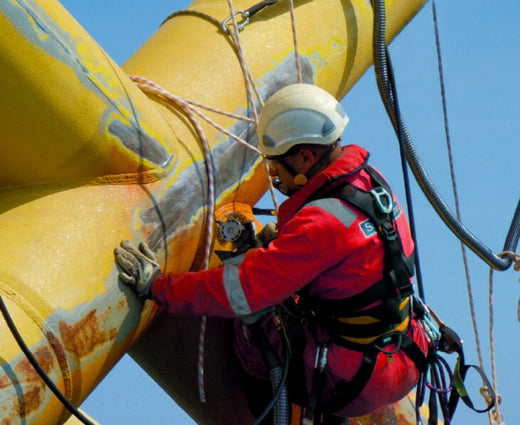
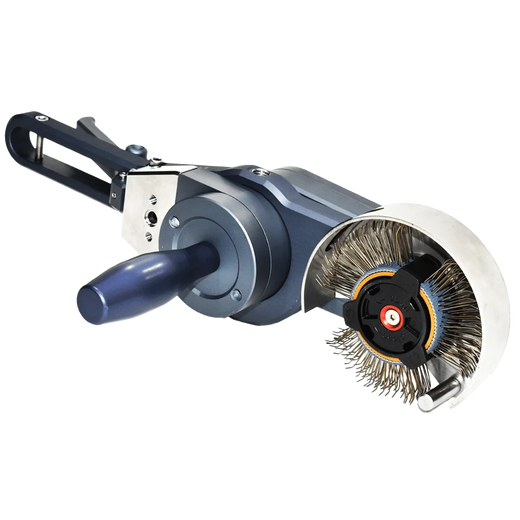
For spot repair of intumescent coatings on operating offshore or industrial structures, SSPC-SP 11 power tool cleaning to bare metal is commonly specified for the repair areas, subject to the manufacturer's repair procedure. Where the original system requires blast-grade cleanliness, the Bristle Blaster® produces cleanliness comparable to SSPC-SP 10 / Sa 2½ with a 65–85 µm Rz anchor profile on standard steel in documented tests, without loose abrasive; results vary with steel grade, rust grade, belt and technique. The Bristle Blaster® Pneumatic has been ATEX-evaluated as Category 2 equipment for zone 1 explosive gas and zone 21 explosive dust atmospheres, which suits maintenance in classified areas of offshore platforms and processing facilities.
Any intumescent coating repair must use the manufacturer-approved system of the original application; mixing intumescent products from different manufacturers within the same system is not acceptable. The repair must be documented, and the repaired thickness verified against the original fire protection specification.
Key takeaways
- Intumescent coatings protect structural steel in fires by expanding into an insulating carbonaceous char that delays the steel reaching its limiting temperature. Fire ratings (typically 30–120 minutes) are product- and section-specific.
- Two main types exist: cellulosic (building fires; thin film) and hydrocarbon (pool and jet fires; thick film). They are not interchangeable.
- SSPC-SP 10 / Sa 2½ is the usual minimum surface preparation, driven by the approved primer. Specify what the TDS requires, not less.
- The intumescent system must use a primer specifically approved by the intumescent manufacturer.
- Repairs on operating assets, including ATEX zones and confined spaces, are commonly prepared to SP 11 or to a cleanliness comparable to SP 10, achievable with grit-free impact tools.
Frequently asked questions
What surface preparation do intumescent coatings need?
Preparation follows the manufacturer-approved primer, most often SSPC-SP 10 / ISO 8501-1 Sa 2½ with the anchor profile stated in the primer data sheet, commonly in the 40–75 µm range. Some thin-film products for dry interiors accept SP 6 / Sa 2. Soluble salts must also be tested and kept within the specified limit before priming.
Can intumescent coatings be applied directly to bare steel?
Generally not. Most intumescent systems are built up from a compatible primer, the reactive intumescent basecoat and, where needed, a sealer or topcoat. The primer must be approved by the intumescent manufacturer, because an incompatible primer can lose adhesion or interfere with char formation in a fire.
What is the difference between cellulosic and hydrocarbon intumescents?
Cellulosic (thin-film) intumescents protect building steel against standard fires following ISO 834 and are applied relatively thin. Hydrocarbon (usually epoxy-based, thick-film) intumescents are designed for pool and jet fires in oil, gas and petrochemical plants, tested to curves such as UL 1709 and ISO 22899. They are not interchangeable.
How is steel prepared for intumescent repairs on a live plant?
Repair areas are commonly prepared to SSPC-SP 11 power tool cleaning to bare metal, or to a cleanliness comparable to SP 10 / Sa 2½ where the original system requires it. Grit-free impact tools such as the Bristle Blaster® do this without blast containment; the pneumatic version is ATEX-evaluated for zone 1 gas and zone 21 dust.
Related articles
Sources
- SCI / steelconstruction.info, Fire protecting structural steelwork (intumescent reaction temperature, expansion ratio, thin-film system components, limiting temperatures). steelconstruction.info
- KTA-Tator, Industry Standards for Surface Preparation. kta.com
- SSPC-SP 11, Power Tool Cleaning to Bare Metal.
- IMO Resolution MSC.215(82), Performance Standard for Protective Coatings (PSPC), Table 1. PDF
- MontiPower, Bristle Blaster® product data and Surface Preparation Safety page (ATEX evaluation of the Bristle Blaster® Pneumatic).