Short answer: A corrosion control programme for industrial assets has six steps: classify the environment to ISO 12944, specify a protection system for the required durability, control surface preparation and application quality, inspect on a risk-based schedule, intervene by condition, and judge decisions on life-cycle cost. Surface preparation is the step most often responsible for preventable coating failures.
This article sets out a practical six-step framework for corrosion control on industrial assets, with the standards that apply at each step, a decision table for maintenance interventions, and the surface preparation options for assets that cannot be shut down or blasted.
Corrosion control is the systematic application of engineering, operational and management measures to prevent, detect and mitigate corrosion in industrial assets. It is not a single action. It is a programme that spans asset design, materials selection, coating specification, construction quality, inspection scheduling, maintenance execution and end-of-life planning. The difference between a well-managed programme and ad-hoc reactive maintenance is the difference between predictable, budgeted maintenance and unplanned shutdowns, emergency repairs and early asset replacement.
The cost and consequence of inadequate corrosion control
NACE International's IMPACT study estimated the global cost of corrosion at US$2.5 trillion, equivalent to 3.4% of global GDP (2013). The same study estimated that 15–35% of that cost, between US$375 and US$875 billion a year, could be saved by using corrosion control practices that already exist. These figures cover direct costs and do not include the full cost of safety incidents and environmental consequences. In the sectors most affected by structural corrosion (oil and gas, marine, power generation, chemical processing and infrastructure), corrosion-related failures are a major cause of unplanned downtime and asset integrity incidents.
Many corrosion-related coating failures are preventable through adequate surface preparation and correct application; they are not caused by coating product defects or unavoidable service conditions. Inadequate corrosion control is, in large part, an execution problem.
The corrosion control framework
Step 1: Environment assessment and corrosivity classification
Effective corrosion control starts with understanding the service environment. ISO 12944-2 provides the standard corrosivity classification: C1 to CX for atmospheric exposure and Im1 to Im4 for immersion and buried structures. Atmospheric categories are described by typical environments and can be determined more precisely from the first-year corrosion of reference steel and zinc samples, or estimated from humidity, chloride deposition and pollutant levels (ISO 9223). For assets that span several environments, such as offshore structures with atmospheric, splash and submerged zones, classify each zone separately.
Step 2: Corrosion protection system specification
The corrosion protection system (primer, intermediate coat, topcoat, total film thickness and surface preparation) must match the corrosivity category and the required service life. Key specification decisions:
- Durability range: how long must the system protect before the first major maintenance? ISO 12944 defines low (L: up to 7 years), medium (M: 7–15 years), high (H: 15–25 years) and very high (VH: more than 25 years).
- Coating system type: zinc-rich primer systems for galvanic (sacrificial) protection of steel at coating damage; high-build epoxy for barrier-dominated environments; thermal spray aluminium for very long service life in CX and immersion environments.
- Surface preparation standard: the coating data sheet and the ISO 12944-5 system tables set the minimum preparation grade. For high-performance systems in C4, C5, CX and immersion, this is typically Sa 2½ (SSPC-SP 10) with a specified profile range.
- Soluble salt limits: define the maximum acceptable contamination for the service environment. Write the measurement method (ISO 8502-6 extraction with ISO 8502-9 conductivity) and the project limit into the specification.
Step 3: Construction and application quality control
The most technically correct specification delivers no value if execution is not controlled. An effective QC programme for coating application covers:
- Surface preparation verification before coating: cleanliness grade, anchor profile measurement and soluble salt testing
- Environmental condition monitoring during preparation and application (steel temperature, relative humidity, dew point)
- Wet film thickness measurement during application and dry film thickness verification after cure
- Holiday testing for immersion service coatings
- Documentation of all inspection results with location, date, inspector and instrument
Step 4: In-service inspection programme
An inspection schedule defines when the asset will be examined, what will be assessed and which condition thresholds trigger maintenance. A risk-based approach prioritises the most critical assets and the most exposed areas within each asset. Inspection outputs should include:
- Overall coating condition rating on a standard scale, for example degree of rusting Ri 0 to Ri 5 to ISO 4628-3
- Identification and location of coating defects by type (blistering, cracking, flaking, rust)
- Steel loss assessment at areas of active corrosion (ultrasonic thickness measurement)
- Trend analysis comparing current condition with previous inspections
Step 5: Maintenance intervention
Maintenance interventions are triggered by the condition thresholds defined in the inspection programme. The choice between spot repair, zone overcoat and full recoating depends on the extent and type of coating degradation. The thresholds below are typical examples; set your own in the maintenance specification.
| Condition (example threshold) | Intervention | Surface preparation required |
|---|---|---|
| Isolated mechanical damage or spot corrosion (<1% of surface area) | Spot repair | SSPC-SP 11 minimum (bare metal, ≥25 µm / 1 mil profile); a result comparable to SSPC-SP 10 preferred for high-performance systems |
| Widespread coating breakdown (about 1–10% of area) without delamination | Zone overcoat after local preparation | Comparable to SSPC-SP 10 on corroded areas; sweep blasting or abrading of intact coating for adhesion |
| Widespread delamination, osmotic blistering or underfilm corrosion | Full recoating after complete removal | SSPC-SP 10 / Sa 2½ as a minimum, or as the original specification |
| Active corrosion threatening structural integrity | Emergency repair and structural assessment | SSPC-SP 11 minimum for the coating repair; structural engineering review |
Step 6: Life-cycle cost analysis
Corrosion control decisions should be evaluated on a life-cycle cost basis, not on initial cost alone. For example, a coating system that costs 40% more than a lower-specification alternative, but lasts twice as long and needs half as many maintenance interventions, is significantly cheaper over the asset's service life. Life-cycle cost models should account for:
- Initial application cost (materials, labour, surface preparation)
- Inspection and monitoring costs
- Maintenance intervention frequency and cost
- Lost production during application and maintenance
- Replacement cost and timing
Corrosion control in maintenance-constrained environments
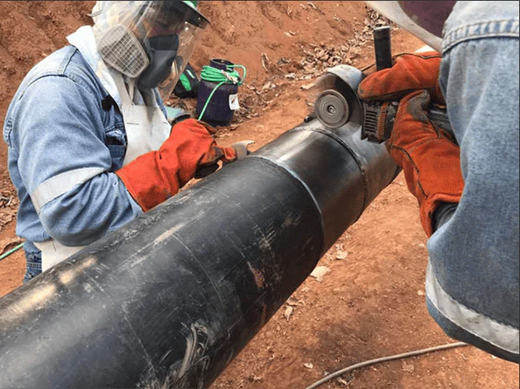
Many industrial assets, particularly in oil and gas, offshore and energy, cannot be taken out of service for surface preparation and recoating. Maintenance has to be done on operating plant, in ATEX-classified zones, in confined spaces and at remote locations. These constraints call for preparation methods without the logistical footprint of abrasive blasting; see in-service surface preparation.
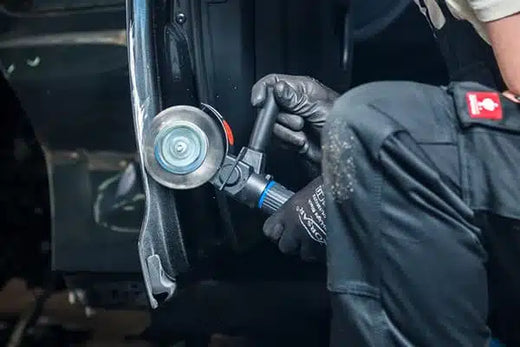
- The Bristle Blaster® from MontiPower® gives cleanliness comparable to Sa 2½ / SSPC-SP 10 and a 65–85 µm Rz anchor profile on API 5L steel in documented tests, without grit, blast containment or blasting equipment. Results vary with steel grade, rust grade, belt and technique. The fully pneumatic version is ATEX-evaluated for zone 1 gas (group IIA, T4) and zone 21 dust, subject to the site permit system.
- Tercoo® discs remove bulk corrosion and thick coatings before bristle blasting in the Two-Step Method for heavily corroded areas.
- Pneumatic drives run on the compressed-air supply available on most industrial sites; electric and 18 V cordless drives cover areas without air.
- Grit-free is not dust-free: removed rust and old coating still become particles, so extraction and respiratory protection follow the site risk assessment.
Key takeaways
- Corrosion control is a programme, not a product. It spans environment assessment, protection system specification, application QC, inspection and planned maintenance across the asset's service life.
- Inadequate surface preparation is one of the largest preventable causes of coating failure. A robust programme defines and enforces surface preparation standards at every coating intervention.
- ISO 12944 is the reference framework for corrosivity classification and coating system selection. High-performance systems in the more corrosive categories typically require Sa 2½ (SSPC-SP 10) with a specified profile.
- Life-cycle cost, not initial application cost, is the right basis for corrosion control investment. Properly specified, applied and maintained systems are generally cheaper over their service life than underspecified systems that need early intervention.
- Maintenance-constrained environments need preparation methods that work on live assets without blasting logistics. Impact power tools can reach the preparation standards that high-performance coatings require, verified by inspection.
Related articles
- Corrosion Protection for Steel Structures: A Practical Guide
- How to Keep Steel Corrosion-Free: Maintenance Cycles
- Industrial Coatings: Types, Systems, and Surface Preparation Requirements
- Soluble Salt Contamination and Coating Failure
- How to Write a Surface Preparation Specification
Frequently asked questions
What is corrosion control for industrial assets?
Corrosion control is a managed programme of engineering, operational and maintenance measures that prevents, detects and mitigates corrosion. For industrial assets it covers environment classification, coating system specification, surface preparation and application quality control, risk-based inspection, condition-based maintenance and life-cycle cost decisions across the asset's whole service life.
How much does corrosion cost?
NACE International's IMPACT study estimated the global cost of corrosion at US$2.5 trillion, about 3.4% of global GDP in 2013. It also estimated that 15–35% of that cost could be saved by applying corrosion control practices that already exist, which is why structured programmes pay back on industrial assets.
Which standard is used to classify corrosivity for coating selection?
ISO 12944-2 classifies atmospheric corrosivity from C1 (very low) to CX (extreme) and immersion or buried exposure from Im1 to Im4. ISO 12944-5 then gives example protective paint systems for each category and for the low, medium, high and very high durability ranges.
What surface preparation do coating repairs need?
Spot repairs to high-performance systems usually require at least SSPC-SP 11, power tool cleaning to bare metal with a minimum 25 µm (1 mil) profile, or a result comparable to the original blast grade. Full recoating normally returns to the original specification, typically Sa 2½ / SSPC-SP 10. Always follow the coating data sheet.
Sources
- NACE International, IMPACT: International Measures of Prevention, Application, and Economics of Corrosion Technologies Study (2016). impact.nace.org
- ISO, ISO 12944-1:2017 Paints and varnishes: Corrosion protection of steel structures by protective paint systems, Part 1. iso.org
- Carboline, ISO 12944 brochure (durability ranges and corrosivity categories). carboline.com
- SSPC-SP 11, Power Tool Cleaning to Bare Metal. glavin.net
- KTA-Tator, Industry Standards for Surface Preparation. kta.com