Short answer: The main types of corrosion in steel pipelines are uniform (general) corrosion, pitting, crevice corrosion, galvanic corrosion, stray current corrosion, stress corrosion cracking, intergranular corrosion, acid corrosion and microbiologically influenced corrosion (MIC). All are electrochemical. They are controlled with coatings, cathodic protection and inspection, and every coating repair starts with removing the corrosion and restoring a clean, profiled surface.
Corrosion of steel pipelines
This article explains what corrosion is, describes the ten types that affect steel pipelines and how to recognize them, and outlines how pipeline corrosion is controlled and repaired.
Corrosion of steel pipelines is a common process that is difficult to stop completely. To keep pipelines in good condition, corrosion must be detected and removed in time. When corrosion has progressed too far, a section or even the entire pipeline may have to be replaced, a demanding and expensive job. Across all industries, the global cost of corrosion was estimated by NACE International at US$2.5 trillion, about 3.4% of global GDP (2013), and the same study estimated that 15–35% of that cost could be saved with available corrosion control practices.
There are various types of corrosion in pipelines. Each type has its own characteristics and ways to combat it. But what is corrosion exactly? How does corrosion occur in pipelines? And which types can we distinguish?
What is corrosion?
Corrosion is the deterioration of a metal through an electrochemical reaction with its environment. It requires an anode, where the metal dissolves, a cathode, and an electrolyte such as water or moist soil that connects them. Corrosion is often confused with rust. However, corrosion is a broader concept than rust. Rust is specifically the iron oxide that forms when iron or steel reacts with oxygen in the presence of moisture; it is the well-known brown layer on the metal surface. Corrosion covers every form of this deterioration, on any metal, whatever the cause. For a wider introduction, see what is corrosion: types, causes and prevention and rust vs corrosion.
There are various forms of corrosion in pipelines. What are the most common, and what characterizes them?
The types of corrosion in pipelines
Oxygen corrosion
Oxygen corrosion is the process that produces rust. It is the most common and most visible type of corrosion in steel pipelines. It is caused by the reaction of steel with oxygen and water or another form of moisture. The resulting iron oxide layer, the brown rust we know, is porous and does not protect the metal: oxygen and water continue to reach the steel underneath, so the steel slowly but steadily corrodes. Stainless steel and aluminum behave differently because they form a thin, dense and adherent oxide film (a passive layer) that protects the metal beneath, which is why they are used in some applications where oxygen corrosion must be avoided.
Uniform corrosion
Uniform (general) corrosion is closely related to oxygen corrosion and also results from the reaction of steel with moisture and oxygen. As the name says, it is characterized by an even distribution of the corrosion over the entire steel surface. Uniform corrosion is generally considered the least dangerous form. By taking measurements, or from previous experience, the rate and extent of corrosion can often be predicted well, so wall loss can be planned for with a corrosion allowance and inspection intervals.
Acid corrosion
In acid corrosion, an acid reacts with the metal to form a metal salt and hydrogen gas. An acid is a solution with a pH below 7; the lower the pH, the more aggressive it is. Whether a metal is attacked depends on its electrode potential: metals whose standard potential is below that of hydrogen, which includes iron and therefore carbon steel, dissolve in acids with the release of hydrogen. In pipelines, acidic conditions arise for example from dissolved carbon dioxide (sweet corrosion) or hydrogen sulfide (sour corrosion) in produced fluids.
Galvanic corrosion
Electrode potentials, mentioned under acid corrosion, also play a major role in galvanic corrosion. This type of corrosion can occur when two different metals are in electrical contact with each other and are connected by water, moist soil or another electrolyte. The less noble metal, the one with the more negative potential, becomes the anode and corrodes faster, while the more noble metal is protected. A small anode connected to a large cathode corrodes particularly fast. The same principle is used deliberately in zinc-rich primers and sacrificial anodes; see galvanic corrosion and zinc-rich primers.
Stress corrosion cracking
Unlike oxygen corrosion, stress corrosion cracking (SCC) is very difficult to predict and is often detected only at a late stage. SCC occurs when three conditions exist at the same time: a tensile stress above a threshold, often with a cyclic component (from operating pressure, dents or residual stress at welds); a susceptible material; and a potent cracking environment. On buried steel pipelines, two forms are known: high-pH SCC in concentrated carbonate-bicarbonate solutions, more frequent at higher temperatures near compressor or pump stations, and near-neutral pH SCC in dilute groundwater containing dissolved carbon dioxide. Both develop where the coating has disbonded; SCC does not occur beneath an intact coating. In stainless steels, chloride stress corrosion cracking at elevated temperatures is the best-known form, which is why stainless steel, although resistant to oxygen and uniform corrosion, can be more vulnerable to SCC. More in stress corrosion cracking: prevention and coatings.
Stray current corrosion
Stray current corrosion is related to galvanic corrosion. Stray currents are electric currents that flow through the soil along unintended paths, for example from DC rail traction systems or from the cathodic protection system of a neighboring structure. Where such a current enters a pipeline, the steel is protected; where it leaves the pipeline to return through the soil, the steel acts as an anode and corrodes, sometimes very quickly. The difference from galvanic corrosion is that the driving force is not a second metal but an external current source.
Pitting corrosion
Pitting corrosion is a localized attack that starts where a protective oxide film or coating is locally damaged or breaks down, often promoted by chloride ions. The small exposed area acts as an anode against the large surrounding cathode, so corrosion concentrates there and forms small, deep pits in the steel. These are often barely visible at first glance but can penetrate the pipe wall much faster than uniform corrosion. See pitting corrosion and surface preparation.
Crevice corrosion
Crevice corrosion is similar to pitting corrosion, but it occurs in narrow, shielded gaps: under gaskets, flanges and clamps, beneath deposits, or under disbonded coating. Inside the crevice, oxygen is depleted and the trapped liquid becomes more acidic and richer in chlorides than the surrounding environment, so the metal in the crevice becomes the anode. As with pitting, the attack tends to accelerate once it has started, and the crevice becomes deeper.
Intergranular corrosion
Intergranular corrosion is one of the most insidious forms of corrosion. It attacks the boundaries between the metal grains rather than the grains themselves, so it is hardly visible to the naked eye. The surface may show little or no corrosion while the material is weakened from within. The metal becomes increasingly brittle, loses its cohesion and may eventually fail. A well-known example is sensitized stainless steel, where chromium carbides form at the grain boundaries after welding or heat treatment.
Microbiologically influenced corrosion (MIC)
Microbiologically influenced corrosion is one of the less familiar forms of corrosion. Nevertheless, it is very relevant to steel pipelines, both internally, where water settles in low points, and externally under disbonded coatings. Many of the bacteria involved, such as sulfate-reducing bacteria, thrive in oxygen-free conditions. The corrosion is caused by the substances the bacteria produce, such as hydrogen sulfide and organic acids, which attack the steel. MIC is therefore comparable to acid corrosion, but the corrosive agent is produced by the bacteria. More in MIC corrosion explained.
How pipeline corrosion is controlled and repaired
Pipeline operators combine several layers of protection:
- External coatings such as fusion-bonded epoxy, three-layer polyethylene or polypropylene, and field joint coatings at the girth welds.
- Cathodic protection for buried and submerged sections, which makes the pipe the cathode so that coating defects do not corrode.
- Internal measures such as inhibitors, dehydration and cleaning pigs against internal corrosion and MIC.
- Inspection and monitoring, including in-line inspection, coating surveys and stray current surveys.
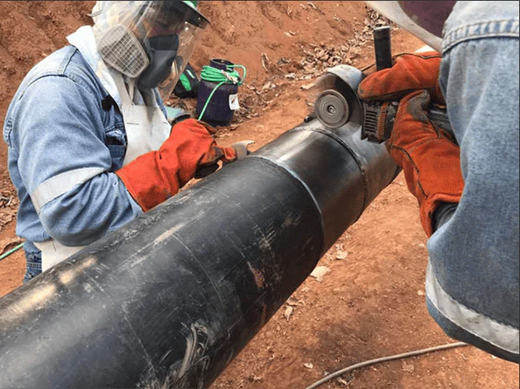
When corrosion is found and the remaining wall thickness is acceptable, the damaged area is cleaned back to bare steel and recoated. The repair coating only performs if the surface is properly prepared: corrosion products, old coating and salts removed, and an anchor profile created for adhesion. Field joints and corroded welds are a typical case; see surface preparation for pipeline field joints.
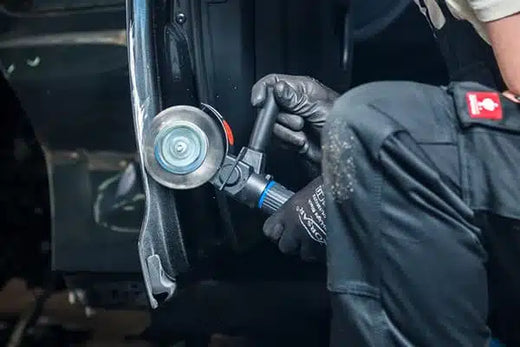
On site, the Bristle Blaster® from MontiPower® removes rust and coating and creates the anchor profile in one pass, without abrasive media. In documented tests on API 5L pipeline steel it produces cleanliness comparable to ISO 8501-1 Sa 2½ / SSPC-SP 10 with a 65–85 µm Rz anchor profile; results vary with steel grade, rust grade, belt and technique. Read more on our oil, gas and pipelines page and in how to remove rust from a metal pipe.
Frequently asked questions
What is the most common type of corrosion in pipelines?
Uniform or general corrosion of carbon steel, the familiar rust caused by oxygen and moisture, is the most common and most visible form. It is also the most predictable. Localized forms such as pitting, crevice corrosion, MIC and stress corrosion cracking are less common but more dangerous, because they can penetrate the wall with little visible warning.
What causes stress corrosion cracking in pipelines?
Stress corrosion cracking needs three conditions at once: a tensile stress above a threshold, a susceptible material and a potent cracking environment. On buried pipelines it occurs as high-pH SCC in carbonate-bicarbonate solutions and near-neutral pH SCC in dilute groundwater, both typically where the coating has disbonded and cathodic protection cannot reach the steel.
How do you prevent corrosion in steel pipelines?
Pipelines are protected by an external coating system, cathodic protection for buried or submerged sections, internal measures such as inhibitors and cleaning pigs, and regular inspection. Where corrosion is found, it is removed and the steel prepared to the cleanliness and anchor profile required by the repair coating, then recoated, or the section is repaired or replaced if wall loss is too great.
How is corrosion removed before recoating a pipeline?
Abrasive blasting is the traditional method. For field joints, spot repairs and in-service lines, a bristle blasting tool can remove rust and coating and create an anchor profile in one pass, with cleanliness comparable to Sa 2½ / SSPC-SP 10 and a 65–85 µm Rz profile in documented tests on API 5L steel. Results vary with steel, rust grade and technique.
Sources
- NACE International, International Measures of Prevention, Application, and Economics of Corrosion Technologies Study (IMPACT) (2016). impact.nace.org
- Michael Baker Jr., Inc. for PHMSA, Stress Corrosion Cracking Study (2005). phmsa.dot.gov
- Corrosion Alliance, Principles of Corrosion. corrosionalliance.com
- MontiPower, Bristle Blaster® technical data (cleanliness comparable to Sa 2½ / Sa 3; 65–85 µm Rz on API 5L steel).