Short answer: Keep steel corrosion-free by applying a protective coating system over properly prepared steel, then maintaining it on a planned cycle: regular inspection, prompt spot repair, maintenance overcoating while the existing coating is still sound, and full recoating only when it is not. Surface preparation quality and soluble salt control at each stage largely decide how long the coating protects.
Steel does not stay corrosion-free on its own. Unprotected steel exposed to moisture and oxygen can start to rust within hours — freshly blast-cleaned steel in humid air shows flash rust very quickly. Keeping steel structures and assets corrosion-free is an active, ongoing process: the right protective coating system, applied to properly prepared steel, maintained through regular inspection and timely repair throughout the asset's service life. This article explains why steel corrodes, the five phases of the coating maintenance cycle, the surface preparation each phase needs, and the factors that cut coating life short. Managed well, a high-durability coating system in the ISO 12944 sense is designed to last more than 25 years before its first major maintenance; neglected, the cost of remediation rises rapidly.
Why steel corrodes and what stops it
Steel corrodes because iron is thermodynamically unstable in the presence of water and oxygen — it spontaneously oxidises to form iron oxide (rust). The corrosion reaction is electrochemical: an anode (where iron is oxidised) and a cathode (where oxygen is reduced) form on the steel surface, connected by an electrolyte (moisture containing dissolved ions). The corrosion rate depends on how easily water, oxygen and dissolved ions can reach the steel surface. For a fuller introduction, see what corrosion is and how surface preparation stops it.
Protective coatings interrupt this process by:
- Barrier protection — creating a physical film that restricts the diffusion of water, oxygen and ions to the steel surface
- Cathodic (sacrificial) protection — zinc-rich primers make zinc the sacrificial anode, protecting steel at small coating breaches
- Inhibition — some primer formulations contain pigments that slow the corrosion reaction when moisture does penetrate the coating
All three mechanisms depend on the coating remaining intact and well adhered to the steel surface — which, in turn, depends on the quality of the original surface preparation and the maintenance of the coating system over time.
The coating maintenance cycle
Keeping steel corrosion-free over an asset's service life requires a planned maintenance cycle, not reactive repair. The key phases are:
Phase 1: Initial surface preparation and coating application
The quality of the original surface preparation and coating application sets the ceiling on how long the coating system can protect the steel. A high-performance epoxy system applied over SSPC-SP 10 / Sa 2½ prepared steel in a controlled environment, at the correct film thickness and with verified soluble salt levels below specification limits, will generally outperform the same coating applied over SSPC-SP 6 preparation or with uncontrolled salt contamination. The investment in rigorous surface preparation at this stage pays back over the entire service life of the coating.
Phase 2: In-service inspection
The coating system should be inspected at regular intervals — commonly once a year for assets in C4–C5 environments (ISO 12944 corrosivity categories), or according to a risk-based inspection schedule for critical assets. Inspection records should document:
- Percentage of surface area showing coating breakdown (rust grade or coating condition rating)
- Location and type of defects: mechanical damage, blistering, cracking, edge corrosion, weld seam defects
- Overall progression since the last inspection
The objective is to detect coating degradation before it reaches the point where maintenance painting requires full reblasting — the most expensive maintenance intervention.
Phase 3: Spot repair and touch-up
Individual coating defects — mechanical damage, weld repairs, areas of disbondment — should be repaired promptly. Corrosion spreads by undercutting: once the coating adhesion fails at a defect, moisture and ions migrate laterally under the intact coating, expanding the area of unprotected steel. A small rust spot left unrepaired can grow into a much larger area of coating loss within a season or two in aggressive environments.
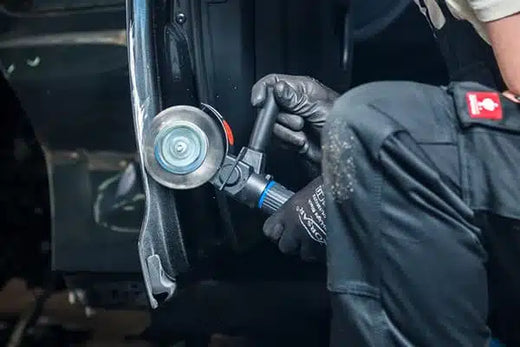
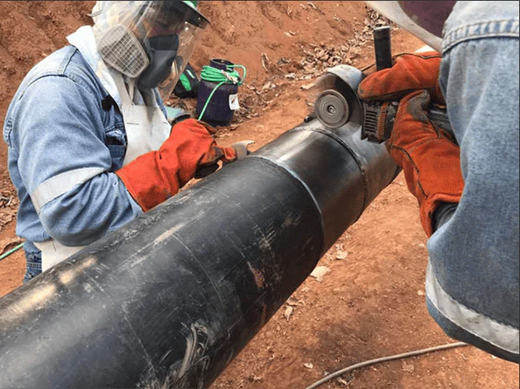
Spot repair surface preparation: typically SSPC-SP 11 (power tool cleaning to bare metal, minimum 25 µm / 1 mil profile) for the corroded area, feathering out into sound coating — or whatever the coating manufacturer specifies. For high-performance coating systems originally applied over Sa 2½, preparation of the spot area to a cleanliness comparable to SSPC-SP 10 with the Bristle Blaster® helps maintain adhesion compatibility with the existing system. See spot repair preparation for the method.
Phase 4: Maintenance overcoat
When the coating system approaches the end of its effective service life — often defined as around 1% of the surface area showing active rusting (rust grade Ri 3 in ISO 4628-3), or coating condition falling below a project-defined threshold — a maintenance overcoat can be applied over the cleaned, intact existing coating without full removal. This is feasible when:
- The existing coating system is firmly adherent with no widespread delamination or osmotic blistering
- The new coating is compatible with the existing system (solvent and adhesion compatibility)
- The total film thickness after overcoating remains within acceptable limits for the structure
Phase 5: Full recoating
When the existing coating system is too degraded to accept an overcoat — widespread delamination, active corrosion under the coating, osmotic blistering — full removal and reapplication is required. This is the most expensive intervention and the one that rigorous maintenance is designed to postpone as long as possible. Full recoating generally requires the same surface preparation as the original application: SSPC-SP 10 / Sa 2½, or a result comparable to it, as the effective minimum for high-performance systems.
Surface preparation requirements for maintenance coating
Maintenance coating over partially intact existing coatings requires careful surface preparation at the transition between corroded and sound coating areas. The standard approach:
- Solvent clean first — SSPC-SP 1 (solvent cleaning) to remove oil, grease and surface contamination before any mechanical preparation
- Mechanical preparation of corroded areas — bring corroded areas to bare metal (SSPC-SP 11 minimum; a result comparable to SSPC-SP 10 preferred for high-performance systems) using the Bristle Blaster® or an equivalent method. The SSPC-SP 11 technical guide covers the requirements in detail
- Feather edge treatment — mechanical abrasion of the interface between the corroded area and sound coating to create a gradual transition; this avoids a sharp film thickness step that could act as a stress concentration
- Soluble salt test — particularly important in marine and coastal environments where salt deposition is ongoing; test prepared areas before priming
- Full-surface scuff sanding or sweep blasting — to prepare the intact existing coating for adhesion of the new overcoat
Factors that shorten coating service life
Steel protection systems fail before their expected service life for predictable reasons:
- Inadequate original surface preparation — a leading cause; contamination or insufficient profile reduces adhesion from day one
- Soluble salt contamination not controlled — invisible at application time, it can cause osmotic blistering early in service in aggressive environments
- Application at incorrect temperature or humidity — the steel temperature should be kept at least 3 °C above the dew point (except for moisture-cured paints), and many coating data sheets also set a maximum relative humidity, often 85%; application outside these conditions compromises film formation and adhesion
- Insufficient dry film thickness — below-specification DFT reduces the barrier properties of the system and shortens its service life
- Edge and weld seam deficiencies — sharp edges and weld beads are areas of thin film coverage; stripe coating of edges and welds before the main coat is standard practice for high-performance systems
- Delayed maintenance — allowing corrosion to spread from small defects rather than addressing them promptly multiplies the eventual repair cost
Key takeaways
- Keeping steel corrosion-free is an active maintenance process, not a one-time application. Protective coating systems have defined durability ranges that depend on environment, surface preparation quality, application quality and maintenance frequency.
- The coating maintenance cycle — inspection, spot repair, maintenance overcoat, full recoating — is the framework for managing corrosion protection cost over an asset's service life.
- Spot repair is the most cost-effective maintenance intervention: addressing coating failures promptly prevents the lateral spread of corrosion under the intact coating.
- Surface preparation requirements for maintenance coating are usually the same as for the original application: SSPC-SP 10 / Sa 2½ or a comparable result for high-performance systems in aggressive environments.
- Soluble salt control is as important in maintenance as it is in the original application — in marine environments, salt deposition is ongoing and must be measured before each recoating cycle.
Frequently asked questions
How often should a steel coating system be inspected?
Commonly once a year for assets in aggressive C4–C5 environments, or according to a risk-based inspection schedule for critical assets. Each inspection should record the percentage of coating breakdown, the location and type of defects such as blistering, cracking, edge and weld seam corrosion, and how the condition has progressed since the last inspection.
How long can a coating system keep steel corrosion-free?
ISO 12944 groups protective coating systems into durability ranges: low (up to 7 years), medium (7–15), high (15–25) and very high (more than 25 years). Durability is a planning parameter for the time to first major maintenance, not a guarantee, and it depends on the corrosivity category, surface preparation, application quality and ongoing maintenance.
What surface preparation is needed for coating spot repairs?
Typically SSPC-SP 11, power tool cleaning to bare metal with a minimum 25 µm (1 mil) profile, feathered into the surrounding sound coating, unless the coating manufacturer specifies otherwise. For high-performance systems originally applied over Sa 2½, preparing the spot to a cleanliness comparable to SSPC-SP 10, for example with a Bristle Blaster®, keeps the repair compatible with the existing system.
When is a maintenance overcoat possible instead of full recoating?
An overcoat is possible when the existing coating is still firmly adherent with no widespread delamination or osmotic blistering, the new coating is compatible with the old one, and the total film thickness stays within acceptable limits. Once corrosion runs under the coating or delamination is widespread, full removal and recoating is the only durable option.
Related articles
- Corrosion Protection for Steel Structures: A Practical Guide
- SSPC Surface Preparation Standards: Complete Guide
- Soluble Salt Contamination and Coating Failure
- SSPC-SP10 Near-White Metal Blast: Complete Guide
- Flash Rust: Causes, Levels, and Prevention
Sources
- Carboline, ISO 12944 brochure — durability ranges (very high: more than 25 years) and corrosivity categories C1–CX. carboline.com
- KTA-Tator, Industry Standards for Surface Preparation (SP 6, SP 10, SP 11 definitions). kta.com
- SSPC-SP 11, Power Tool Cleaning to Bare Metal. Copy of standard
- The Steel Construction Institute, Guidance Note 8.06: The inspection of surface preparation and coating treatments (dew point rule). steelconstruction.info
- Corrosion Alliance, Principles of corrosion. corrosionalliance.com