Short answer: Corrosion protection for steel structures rests on three steps: classify the service environment with ISO 12944 (C1–CX, Im1–Im4), prepare the steel to the grade the coating system needs (usually Sa 2½ / SSPC-SP10 or comparable, with soluble salts under the specified limit), then apply a matched coating system and maintain it before it breaks down.
This guide covers the full framework for corrosion protection of steel structures: how steel corrodes, how to classify the environment under ISO 12944, the surface preparation each coating system needs, typical systems by industry, soluble salt control, and how to maintain protection on assets that cannot be shut down for blasting.
The NACE IMPACT study estimated the global cost of corrosion at about US$2.5 trillion, equivalent to 3.4% of global GDP (2013), and concluded that using available corrosion control practices could save 15–35% of that cost. Much of the saving comes from doing the basics well: specifying the right coating system for the service environment, preparing the substrate to the required standard, and maintaining the protection system throughout the asset's service life. Surface preparation is where most of those decisions are won or lost.
How steel corrodes
Steel corrosion is an electrochemical reaction in which iron is oxidised in the presence of water and oxygen. The basic reaction produces iron oxide (rust), which is porous and non-protective. Unlike the passive oxide layer that forms on stainless steel or aluminium, rust does not arrest corrosion. Corrosion progresses by:
- Uniform corrosion: general thinning of the steel section over the exposed surface
- Pitting corrosion: localised attack that creates deep, narrow pits, particularly in the presence of chloride ions
- Crevice corrosion: accelerated corrosion in tight gaps where oxygen is restricted
- Galvanic corrosion: accelerated corrosion of the less noble metal where two dissimilar metals are in electrical contact in an electrolyte
- Erosion-corrosion: combined mechanical and electrochemical attack in flowing fluid environments
The rate of corrosion is controlled by the environment: temperature, humidity and time of wetness, chloride deposition, pollutants such as sulphur dioxide, and contact with liquids or soil. A steel structure in a dry, clean inland atmosphere corrodes at a small fraction of the rate of the same steel in a tropical marine environment.
Assessing the corrosion environment: ISO 12944 corrosivity categories
ISO 12944 is the internationally recognised framework for categorising corrosion environments and specifying protective paint systems for steel structures. ISO 12944-2 assigns atmospheric corrosivity categories based on the first-year mass or thickness loss of standard low-carbon steel specimens; where no measurement is available, the category is estimated from typical environments:
| Category | Description | Typical environments | Carbon steel thickness loss, first year (µm) |
|---|---|---|---|
| C1: Very low | Heated interiors with clean atmospheres | Offices, shops, schools, hotels | ≤1.3 |
| C2: Low | Low pollution, mostly rural; unheated interiors where condensation may occur | Rural structures, depots, sports halls | >1.3–25 |
| C3: Medium | Urban and industrial atmospheres with moderate SO₂; coastal areas with low salinity | Urban bridges, production halls with high humidity | >25–50 |
| C4: High | Industrial areas; coastal areas with moderate salinity | Chemical plants, swimming pools, coastal shipyards | >50–80 |
| C5: Very high | Industrial areas with high humidity and aggressive atmosphere; coastal areas with high salinity | Coastal processing plants, permanently wet buildings | >80–200 |
| CX: Extreme | Offshore areas with high salinity; extreme-humidity industrial areas; subtropical and tropical atmospheres | Offshore structures, extreme industrial sites | >200–700 |
| Im1 | Fresh water immersion | River structures, hydroelectric plant | — |
| Im2 | Sea or brackish water immersion (without cathodic protection) | Harbour structures, sluice gates, jetties | — |
| Im3 | Soil burial | Buried pipelines, underground tanks, steel piles | — |
| Im4 | Sea or brackish water immersion with cathodic protection | Offshore submerged structures | — |
Assigning the correct corrosivity category to the service environment is the first step in specifying a corrosion protection system. Under-categorising the environment, for example treating a C5 site as C3, is a common cause of premature coating failure.
The three pillars of corrosion protection for steel
1. Surface preparation
Surface preparation is widely regarded as the most important single factor in coating system performance. Industry failure analyses consistently attribute a large share of premature protective coating failures to inadequate surface preparation rather than to the coating products themselves. A system applied over contaminated, poorly profiled or incompletely cleaned steel will not achieve its rated durability, regardless of the quality of the products specified.
The required surface preparation grade is set by the coating system and the corrosivity category:
- C3 and below: Sa 2 (SSPC-SP6) to Sa 2½ (SSPC-SP10), depending on the coating system
- C4, C5, CX and immersion categories: Sa 2½ (SSPC-SP10) is the usual minimum for high-performance coating systems
- Thermal spray coatings (TSA/TSZ): Sa 3 (SSPC-SP5) is normally required
The coating data sheet also sets the anchor profile, and the specification sets the soluble salt limit. For the full set of grades, see the SSPC surface preparation standards guide.
2. Coating system selection
The coating system must be matched to the corrosivity category, the required durability range and the service conditions. ISO 12944-5 provides tables of example paint systems for each corrosivity category and durability range. Key selection criteria:
- Durability range: Low (up to 7 years), Medium (7–15 years), High (15–25 years), Very high (more than 25 years). Durability is the expected time to the first major maintenance, not a guarantee. Higher durability requires more robust coating systems and more stringent surface preparation.
- Coating system type: zinc-rich primer, epoxy intermediate and polyurethane topcoat is a common system for C4–C5 atmospheric applications. High-build epoxy plus polyurethane is common for C3–C4. Thermal spray aluminium is used where very long service life is required in C5–CX and immersion environments.
- Total dry film thickness: ISO 12944-5 gives a nominal dry film thickness (NDFT) for each example system. Higher corrosivity categories and durability ranges call for greater total film thickness.
3. Ongoing inspection and maintenance
No corrosion protection system lasts indefinitely without maintenance. The durability of a coating system is the interval before first major maintenance is needed, not the time until all protection is exhausted. Planned maintenance, meaning inspection at defined intervals, touch-up of mechanical damage, and overcoating or full recoating before the system degrades past the point of effective repair, is essential to life-cycle cost management.
Corrosion protection system selection by industry
The table below shows typical choices. The project specification and coating manufacturer's data sheets always take precedence.
| Industry / asset type | Typical corrosivity category | Typical coating system | Surface prep requirement |
|---|---|---|---|
| Offshore topsides structure | C5 / CX | Inorganic zinc + HB epoxy + polyurethane | Sa 2½ (SP10) |
| Offshore splash zone | CX / Im2 | TSA or high-build multi-layer epoxy system | Sa 3 (SP5) for TSA |
| Offshore submerged zone | Im2 / Im4 | Anticorrosive coating with cathodic protection | Sa 2½ (SP10) |
| Onshore oil & gas processing | C4–C5 | Zinc-rich epoxy primer + HB epoxy + PU topcoat | Sa 2½ (SP10) |
| Buried pipeline | Im3 | FBE or three-layer PE/PP (mill-applied); field joint coating | Sa 2½ (SP10) |
| Steel bridge (atmospheric) | C3–C4 | Zinc-rich primer + epoxy + polyurethane | Sa 2½ (SP10) |
| Marine vessel hull | Im2 | Anticorrosive epoxy + antifouling | Sa 2½ (SP10) |
| Ballast tank interior (new build) | Im2 (IMO PSPC) | Epoxy-based system, min. 2 stripe + 2 spray coats, NDFT 320 µm | Sa 2½, profile 30–75 µm, salts ≤50 mg/m² as NaCl |
| Wind turbine tower (offshore) | C5 / CX | Zinc-rich + HB epoxy + polyurethane (interior and exterior) | Sa 2½ (SP10) |
| Power station structural steel | C3–C4 | Epoxy primer + epoxy intermediate + polyurethane | Sa 2½ (SP10) |
| Storage tank exterior | C4–C5 | Zinc-rich primer + epoxy + topcoat | Sa 2½ (SP10) |
| Storage tank interior (water) | Im1 (potable water) | Approved epoxy lining system | Sa 2½ (SP10); salt limit per lining manufacturer |
The role of soluble salt control in corrosion protection
Soluble salt contamination, primarily chlorides and sulphates, is one of the least controlled variables in corrosion protection. Salts left on the steel under an applied coating can cause osmotic blistering: they draw water through the coating film until the coating blisters and loses adhesion. This failure mode is:
- Invisible at the time of coating application: salts cannot be detected by visual inspection
- Not reliably removed by dry abrasive blasting: blasting removes rust and mill scale but may not remove chloride contamination held in pits
- Measurable and controllable: the Bresle patch method (ISO 8502-6 and ISO 8502-9) gives a quantitative field measurement before coating
In marine and coastal environments, where chloride deposition is continuous, salt testing before coating should be a standard hold point. For ballast tanks, IMO PSPC sets a limit of 50 mg/m² measured as NaCl. More detail: soluble salt contamination and coating failure.
Maintaining corrosion protection on operating assets
Maintenance painting on operating industrial assets, where the structure cannot be taken out of service for preparation and coating, creates constraints that standard blasting struggles to meet. The most common scenarios needing in-situ maintenance preparation are:
- Operating offshore platforms where topsides must remain operational
- ATEX-classified zones in oil and gas processing, where blasting creates an ignition risk
- Pipelines and pressure vessels where grit contamination of the process is unacceptable
- Confined spaces (ballast tanks, vessel internals) where blasting logistics are prohibitive
- Remote locations where mobilising a blasting crew and equipment is cost-prohibitive
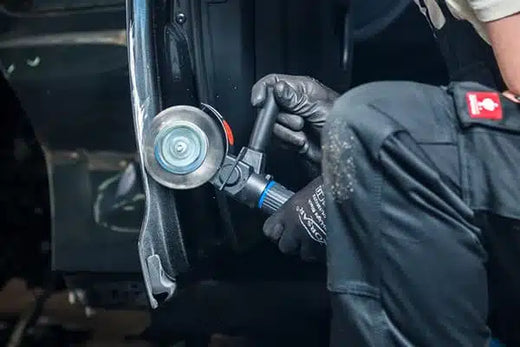
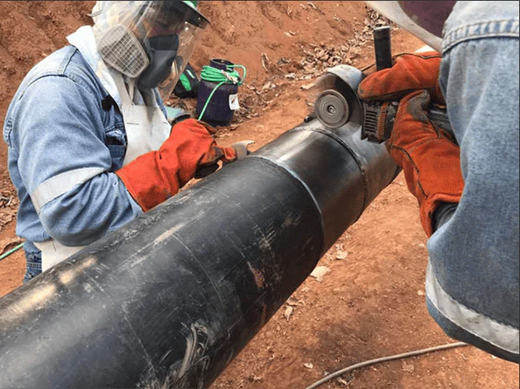
In these situations, the Bristle Blaster® mechanical preparation tool produces surface cleanliness comparable to Sa 2½ (ISO 8501-1) / SSPC-SP10 and an anchor profile of 65–85 µm Rz on standard steel in documented tests, which suits many high-performance industrial coating systems, without grit, containment or blasting equipment. Results vary with steel grade, rust grade, belt and technique. The Bristle Blaster® Pneumatic is fully pneumatic and ATEX-evaluated for zone 1 explosive gas and zone 21 explosive dust. See in-service surface preparation. For steel with heavy existing corrosion, the two-step MontiPower® method (Tercoo® for bulk corrosion removal, then the Bristle Blaster® for final preparation) addresses conditions that single-pass mechanical preparation alone cannot treat efficiently.
Key takeaways
- The NACE IMPACT study put the global cost of corrosion at about 3.4% of global GDP (2013), with 15–35% of it avoidable using available corrosion control practices.
- ISO 12944 provides the international framework for protecting steel structures with paint systems: corrosivity categories C1–CX and Im1–Im4, then example systems and surface preparation for each category and durability range.
- Surface preparation is the most important single variable in coating system performance. Sa 2½ (SSPC-SP10) is the usual minimum for high-performance systems in C4 and above.
- Soluble salt contamination is invisible, can survive dry blasting, and causes osmotic blistering. Test it with the Bresle patch method and treat it before high-performance coating in marine or industrial environments.
- On operating assets, purpose-designed impact power tools can reach the cleanliness and profile that most industrial coating systems require, without grit or containment, where the specification accepts them.
Frequently asked questions
What is the most effective corrosion protection for steel structures?
A correctly specified protective coating system applied over properly prepared steel, combined with planned maintenance. For immersed or buried steel, coatings are often combined with cathodic protection. The coating system is chosen for the ISO 12944 corrosivity category and durability required, and surface preparation is what lets it reach that durability.
What surface preparation does ISO 12944 require?
ISO 12944-4 covers surface types and preparation grades, and the example systems in ISO 12944-5 are generally based on blast cleaning to Sa 2½ for high-performance coatings. Thermal spray metal coatings normally need Sa 3. The coating manufacturer's data sheet sets the anchor profile and the project specification sets soluble salt limits.
How is the corrosivity category of a site determined?
ISO 12944-2 classifies atmospheric corrosivity by the first-year mass or thickness loss of standard carbon steel, from C1 (up to 1.3 µm) to CX (over 200 µm). Where no measurement exists, the category is estimated from typical environments, such as heated interiors for C1 or high-salinity coastal and offshore areas for C5 and CX.
Can corrosion protection be maintained without sandblasting?
Yes, in many cases. On operating assets, ATEX zones and confined spaces, impact power tools such as the Bristle Blaster® produce cleanliness comparable to Sa 2½ / SSPC-SP10 with a 65–85 µm Rz anchor profile in documented tests, without grit or containment. Acceptance depends on the coating specification, and results vary with steel and rust grade.
Related articles
- Corrosion Resistant Coatings: The Role of Surface Preparation
- Industrial Coatings: Types, Systems, and Surface Preparation Requirements
- SSPC-SP10 Near-White Metal Blast: Complete Guide
Sources
- NACE International, International Measures of Prevention, Application, and Economics of Corrosion Technologies (IMPACT) study (2016). impact.nace.org
- ISO 12944-2 corrosivity categories for carbon steel, as summarised by SteelConstruction.info, Standard corrosion protection systems for buildings. steelconstruction.info
- Hempel, IMO PSPC ballast tanks technical guideline (IMO Resolution MSC.215(82)). hempel.com
- Corrosion Alliance, Principles of corrosion. corrosionalliance.com
- R. Dankiw, D. Fosdike, Defining Mechanical Surface Preparation Standards with Power Tools, Corrosion & Prevention 2018, Paper 74. PDF
- MontiPower®, Bristle Blaster® Pneumatic ATEX evaluation (2014/34/EU) and Bristle Blaster® product data.