Short answer: Galvanic corrosion happens when two dissimilar metals are electrically connected in an electrolyte: the more active metal (the anode) corrodes faster and the more noble one (the cathode) is protected. Zinc-rich primers use the same principle on purpose: zinc corrodes sacrificially to protect steel at coating damage, provided the steel is blast-clean enough for zinc-to-steel contact.
Galvanic corrosion occurs when two dissimilar metals are in electrical contact in the presence of an electrolyte, typically water containing dissolved ions. The less noble metal corrodes preferentially while the more noble metal is protected. In industrial and marine structures, galvanic corrosion at steel connections to other metals is a common and predictable failure mode. The same principle is deliberately harnessed in zinc-rich primers to give cathodic protection to steel. This article explains the mechanism, the factors that control its severity, how to prevent it at dissimilar-metal joints, and what zinc-rich primers need from surface preparation.
The electrochemical basis of galvanic corrosion
When two dissimilar metals are connected in an electrolyte, they form a galvanic cell: an electrochemical cell in which the difference in electrode potential between the two metals drives a current. The metal with the lower (more negative) electrode potential becomes the anode: it is oxidised and corrodes. The metal with the higher (more positive, more noble) potential becomes the cathode and is protected. For a wider look at how corrosion and rust relate, see rust vs corrosion.
The galvanic series ranks metals and alloys in seawater from most active (anodic) to most noble (cathodic). Key positions relevant to structural applications:
| Position | Metal / alloy | Behaviour in a galvanic couple |
|---|---|---|
| Most active (anodic) | Magnesium | Corrodes when coupled to almost any structural metal; used for sacrificial anodes |
| Zinc | Corrodes when coupled to steel or more noble metals; basis of galvanising and zinc-rich primers | |
| Aluminium alloys | Active in seawater; corrodes when coupled to steel despite its passive oxide film | |
| Carbon steel / iron | Corrodes when coupled to copper, stainless steel or titanium | |
| Cast iron | Close to carbon steel in the series; little driving force in a steel couple | |
| 304 / 316 stainless steel (passive) | Noble when passive; can drive galvanic corrosion of carbon steel at connections | |
| Copper and copper alloys | More noble than steel; drives galvanic attack on steel and aluminium in contact | |
| Titanium | Very noble; can cause severe galvanic corrosion of active metals in contact | |
| Most noble (cathodic) | Platinum, gold | Protected in practically any couple |
The exact order depends on the electrolyte and temperature, so the seawater series is a guide rather than a fixed rule for every environment.
What controls the severity of galvanic corrosion?
The potential difference between the two metals is the thermodynamic driving force, but the rate of galvanic corrosion is controlled by several practical factors:
- Electrolyte conductivity: galvanic corrosion is more severe in seawater (high conductivity) than in fresh water (lower conductivity) or soil (variable). Offshore and marine environments are therefore the most aggressive.
- Area ratio: the ratio of cathode area to anode area is critical. A small anode connected to a large cathode corrodes much faster than if the areas were equal, because the whole cathodic current is concentrated on the small anode. A steel bolt in a copper plate corrodes rapidly; a copper bolt in a steel plate attacks the surrounding steel much more slowly. TWI advises keeping the anode-to-cathode area ratio large, above 10 where possible.
- Geometry and distance: attack concentrates at the junction between the two metals and diminishes with distance, particularly in lower-conductivity electrolytes.
- Temperature: higher temperatures generally increase corrosion rates by increasing electrolyte conductivity and reaction kinetics.
Common galvanic corrosion scenarios in industrial structures
- Steel–aluminium connections: carbon steel fasteners in aluminium members (or vice versa) in marine or offshore environments. The aluminium is the anode, and it pits around the steel fastener.
- Steel–stainless steel connections: stainless handrails, gratings or fittings connected to structural carbon steel. The carbon steel corrodes at the interface, a common failure in coastal construction.
- Steel–copper earthing connections: copper earthing conductors attached to steel members can drive galvanic attack of the steel at the connection point.
- Steel–copper pipework: in building services, steel pipework connected to copper corrodes at the transition.
- Sacrificial anodes on offshore jackets: here the effect is used deliberately. Aluminium or zinc anodes connected to a carbon steel jacket corrode preferentially and protect the steel.
How do zinc-rich primers use galvanic protection?
The principle that damages steel when it is connected to a more noble metal protects steel when it is connected to a more active metal, specifically zinc. Zinc-rich primers carry a very high loading of zinc dust in the dry film, dispersed in an organic (usually epoxy) or inorganic (silicate) binder. SSPC-Paint 20 classifies them by zinc dust in the dry film by weight: Level 1 at 85% or more, Level 2 from 77% to under 85%, and Level 3 ("reduced zinc") from 65% to under 77%. ISO 12944 treats a primer as zinc-rich when the dry film contains more than 80% zinc dust.
The protection mechanism: when the coating is breached by mechanical damage, a defect or edge failure, the zinc particles are exposed to the environment and form galvanic couples with the steel. Zinc is the anode and steel the cathode, so the zinc corrodes preferentially and protects the steel at and around the breach. This cathodic protection is the defining property of zinc-rich primers and distinguishes them from barrier-only epoxy primers.
This is why zinc-rich primers are specified for demanding corrosion protection: offshore structures, major bridges, wind turbine towers and industrial plant in ISO 12944 C4 and C5 environments. Even after mechanical damage, a zinc-rich system continues to protect exposed steel locally instead of letting corrosion start immediately at the defect. For where zinc primers sit among other systems, see industrial coatings: types, systems and surface preparation.
Surface preparation requirements for zinc-rich primer systems
Galvanic protection from a zinc-rich primer depends on electrical contact between the zinc particles and the steel. Contamination that interrupts that contact, such as residual rust, mill scale, oil or soluble salts, reduces the protection the primer can give. That is why zinc-rich primers have some of the strictest surface preparation requirements of any industrial coating. The figures below are typical; the product data sheet (TDS) and project specification always govern.
Organic zinc-rich primers (epoxy binder)
- Typical surface preparation: abrasive blast cleaning to SSPC-SP 10 / Sa 2½ (near-white metal). Some products accept other grades for maintenance repair; check the TDS.
- Anchor profile: as stated on the TDS, typically a sharp, angular profile in the tens of micrometres
- The epoxy binder bonds mechanically to the profile, while galvanic action needs zinc-to-zinc and zinc-to-steel electrical contact through the film
- Applying an organic zinc-rich primer over inadequate preparation significantly shortens its effective protection period
Inorganic zinc silicate primers
- Typical surface preparation: SSPC-SP 10 / Sa 2½ to SSPC-SP 5 / Sa 3. Most manufacturers specify SP 10 as the minimum; some project specifications require SP 5 for severe exposure.
- Anchor profile: as stated on the TDS, achieved with angular abrasive to maximise mechanical bonding
- The silicate binder cures by hydrolysis and condensation and is generally described as bonding chemically to the clean steel surface. Contamination between binder and steel prevents that bond from forming correctly.
- Inorganic zinc silicate is the most demanding primer for surface preparation. Over inadequate preparation it is prone to poor adhesion and disbondment, losing both its barrier and its galvanic function.
Soluble salt limits for zinc-rich systems
Soluble salt contamination under a zinc-rich primer can drive osmotic blistering regardless of the galvanic protection the zinc provides. The acceptable limit is set by the project specification or coating manufacturer, and immersion service normally demands a lower limit than atmospheric exposure. Measure before priming with the Bresle patch extraction (ISO 8502-6) and conductometric determination (ISO 8502-9), which report salts as mg/m² NaCl equivalent. More detail in our article on soluble salt contamination and coating failure.
Where blasting is not possible
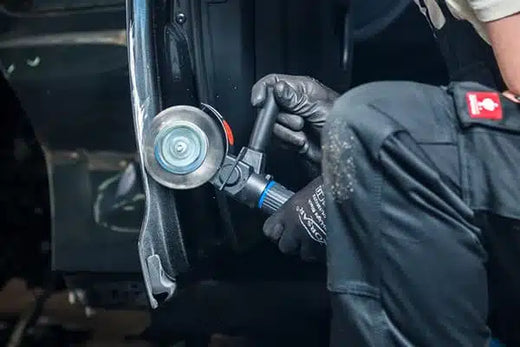
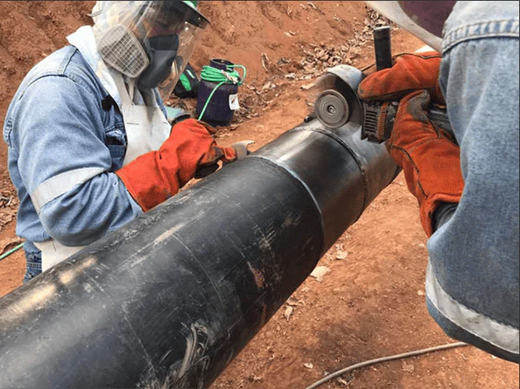
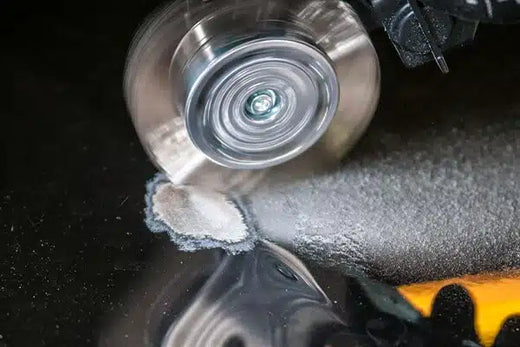
For maintenance repairs on zinc-rich systems where abrasive blasting is excluded, the coating manufacturer decides which alternative preparation is acceptable. Bristle blasting with the Bristle Blaster® gives cleanliness comparable to Sa 2½ / SSPC-SP 10 and a 65–85 µm Rz anchor profile on standard steel in documented tests, with results varying by steel grade, rust grade, belt and technique. Confirm acceptance with the primer manufacturer before specifying it for a zinc-rich system.
How to prevent galvanic corrosion at dissimilar-metal connections
Where dissimilar metals must be joined in corrosive environments, the main mitigation measures are:
- Electrical isolation: insulating sleeves, gaskets and washers break the electrical path so the galvanic cell cannot form. This is very effective but has to be designed in, and the isolation components must be maintained.
- Coat the cathode, or both metals: coating the more noble metal reduces the cathode area available to drive the reaction. Never coat only the anode: a holiday in that coating creates a very small anode next to a large bare cathode, which concentrates attack at the defect. TWI notes that the coating on the cathode is the most important and must be kept in good condition.
- Sacrificial anodes: a more active metal (aluminium or zinc anodes on offshore structures) provides cathodic protection to steel without an external power supply.
- Exclude the electrolyte: sealing joints and providing drainage keeps water out of the crevice between the metals.
- Material selection: choosing metals close together in the galvanic series minimises the driving force.
Key takeaways
- Galvanic corrosion occurs when dissimilar metals are electrically coupled in an electrolyte. The anode corrodes; the cathode is protected. Severity is controlled by the potential difference, electrolyte conductivity and the cathode-to-anode area ratio.
- Zinc-rich primers use the galvanic principle deliberately: zinc corrodes sacrificially to protect steel at coating defects. This is what distinguishes them from barrier-only primers.
- Zinc-rich primers are normally applied to blast-cleaned steel, typically SSPC-SP 10 / Sa 2½ minimum, with inorganic zinc silicates the most demanding. These requirements follow from the mechanism, not from conservative specification writing.
- Soluble salts under zinc-rich primers can cause osmotic blistering even when the zinc's galvanic function is intact. Test and control salt levels before priming.
- At dissimilar-metal connections, isolate the metals, coat the cathode (or both metals, never only the anode) and use sacrificial anodes where appropriate.
Related articles
- Complete Guide to SSPC Surface Preparation Standards
- Corrosion Resistant Coatings: Why Surface Preparation Determines Whether They Work
- SSPC-SP10 Near-White Metal Blast: The Complete Technical Guide
Frequently asked questions
What causes galvanic corrosion?
Three conditions together: two metals with different electrode potentials, an electrical connection between them, and a shared electrolyte such as seawater or condensation. The more active metal becomes the anode and corrodes faster than it would alone, while the more noble metal is protected. Remove any one of the three and the galvanic cell stops.
Should you coat the anode or the cathode to prevent galvanic corrosion?
Coat the cathode, the more noble metal, or coat both. Coating only the anode is risky: any holiday in that coating becomes a very small anode connected to a large bare cathode, which concentrates the attack. TWI notes that the coating on the cathode is the most important and must be kept in good condition.
How much zinc does a zinc-rich primer contain?
SSPC-Paint 20 classifies zinc-rich primers by zinc dust in the dry film by weight: Level 1 at 85% or more, Level 2 from 77% to under 85%, and Level 3 (reduced zinc) from 65% to under 77%. ISO 12944 treats primers as zinc-rich at more than 80% zinc dust in the dry film.
What surface preparation do zinc-rich primers need?
Zinc-rich primers are normally applied to blast-cleaned steel, typically at least Sa 2½ / SSPC-SP 10, with a surface profile set by the data sheet. Inorganic zinc silicates are the most demanding. Some organic zinc epoxies accept other grades for repair work, so always follow the product data sheet and the project specification.
Sources
- TWI, What is galvanic corrosion and how can it be avoided? twi-global.com
- Corrosion Alliance, Principles of corrosion. corrosionalliance.com
- Institute of Corrosion, Ask the Expert (SSPC-Paint 20 zinc levels, ISO 12944 zinc-rich definition, surface preparation for zinc-rich primers). icorr.org
- KTA-Tator, Industry Standards for Surface Preparation (SSPC-SP 10 and SP 5 definitions). kta.com
- MontiPower, Bristle Blaster® product specifications (cleanliness comparable to ISO 8501-1 Sa 2½ / Sa 3; 65–85 µm Rz anchor profile).