Short answer: Stress corrosion cracking (SCC) is cracking caused by sustained tensile stress acting together with a specific corrosive environment on a susceptible material. Remove any one of the three and SCC cannot occur. On buried pipelines and coated steel, an intact, well-adhered coating with cathodic protection keeps the cracking electrolyte off the steel, so surface preparation at field joints and welds is decisive.
Stress corrosion cracking (SCC) is a failure mechanism in which a metal cracks under the combined effect of a sustained tensile stress and exposure to a specific corrosive environment, neither of which, acting alone, would cause the material to fail at the same stress level. SCC is particularly insidious because it can occur at stresses well below the material's yield strength, produces brittle-appearing fracture in materials that are ductile under normal conditions, and is often difficult to detect before failure. In the oil and gas, offshore and chemical processing industries, SCC is a significant cause of pipeline and pressure vessel failures with serious safety and environmental consequences. For buried and immersed steel, protective coatings working together with cathodic protection are the main defence against environmentally assisted cracking. This article explains the conditions, the SCC types that matter for industrial steel, and the coating and surface preparation requirements that keep cracking from starting.
The three conditions required for stress corrosion cracking
SCC requires three conditions to be present simultaneously. Eliminating any one of them prevents SCC:
- Susceptible material: Not all materials are susceptible to SCC in all environments. Carbon steel is susceptible to SCC in specific environments including concentrated hydroxide (caustic SCC), carbonate-bicarbonate solutions, and H₂S-containing environments (sulfide stress cracking). Austenitic stainless steels are susceptible to chloride SCC. Higher-strength and harder steels are generally more susceptible than lower-strength grades.
- Tensile stress: Either applied stress (from service loads, pressure) or residual stress (from welding, forming or heat treatment) must be present. Residual tensile stresses at welds are a particularly common SCC initiation site because they are difficult to eliminate and are located where the microstructure may also be altered by the heat-affected zone.
- Specific corrosive environment: SCC is environment-material-specific. The chemical species that causes SCC in one material may be benign in another. The concentration and temperature of the corrosive species also matter; SCC is typically more severe above threshold concentrations and temperatures.
Types of stress corrosion cracking relevant to industrial steel
Sulfide stress cracking (SSC): H₂S environments
Sulfide stress cracking (SSC) affects high-strength and hard carbon and low-alloy steels in the presence of hydrogen sulfide (H₂S) and water. H₂S promotes hydrogen absorption into the steel, so SSC is strictly a form of hydrogen embrittlement, reducing ductility and causing cracking at stress concentrations and hard zones such as weld heat-affected zones. SSC is the most significant cracking mechanism in sour oil and gas production systems and is governed by NACE MR0175 / ISO 15156, which specifies material requirements, hardness limits and heat treatment requirements for equipment in sour (H₂S-containing) service. ISO 15156-2 covers cracking-resistant carbon and low-alloy steels, including resistance to SSC and hydrogen-induced cracking (HIC); it is concerned with cracking only, not with general or localized corrosion.
Near-neutral pH SCC (NNpH SCC): buried pipelines
Near-neutral pH SCC affects buried pipeline steels at coating disbondment sites where the trapped electrolyte has a pH of approximately 5.5–7.5, conditions that arise from CO₂ dissolved in dilute groundwater beneath a disbonded coating, typically where the coating also shields the steel from cathodic protection. It is characterised by predominantly transgranular cracking, often in colonies on the pipe body and near longitudinal welds. NNpH SCC has caused pipeline failures in Canada and the United States, mainly on high-pressure gas transmission lines. The mechanism requires a disbonded coating that traps the electrolyte; intact, adherent coatings that let cathodic protection current reach any defect deny it that environment.
High-pH SCC (classical SCC): buried pipelines
High-pH SCC affects buried pipelines in concentrated carbonate-bicarbonate solutions (pH above about 9) that form at disbonded coatings when cathodic protection generates hydroxide that reacts with CO₂ in the soil. It produces intergranular cracks, occurs within a narrow potential range near the cathodic protection potential, and is strongly temperature-dependent, which is why it is found most often on the warmer pipe sections downstream of compressor stations.
Chloride SCC: austenitic stainless steels
Austenitic stainless steels (304, 316 series) are susceptible to SCC in chloride-containing environments, generally above approximately 60 °C. This is primarily relevant in chemical processing, heat exchangers and offshore processing equipment: not directly relevant to carbon steel structural applications, but important for mixed-material systems.
Where SCC occurs in industrial infrastructure
| Asset type | SCC type | Critical conditions | Coating protection role |
|---|---|---|---|
| Buried oil and gas pipelines | NNpH SCC, high-pH SCC | Disbonded coating, CO₂ in groundwater, cathodic protection shielding or potential range, temperature | Intact, adherent pipeline coating with effective cathodic protection keeps electrolyte off the steel and prevents initiation sites forming |
| Sour gas / oil production equipment | Sulfide stress cracking (SSC) | H₂S partial pressure, pH, water presence, material hardness | Material selection to NACE MR0175 / ISO 15156 is the primary control; external coatings address the external environment only |
| Steel equipment in wet H₂S service | SSC / hydrogen-induced cracking (HIC) | H₂S, water, hard or high-strength steel (carbon steel hardness commonly limited to 22 HRC) | NACE MR0175 / ISO 15156-compliant material; HIC-resistant plate where required; coatings or linings as supplementary protection |
| Caustic service vessels and piping | Caustic SCC | Concentrated NaOH at elevated temperature; caustic injection systems and vessel internals | Stress relief (post-weld heat treatment) of welds is the main control; linings where specified |
| Pipeline field joints and repair areas | NNpH SCC | Field joint coatings are common initiation sites if adhesion is inadequate; coating disbondment at girth welds | Field joint coating applied over the specified preparation grade (typically Sa 2½ / SSPC-SP 10) with verified profile and salt levels; proper overlap with the mill-applied coating |
How protective coatings prevent stress corrosion cracking
Coatings prevent external SCC by excluding the corrosive species from the steel surface, breaking the third leg of the SCC triangle (susceptible material + stress + corrosive environment). The effectiveness of coating-based SCC prevention depends on coating integrity: a disbonded or damaged coating creates exactly the microenvironment (trapped electrolyte at the steel surface under a non-adherent film, partly shielded from cathodic protection) in which near-neutral pH SCC and other forms of environmentally assisted cracking initiate.
Key requirements for coatings used in SCC prevention:
- High adhesion: The coating must maintain adhesion under the mechanical, thermal and chemical stresses of the operating environment. Adhesion loss is the precondition for buried pipeline SCC.
- Resistance to cathodic disbondment: Buried pipelines under cathodic protection are susceptible to cathodic disbondment, the process by which cathodic protection current at coating defects generates hydroxyl ions that attack the coating-to-steel interface. The ISO 21809 series of external pipeline coating standards includes cathodic disbondment tests to qualify coating systems for buried service; NACE SP0169 (now AMPP SP0169) sets out external corrosion control of buried pipelines, including coatings and cathodic protection.
- Not shielding cathodic protection: Where a coating does disbond, it should not block cathodic protection current from reaching the steel beneath. Shielding is what allows a near-neutral pH electrolyte to persist under the disbondment.
- Resistance to soil stress and ground movement: Pipeline coatings must maintain adhesion under soil overburden, ground movement and thermally driven expansion and contraction of the pipeline.
- Adequate surface preparation: The coating-steel bond that resists disbondment is established at the time of application. Sa 2½ / SSPC-SP 10 is the typical minimum for pipeline and structural coating systems used in SCC prevention; always confirm against the product data sheet.
Surface preparation for SCC-critical applications
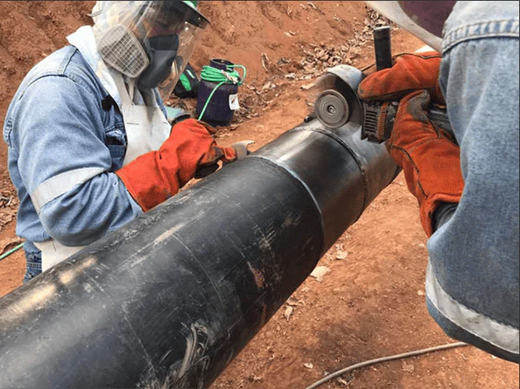
Field joint coating on pipelines is among the most SCC-critical surface preparation applications: the field joint combines a stress concentration (the girth weld) with the most likely point of coating system discontinuity. The full workflow is covered in surface preparation for pipeline field joints and corroded welds. Typical requirements:
- Sa 2½ / SSPC-SP 10 minimum for most field joint coating systems; verify against the specific product technical data sheet.
- Anchor profile: within the range on the coating data sheet. Many liquid epoxy and FBE field joint systems call for a profile in the region of 40–75 µm or more, and some three-layer systems have their own requirements; consult the manufacturer.
- Soluble salt contamination: below the chloride limit set in the project specification or data sheet, measured on site (for example by the Bresle method, ISO 8502-6 / 8502-9). Watch the units: 1 µg/cm² = 10 mg/m². Salt under a buried coating causes osmotic blistering and disbondment, creating SCC initiation conditions. See soluble salt contamination and coating failure.
- Overlap preparation: the transition zone between the field joint coating and the adjacent mill-applied coating must be mechanically prepared to ensure adhesion across the joint.
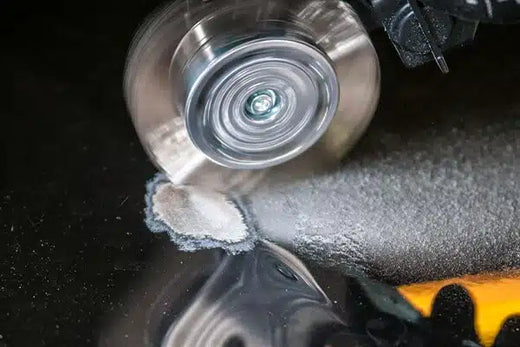
For field joint preparation in remote locations where abrasive blasting equipment is not logistically viable, the Bristle Blaster® produces cleanliness comparable to Sa 2½ / SSPC-SP 10 and a 65–85 µm Rz anchor profile on standard pipeline steel in documented tests, without grit or blast containment; the pneumatic version is ATEX-evaluated for zone 1 gas and zone 21 dust. Results vary with steel grade, rust grade, belt and technique, and acceptance against the coating specification is confirmed by the inspector. It is widely used for field joint and repair preparation where blasting is impractical.
A related point: because bristle tips strike and rebound, bristle blasting cold-works the surface and leaves compressive residual stress, documented in a NACE residual stress study. Compressive surface stress generally resists crack initiation, as in shot peening, but no claim is made here that it prevents SCC in any particular system; the coating and cathodic protection remain the primary defence.
Key takeaways
- Stress corrosion cracking requires three simultaneous conditions: susceptible material, tensile stress and a specific corrosive environment. Eliminating any one prevents SCC.
- The main SCC types affecting carbon steel infrastructure are sulfide stress cracking (SSC) in H₂S environments, near-neutral pH SCC (transgranular) and high-pH SCC (intergranular) in buried pipelines, and caustic SCC in alkaline process environments.
- Coatings with cathodic protection prevent external SCC by excluding the corrosive species from the steel surface. Coating disbondment at field joints, weld areas and mechanical damage sites is the primary SCC initiation condition in buried pipeline systems.
- Surface preparation quality at SCC-critical coating applications, particularly pipeline field joints, directly controls adhesion and disbondment resistance. Sa 2½ / SP 10 as the usual minimum, strict salt control and a verified anchor profile are essential.
- NACE MR0175 / ISO 15156 governs material selection for sour service; the ISO 21809 series and AMPP SP0169 govern external pipeline coatings and corrosion control. They address different parts of the problem and complement each other.
Related articles
- MIC Corrosion: What It Is and How Coatings Address It
- Pitting Corrosion: Surface Preparation Challenges and Solutions
- Corrosion Control for Industrial Assets
- Industrial Coatings: Types, Systems, and Surface Preparation Requirements
Frequently asked questions
What three conditions cause stress corrosion cracking?
A susceptible material, a tensile stress (applied or residual, for example from welding) and a specific corrosive environment, all present at the same time. Removing any one prevents SCC. That is why mitigation combines material selection, stress control such as post-weld heat treatment, and coatings with cathodic protection that keep the environment away from the steel.
What is the difference between near-neutral pH and high-pH SCC?
Both affect buried pipelines under disbonded coatings. Near-neutral pH SCC forms in dilute groundwater with dissolved CO₂ at roughly pH 5.5–7.5 and produces mainly transgranular cracks. High-pH SCC forms in concentrated carbonate-bicarbonate electrolyte above about pH 9, is intergranular, and is more common where pipe temperatures are higher, such as downstream of compressor stations.
Can coatings prevent sulfide stress cracking?
Not on their own. Sulfide stress cracking is controlled mainly by material selection, hardness limits and heat treatment under NACE MR0175 / ISO 15156. External coatings protect against environments outside the pipe or vessel, but the sour process fluid is inside, so the qualified material is the primary barrier.
Why are pipeline field joints a common SCC initiation site?
The girth weld adds residual tensile stress, and the field joint coating is applied on site under less controlled conditions than the mill coating. If preparation is poor, the coating disbonds, traps electrolyte and can shield the steel from cathodic protection, creating the conditions in which near-neutral pH SCC starts.
Sources
- W. Chen, R. Kania, R. Worthingham, G. Van Boven (University of Alberta, TransCanada, Spectra Energy), Transgranular Crack Growth in Pipeline Steels Exposed to Near-Neutral pH Soil Aqueous Solutions: The Role of Hydrogen (2009). primis.phmsa.dot.gov
- ISO, ISO 15156-2:2020, Materials for use in H2S-containing environments in oil and gas production, Part 2: Cracking-resistant carbon and low-alloy steels (2020). iso.org
- ISO 21809 series, External coatings for buried or submerged pipelines used in pipeline transportation systems; AMPP (NACE) SP0169, Control of External Corrosion on Underground or Submerged Metallic Piping Systems.
- MontiPower, NACE paper summary: Comprehensive Residual Stress Study of bristle-blasted steel (2014); Bristle Blaster® technical data sheets (cleanliness comparable to Sa 2½ / SP 10; 65–85 µm Rz on API 5L steel in documented tests).