Short answer: Corrosion is the electrochemical degradation of a metal by its environment. On steel it needs an anode, a cathode, an electrolyte and a metallic path; remove one and it stops. The main types are uniform, pitting, crevice, galvanic, stress corrosion cracking, erosion-corrosion, filiform and MIC. Coatings stop it only when the surface underneath is clean, salt-free and profiled.
Corrosion is the electrochemical degradation of a metal through its reaction with the surrounding environment. In steel structures it is the dominant mechanism of material degradation, and its cost is large: the NACE International IMPACT study estimated the global cost of corrosion at US$2.5 trillion, equivalent to about 3.4% of global GDP (2013), and found that existing corrosion control practices could save 15–35% of that cost.
This guide explains how corrosion starts, the eight main types that affect steel structures, the environmental factors that drive the corrosion rate, and why surface preparation is the variable that most often decides whether a protective coating stops corrosion or fails early.
What is corrosion? The electrochemical mechanism
Corrosion is not simply "rust". It is a spontaneous electrochemical process in which a metal returns towards its thermodynamically stable oxide state. For steel (iron alloys), the driving force is the natural tendency of iron to oxidise:
Fe → Fe²⁺ + 2e⁻ (anodic reaction: metal dissolves)O₂ + 2H₂O + 4e⁻ → 4OH⁻ (cathodic reaction: oxygen is reduced)
For corrosion to occur, four components must be present at the same time: an anode (the metal being corroded), a cathode (a more noble area or surface), an electrolyte (water or moisture containing dissolved ions) and a metallic path connecting anode and cathode. Remove any one of these four and the corrosion cell stops. Protective coatings work mainly by keeping the electrolyte away from the steel, which is why coating adhesion to the substrate is so important. The smaller the anode relative to the cathode, the faster the local attack.
The 8 main types of corrosion in steel structures
1. Uniform (general) corrosion
The most visible and predictable form: the metal corrodes at roughly the same rate across the entire exposed surface, producing the characteristic red-brown iron oxide (rust) on carbon steel. It is managed through coatings, cathodic protection or a corrosion allowance in design. It is the least unpredictable form, but the most common cause of long-term mass loss in unprotected or poorly coated structures.
2. Pitting corrosion
Highly localised attack that creates deep pits while leaving the surrounding surface relatively intact. Chloride ions are the usual driver, breaking down protective oxide films locally. Pitting is particularly dangerous in pressure vessels, pipelines and offshore structures because a pit can penetrate a large part of the wall thickness with little visible surface deterioration, and it is widely regarded as one of the most dangerous forms for load-bearing and pressure-containing components. See our guide to pitting corrosion and surface preparation.
3. Crevice corrosion
Occurs in geometrically confined spaces such as under bolt heads, between overlapping plates and inside socket connections, where oxygen depletion and chloride concentration create an aggressive local chemistry. The confined geometry prevents the cathodic reaction from neutralising the acidic anodic environment, which accelerates the attack. It is common in marine structures, heat exchangers and flanged connections.
4. Galvanic corrosion
When two dissimilar metals are electrically connected in the presence of an electrolyte, the less noble metal (lower in the galvanic series) corrodes preferentially. Common examples are aluminium fittings on steel structures, zinc-coated fasteners in contact with copper, and mill scale in contact with bare steel at cracks and discontinuities. Mill scale is cathodic to the underlying steel, so any cracked or damaged mill scale becomes a galvanic corrosion initiation site. This is one reason most high-performance coating specifications require mill scale to be removed before coating.
5. Stress corrosion cracking (SCC)
The simultaneous action of tensile stress and a specific corrosive environment produces cracking that would not occur from either factor alone. It affects high-strength steels, stainless steels in chloride environments and pipelines operating under internal pressure. SCC cracks propagate intergranularly or transgranularly and can lead to sudden brittle fracture with little preceding visible corrosion, which makes it a key topic in oil and gas pipeline integrity management.
6. Erosion-corrosion
The combined effect of mechanical wear (from flowing fluid, suspended solids or cavitation) and electrochemical corrosion. The mechanical action continuously removes the protective oxide layer and any coating, exposing fresh metal. It is prevalent in pipeline bends, pump impellers, heat exchanger tubes and any surface exposed to high-velocity flow.
7. Filiform corrosion
Thread-like corrosion that develops under a coating film, particularly on aluminium and on steel with thin organic coatings in humid environments. It starts at a coating defect and propagates as a filament with an active (anodic) head and a tail of corrosion product. It is cosmetically severe and destroys coating adhesion, though it is typically not structurally critical unless widespread.
8. Microbiologically influenced corrosion (MIC)
Corrosion accelerated by the metabolic activity of micro-organisms such as sulphate-reducing bacteria (SRB), acid-producing bacteria or metal-oxidising bacteria. It is common in buried pipelines, water storage tanks, marine sediments and cooling water systems. MIC can raise local corrosion rates far above those expected from the environment alone and is a recognised cause of internal pipeline failures.
Environmental factors that drive corrosion rate
ISO 9223 and ISO 12944-2 classify atmospheric corrosivity from C1 (very low) to CX (extreme) by the first-year thickness loss of carbon steel: up to 1.3 µm in C1, more than 25 to 50 µm in C3 (medium), more than 80 to 200 µm in C5 (very high) and more than 200 to 700 µm in CX. The factors below explain why sites differ so much.
| Factor | Effect on corrosion rate | Practical note |
|---|---|---|
| Relative humidity | Corrosion accelerates sharply once humidity is high enough for a continuous electrolyte film to form on the steel | A critical humidity of roughly 60–80% RH is commonly cited; contaminants such as salts lower it |
| Chloride concentration | Chlorides break down passive films, increase electrolyte conductivity and initiate pitting | Salts left under a coating draw in moisture and cause osmotic blistering; the IMO PSPC, for example, limits soluble salts to 50 mg/m² (5 µg/cm²) as NaCl before coating ballast tanks |
| Temperature | Higher temperature increases electrochemical reaction rates and oxygen diffusion | Rates generally rise with temperature in closed systems; in open systems falling oxygen solubility can offset this at high temperatures |
| pH | Steel corrodes fastest in acidic environments and tends to passivate in strongly alkaline ones | Below about pH 4 hydrogen evolution accelerates attack; strongly alkaline conditions (e.g. concrete pore water) passivate steel |
| Oxygen concentration | Oxygen drives the cathodic reaction; both its presence and its local absence can be corrosive depending on geometry | Differential aeration (high-O₂ vs. low-O₂ zones) creates concentration cells that drive crevice and pitting attack |
| Dissolved salts / conductivity | Higher ionic conductivity in the electrolyte allows corrosion cells to act over larger distances | Seawater (about 35 g/L dissolved salts) is far more conductive than fresh water, which favours galvanic and localised attack |
Why surface preparation is the most important variable in corrosion prevention
Most premature failures of protective coatings in industrial and marine environments are not caused by defective coating formulations but by inadequate surface preparation; coating inspectors and manufacturers commonly attribute the majority of early failures to it. Three deficiencies account for most of these cases:
- Residual mill scale. Mill scale left on the surface is cathodic to bare steel. A coating applied over mill scale bonds to the scale, not to the steel; when the scale cracks and spalls, the coating delaminates with it. See our detailed guide on what mill scale is and how to remove it.
- Soluble salt contamination. Chlorides, sulphates and nitrates remaining on the surface after preparation create osmotic blisters under the coating as they absorb moisture. Even a few µg/cm² of chloride under a high-performance epoxy can cause blistering in immersion or marine service. Read more about soluble salt contamination and how to test for it.
- Insufficient anchor profile. Coatings mechanically interlock with the surface profile. A profile that is too low provides insufficient adhesion for high-build systems; one that is too high can leave peaks poorly covered, which become corrosion initiation points. The correct range is set in the coating manufacturer's technical data sheet (TDS); the IMO PSPC, for example, specifies 30–75 µm for ballast tank coatings.
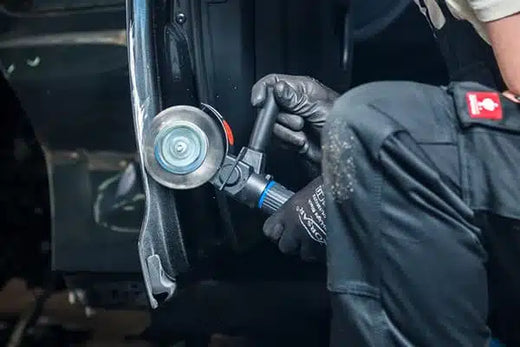
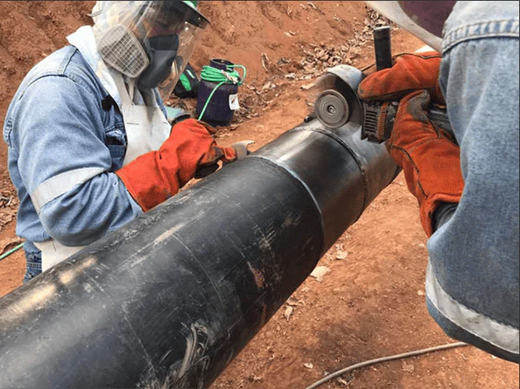
Bristle blasting is one way to address mill scale and profile together where open abrasive blasting is impractical: documented tests show cleanliness comparable to ISO 8501-1 Sa 2½ and a 65–85 µm Rz anchor profile on standard steel, although results vary with steel grade, rust grade, belt and technique.
Corrosion protection: the prevention hierarchy
In order of importance for coated steel structures in industrial and marine environments:
- Correct surface preparation to the specified standard (SSPC-SP 10 / ISO 8501-1 Sa 2½ is common for high-performance systems; SSPC-SP 11 power tool cleaning to bare metal is common for maintenance work) — the foundation of all other measures
- High-performance protective coatings — for example zinc-rich primers, high-build epoxies and polysiloxanes applied over a properly prepared surface
- Cathodic protection — sacrificial anodes or impressed current systems; an effective complement to coatings in immersion and buried service, not a substitute for preparation
- Material selection — stainless steel, corrosion-resistant alloys or weathering steel where appropriate
- Design for corrosion resistance — eliminating crevices, ensuring drainage and avoiding bimetallic contacts
For what SSPC-SP 10 requires and how to verify it in the field, see our SSPC-SP 10 technical guide. For a comparison of preparation methods for different site conditions, see Bristle Blaster® vs. sandblasting.
Frequently asked questions
What is the difference between corrosion and rust?
Rust is one specific form of corrosion: the hydrated iron oxide that forms on iron and carbon steel in the presence of water and oxygen. Corrosion is the broader electrochemical process; on other metals it produces green patina on copper, white oxide on aluminium and tarnish on silver. All rust is corrosion, but not all corrosion is rust. See rust vs corrosion.
How quickly does steel corrode?
It depends on the environment. Under ISO 9223 and ISO 12944-2, uncoated carbon steel loses more than 25 to 50 µm in the first year in a medium (C3) atmosphere, more than 80 to 200 µm in a very high (C5) atmosphere and more than 200 to 700 µm in extreme (CX) conditions. Localised pitting can penetrate considerably faster than these average rates.
Can corrosion be reversed?
No. Iron that has converted to iron oxide does not turn back into sound metal under service conditions. Corrosion can only be managed: the corrosion products are removed by surface preparation, badly wasted sections are repaired or replaced, and the surface is protected again with a coating system and, where suitable, cathodic protection.
What surface preparation standard is required before painting steel?
It depends on the coating system and service environment. For high-performance coatings in marine, offshore and industrial service, SSPC-SP 10 / ISO 8501-1 Sa 2½ (near-white metal blast) is typical. SSPC-SP 5 / Sa 3 (white metal) is often specified for the most aggressive service, some immersion linings and thermal spray. SSPC-SP 6 / Sa 2 (commercial blast) suits some atmospheric systems with lower durability requirements.
MontiPower® technical team: corrosion assessment, surface preparation specification and method selection for your project environment.
→ Request technical consultationSources
- NACE International, International Measures of Prevention, Application, and Economics of Corrosion Technologies (IMPACT) — Economic impact (2016). impact.nace.org
- Corrosion Alliance, Principles of corrosion. corrosionalliance.com
- SteelConstruction.info (SCI/BCSA), Standard corrosion protection systems for buildings (ISO 9223 / ISO 12944-2 corrosivity categories). steelconstruction.info
- IMO, Resolution MSC.215(82): Performance Standard for Protective Coatings (PSPC) (2006). dl.defelsko.com
- KTA-Tator, Industry standards for surface preparation. kta.com