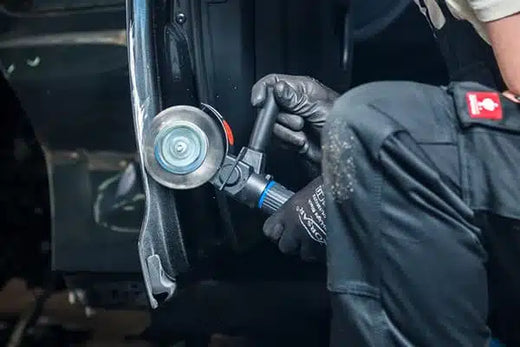
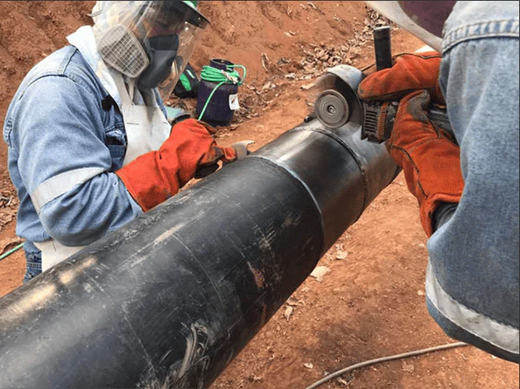
Short answer: Corrosion is the broad term for any electrochemical degradation of a metal by its environment; rust is one specific kind, the reddish-brown iron oxides that form on iron and steel exposed to oxygen and water. All rust is corrosion, but not all corrosion is rust. The difference matters because each corrosion type calls for its own protection and surface preparation approach.
Rust and corrosion are often used interchangeably, but they are not the same thing. This article explains the difference, the main corrosion types that affect steel structures, the ISO 8501-1 rust grades used to describe steel before preparation, and what each means for surface preparation before coating.
What is corrosion?
Corrosion is the chemical or electrochemical reaction between a metal and its environment that degrades the metal's properties. The environment provides the oxidising agent, most commonly oxygen dissolved in water, or water together with atmospheric oxygen. The metal is oxidised (loses electrons) at an anodic site while the oxidising agent is reduced at a cathodic site. In the presence of an electrolyte, which is essentially any moisture containing dissolved ions, the reaction proceeds continuously.
Corrosion affects practically all structural metals used in industry: carbon steel, stainless steel, aluminium, copper, zinc and, in specific environments, even titanium. Each corrodes through mechanisms specific to its chemistry and its environment.
What is rust?
Rust is the common name for the reddish-brown iron oxide compounds that form when iron or steel reacts with oxygen in the presence of water. The main constituents are hydrated iron(III) oxide (Fe₂O₃·nH₂O) and iron(III) oxide-hydroxide (FeOOH). Rust is chemically distinct from the parent metal: it is porous, brittle and generally poorly protective. Unlike the dense, adherent passive films that protect stainless steel and aluminium, rust does not stop further corrosion. As it forms and flakes, fresh steel is exposed to further attack.
Key characteristics of rust:
- Only iron and iron-based alloys rust; other common structural metals form different corrosion products
- Rust occupies several times the volume of the iron it replaces, depending on the oxides formed, which is why corroding reinforcement cracks and spalls the surrounding concrete
- Rust is hygroscopic: it absorbs moisture, which accelerates further corrosion
- Rust in pits and crevices retains chloride and sulfate contamination, a major cause of coating failure when rusted steel is incompletely prepared before recoating
What types of corrosion affect steel structures?
Rust is the most visible form of corrosion on steel, but several distinct mechanisms affect industrial steel structures. Knowing which are present determines the protective strategy:
| Corrosion type | Mechanism | Typical locations | Surface preparation implication |
|---|---|---|---|
| Uniform (general) corrosion | Even electrochemical attack across the surface; classic rusting of unprotected steel | Uncoated or de-coated atmospheric steel | Prepare to the grade on the coating data sheet; soluble salt testing recommended |
| Pitting corrosion | Localised attack, often initiated by chlorides; creates deep cavities while the general surface is relatively intact | Marine and offshore structures; chloride-rich environments | Pit interiors are hard to clean by any method; a two-step approach (Tercoo® for bulk removal, then the Bristle Blaster® for cleanliness and profile) is one option; strict salt control |
| Galvanic corrosion | Accelerated corrosion of the more active metal where two dissimilar metals are connected in an electrolyte | Steel–stainless and steel–copper connections; aluminium fastened with steel | Isolate the metals; coat the cathode or both metals, never only the anode; prepare per coating TDS |
| Crevice corrosion | Accelerated attack in occluded spaces (lap joints, under gaskets, at fasteners) | Structural connections, flanged joints, overlapping plates | Clean crevices thoroughly; stripe coat crevice-forming joints; consider design changes to eliminate crevices |
| Erosion-corrosion | Combined mechanical and electrochemical attack in flowing fluid; the protective film is continuously removed | Pipe bends, pump impellers, heat exchanger tubes, splash zones | Abrasion-resistant coating systems, usually over blast-cleaned steel; cleanliness and anchor profile per TDS |
| Stress corrosion cracking (SCC) | Cracking under combined tensile stress and a specific corrosive environment (for example chlorides on stainless steel, H₂S on high-strength steel) | Sour service equipment; stainless steel in hot chloride environments | Coatings exclude the environment; preparation and primer selection per specification for the service |
| Microbiologically influenced corrosion (MIC) | Bacteria (for example sulfate-reducing or acid-producing) create locally corrosive microenvironments | Pipeline internals, submerged zones, water infrastructure | Remove biofilm and deposits completely before preparation; strict contamination control |
What are the ISO 8501-1 rust grades?
ISO 8501-1 defines four rust grades (A, B, C and D) that describe the initial condition of uncoated steel before surface preparation:
- Grade A: steel surface largely covered with adhering mill scale, with little if any rust. Mill scale is an oxide layer formed during hot rolling. It is cathodic to the underlying steel, so if it is left on and the coating is breached, the exposed steel corrodes preferentially at the break.
- Grade B: steel surface that has begun to rust and from which the mill scale has begun to flake.
- Grade C: steel surface on which the mill scale has rusted away or can be scraped off, with slight pitting visible under normal vision.
- Grade D: steel surface on which the mill scale has rusted away and general pitting is visible under normal vision. This is the most demanding starting condition.
Preparation grades (Sa grades for blast cleaning, St 2 and St 3 for hand and power tool cleaning) are assessed against these initial conditions. The required preparation grade depends on the coating system: many high-performance industrial systems specify Sa 2½ (SSPC-SP 10), while surface-tolerant maintenance coatings may accept less. The coating data sheet governs. Reaching a given grade on Grade D steel with deep pitting takes considerably more effort and time than on Grade B steel.
What does the rust grade tell you about surface preparation?
The rust grade gives practical information before preparing a surface for coating or recoating:
- Grade A steel: mill scale must be removed for most high-performance coating systems, because any break in the scale creates a galvanic cell. Abrasive blasting is the standard route. Hand and power tool cleaning to SSPC-SP 2 / SP 3 (St 2 / St 3) does not remove tightly adherent mill scale; impact power tools working to SSPC-SP 11, such as bristle blasting, can.
- Grade B–C steel: rusted but without severe pitting. Blast cleaning to Sa 2½ is standard; in maintenance work, the Bristle Blaster® gives cleanliness comparable to Sa 2½ / SSPC-SP 10 with a 65–85 µm Rz anchor profile on standard steel in documented tests, depending on steel grade, rust grade, belt and technique.
- Grade D steel: deep pitting is present. Use blast cleaning or a two-step mechanical approach (bulk corrosion removal, then final cleaning and profiling), pay particular attention to pit bottoms, and control soluble salts.
Key takeaways
- Rust is a specific form of corrosion: the iron oxide product of steel reacting with oxygen and water. Corrosion is the broader category of electrochemical metal degradation that affects all structural metals.
- Several corrosion types affect steel structures: uniform rusting, pitting, galvanic, crevice, erosion-corrosion, stress corrosion cracking and MIC. Each has different causes, locations and preparation implications.
- ISO 8501-1 rust grades A–D describe the initial condition of steel, from adhering mill scale (A) to general pitting (D). The rust grade determines the effort needed to reach a given cleanliness grade.
- Many high-performance industrial coating systems specify Sa 2½ (SSPC-SP 10); the coating data sheet sets the actual minimum.
- Pitted steel retains corrosion products and soluble salts that are hard to remove by any single method. Thorough preparation and soluble salt testing are essential before coating.
Related articles
- Corrosion Protection for Steel Structures: A Practical Guide
- Pitting Corrosion: What It Is and How to Address It
- Complete Guide to SSPC Surface Preparation Standards
- How to Keep Steel Corrosion-Free
Frequently asked questions
Is rust the same as corrosion?
No. Corrosion is the general term for a metal degrading through reaction with its environment, and it affects steel, aluminium, copper, zinc and other metals. Rust is the specific corrosion product of iron and steel: hydrated iron oxides and oxide-hydroxides. All rust is corrosion, but aluminium or copper corrosion is not rust.
Can stainless steel rust?
Yes, under the wrong conditions. Stainless steel relies on a thin passive chromium oxide film. Chlorides, crevices, contamination with carbon steel particles or damage to the film can cause pitting, crevice corrosion or surface rust staining. That is why stainless surfaces should be prepared with stainless steel tools, not carbon steel brushes or belts.
What are the ISO 8501-1 rust grades?
ISO 8501-1 describes four initial conditions of uncoated steel: A, adhering mill scale with little or no rust; B, beginning to rust with mill scale starting to flake; C, mill scale rusted away or scrapable, with slight pitting; and D, mill scale rusted away with general pitting visible. Preparation grades are then judged against these starting conditions.
Why is rusted, pitted steel harder to prepare for coating?
Pits trap corrosion products and soluble salts such as chlorides and sulfates. If they remain under a new coating they can cause osmotic blistering and renewed corrosion. Pitted steel therefore needs more thorough preparation, careful attention to pit bottoms and soluble salt testing before coating, whichever preparation method is used.
Sources
- Corrosion Alliance, Principles of corrosion. corrosionalliance.com
- Fitz Coatings, Blast it! ISO 8501-1 (rust grades A–D, Sa and St grades) (2021). fitz-coatings.com
- TWI, What is galvanic corrosion and how can it be avoided? twi-global.com
- SSPC, SSPC-SP 3, Power Tool Cleaning. Copy of standard
- KTA-Tator, Industry Standards for Surface Preparation. kta.com