Short answer: Heavy-duty coatings need two things at the substrate: the cleanliness and the anchor profile specified for the primer. Bristle blasting delivers both in one pass without loose abrasive, with cleanliness comparable to ISO 8501-1 Sa 2½ / Sa 3 and a 65–85 µm Rz profile on standard steel in documented tests, on mill scale, zinc, epoxy, TSA, galvanised and stainless substrates.
A high-performance protective system, whether an epoxy, a zinc-rich primer, a siloxane topcoat or a NORSOK M-501 stack, is only as durable as its bond to the substrate. Industry experience consistently attributes most premature coating failures to surface preparation rather than to the coating itself. This field guide covers the heavy-duty coatings and substrates that bristle blasting has been documented to prepare, the profile it produces, and how to choose the right tool and belt for the surface in front of you.
Why is surface preparation two specifications, not one?
Every coating data sheet asks for two things at the substrate: a degree of cleanliness and a surface profile. Cleanliness is the removal of mill scale, rust, old coatings and contaminants. Profile, the anchor pattern of peaks and valleys, gives the primer something mechanical to key into. Always prepare to the cleanliness and profile prescribed for the primer, the first layer of the system. Hit one without the other and the coating can still fail: a clean but smooth surface gives the primer little to hold, and a well-profiled but contaminated surface traps the seeds of under-film corrosion.
A good profile has no flat, unprofiled areas between the peaks and valleys. That continuous pattern is a large part of the difference between a coating that reaches its design life and one that disbonds early. The cleanliness grades themselves are set out in our complete guide to surface preparation standards.
What is the grit-free alternative to abrasive blasting?
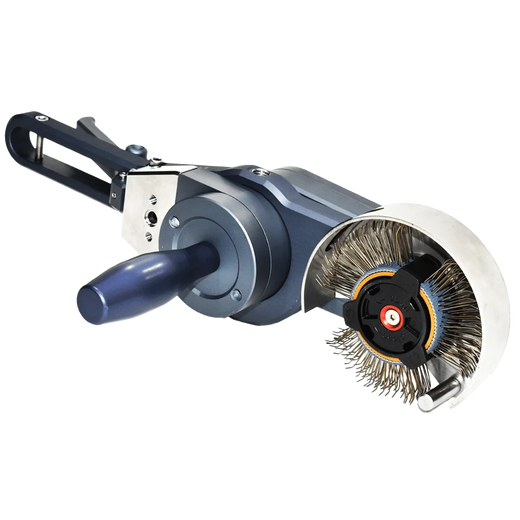
The Bristle Blaster® is a handheld power tool designed to produce a surface profile comparable to grit blasting. Rotary carbon or stainless steel bristle tips strike the corroded surface with kinetic energy comparable to conventional grit-blast media, then rebound. In that strike-and-rebound cycle the tool removes mill scale, rust and existing paint while forming a fresh anchor profile of peaks and valleys in a continuous pattern.
The result is a surface with the texture and visual cleanliness of grit blasting: cleanliness comparable to ISO 8501-1 Sa 2½ and Sa 3 (Sa 3-comparable results documented with the 11 mm belt on rust grade D) and comparable to AMPP SSPC-SP 10 / SP 5. It is achieved without loose abrasive, containment enclosures or media recovery. The removed rust and coating still become dust, so extraction and respiratory protection remain necessary. The Ultimate drive units run at a controlled 2,300 rpm ±5% with low vibration, and the process is cold-working, so it does not burnish the steel or introduce heat damage when used correctly.
How is profile depth controlled? The accelerator bar
Profile depth is selectable. With the accelerator bar engaged, the Bristle Blaster® produces 65–85 µm Rz (2.6–3.3 mil) on standard steel in documented tests, with up to 120 µm Rz reported. Run without the accelerator bar, striking energy is lower and the profile is shallower (MontiPower cites around 25 µm / 1 mil), which can suit softer ferrous and non-ferrous substrates, composites and aluminium. Bristle Blaster® belts come in 23 mm and 11 mm widths, in carbon spring steel or stainless steel, so you can tune both profile and access. In practice you set the profile to the coating specification rather than accepting whatever the abrasive happens to deliver. Results vary with steel grade, rust grade, belt and technique.
Which heavy-duty coatings has bristle blasting been documented on?
MontiPower reports test work on steel panels supplied by heavy-duty coating manufacturers including Carboline, PPG and AkzoNobel, with results verified by 3D surface scan using Keyence profilometry (see also the independent 3D analysis of the bristle-blasted surface profile). Across that work, bristle blasting has been shown to remove and prepare:
- Mill scale and rust grades A, B and C: the foundation case, from intact mill scale through uniform corrosion.
- Inorganic and organic zinc coatings, including inorganic zinc primer, organic zinc, and inorganic zinc with silicone topcoats.
- Inorganic high-temperature-resistant coatings: the hard, brittle systems that defeat hand tools.
- Epoxy systems: epoxy phenolic tank linings and epoxy siloxane topcoats.
- Silicone acrylics and multi-layer painted surfaces.
- NORSOK M-501 three-layer systems: the offshore standard stack, stripped to substrate.
- Thermal spray aluminium (TSA) and hot-dip galvanised steel.
Beyond carbon steel, the same platform prepares other materials: stainless steel (for example SS304, with stainless belts to avoid carbon-steel contamination), wood cleaning and roughening, concrete stain removal, roughening of composite and gelcoat surfaces for bonding, and edge feathering of thick polyethylene and polypropylene with Vinyl Zapper® media. One method covers much of the fabrication and maintenance envelope.
Why do NORSOK and offshore specifiers pay attention?
Conventional power-tool cleaning with grinders, needle guns and wire brushes is often excluded from demanding coating specifications. Rubbing tools generally reach only St 2 / St 3 (SSPC-SP 2 / SP 3) and can polish the surface, while cutting tools reach bare metal with only a shallow, directional profile; in ASC Shipbuilding trials a #36 grit grinder and a #40 flap disc produced 30–40 µm against 50–80 µm for bristle blasting. Because bristle blasting produces cleanliness and anchor profile comparable to ISO 8501-1 Sa 2½ / Sa 3, it can be specified for weld seams, spot repairs and hard-to-reach geometry where abrasive blasting is impractical and ordinary power tools will not pass. It complements blast cleaning rather than downgrading it: it is the tool for the parts of an asset that blasting cannot reach.
How do you choose the tool for the environment?
The Bristle Blaster® family is configured for the job. The Bristle Blaster® Pneumatic has been independently evaluated for ATEX explosive atmospheres (zone 1 gas and zone 21 dust) for live oil & gas, refinery and petrochemical work. The Ultimate Electric and Ultimate Electric Double run on standard mains power, the Double covering larger flat areas at around 3 m² per hour. Cordless units free the operator for remote and rope-access work; the Axial reaches weld seams, corners and flanges; and the Subsea variant prepares surfaces underwater. The MBX® range, with coarse, medium and fine carbon-steel belts and stainless options, is designed for cleaning thin panels such as vehicle bodywork and non-ferrous parts, not for profiling structural steel.
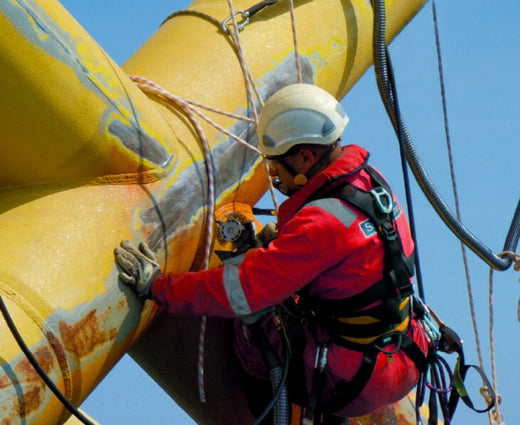
Because the tools are lightweight, portable, low-vibration and need no blast spread, they go where blasting cannot: steel structures over live railways, pipelines inside environmentally protected areas, and confined spaces where enclosures are impossible. Worn belts can be recycled, and the absence of spent abrasive removes an entire waste stream.
How is the result verified?
Confidence in a preparation method comes from measurement. The documented bristle blasting results were captured with 3D surface scanning on a Keyence instrument, which records the actual peak-and-valley topography rather than a single dial reading. In the field, the anchor profile is checked with replica tape or a depth micrometer to ASTM D4417, and cleanliness is assessed visually against the ISO 8501-1 photographic standards; see our anchor profile measurement field guide. A key acceptance check is structural: a continuous profile with no flat, unprofiled area between peaks and valleys. A flat is a weak point where the primer has nothing to key into, and 3D scanning exposes it where a single-point reading might miss it.
What are the hidden economics of grit-free preparation?
Bristle blasting can simplify preparation and reduce cost compared with abrasive blasting, and the saving is rarely just the abrasive. Removing loose media removes the equipment that goes with it: the compressor and blast pot, the containment enclosure, and the media-recovery and waste-disposal stream. Set-up is quick, the tool is portable, and the surrounding asset can often keep operating. For spot repair and maintenance, where mobilising a full blast spread is uneconomic or impossible, the cost difference is often decisive. In a Wales & West Utilities field trial on a small-area corrosion repair, bristle blasting took 45 person-minutes in total against 260 for grit blasting, mostly because of set-up and clean-up.
Where does it fit best? Weld seams, spot repair and in-service work
The method is ideally suited to spot repair, and it scales to larger areas where other metal-cleaning processes are prohibited or where power-tool cleaning is the better option. Its advantage shows on the geometry that defines real assets: weld seams, corners, edges, flanges and fillet welds, where the Axial drive reaches what a blast nozzle cannot. Because the process is cold-working and uses no loose abrasive, it suits in-service preparation on live or sensitive assets: offshore and onshore well installations, bridge refurbishment, naval and marine fabrication and repair, and routine industrial maintenance. Blast the broad acreage, then bristle-blast the critical seams and access-limited areas to a comparable standard.
Get the specification right before the first pass
Before any coating job, confirm the primer's required cleanliness and profile, then match the tool, belt and accelerator-bar setting to deliver it, with particular care on corners, edges and weld seams where geometry changes the result. Training is strongly recommended: knowing which configuration suits each application, and the correct technique, is what turns a capable tool into a consistently coating-ready substrate.
To go deeper, explore the Bristle Blaster® system above, see how it performs by industry and application, or read the pillar guide on grit-free surface preparation. When you are ready, request a quote or talk to a specialist who will match the right configuration to your substrate, standard and environment.
Frequently asked questions
What surface preparation do heavy-duty coatings require?
The cleanliness grade and anchor profile stated on the primer's data sheet. For most immersion and offshore systems that means a grade of Sa 2½ / SSPC-SP 10 or better and a profile in the 50–100 µm range. Bristle blasting can deliver cleanliness comparable to those blast grades where blasting is impractical, subject to inspector acceptance.
Can bristle blasting remove zinc primers and NORSOK M-501 systems?
Yes. MontiPower test work documents removal of inorganic and organic zinc primers, epoxy phenolic and epoxy siloxane coatings and NORSOK M-501 three-layer systems down to substrate, followed by a fresh anchor profile. Removal rate depends on coating thickness and hardness, so very thick systems are often stripped first with a heavy-removal disc.
Is bristle blasting accepted in coating specifications?
Increasingly, for weld seams, spot repairs and access-limited areas. Jotun has published a bristle blast cleaning standard (BIPoT) with grades mapped to Sa 3 to Sa 1, and project specifications name bristle blasting where grit blasting is prohibited. Acceptance is always set by the specification and the responsible inspector.
Which Bristle Blaster® should I use in a hazardous area?
The Bristle Blaster® Pneumatic or Pneumatic Double. They are fully air-driven with no electrical parts and ATEX-evaluated for zone 1 explosive gas and zone 21 explosive dust. Whether work may proceed is still decided by the site operator's zoning, risk assessment and permit system.
Sources
- KTA-Tator, Industry Standards for Surface Preparation (SSPC-SP 5, SP 10, SP 11 and SP 15 definitions). kta.com
- Jotun, Surface Preparation Code and Standard for Bristle Blast Cleaning and Profiling Process (BIPoT). PDF
- R. Dankiw, D. Fosdike, Defining Mechanical Surface Preparation Standards with Power Tools, Corrosion & Prevention 2018. PDF
- R. J. Stango et al., Fundamentals of Bristle Blasting Process for Removing Corrosive Layer, NACE CORROSION 2009. AMPP abstract
- MontiPower®, Bristle Blaster® technical data sheets, belt data sheets and coating-panel test documentation (3D scan, Keyence); Peak Times Moments: Wales & West Utilities field trial.