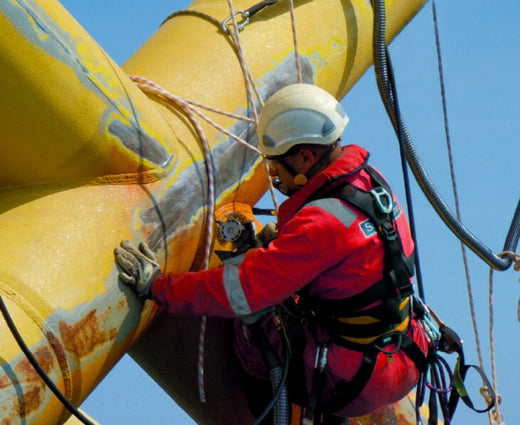
In brief: At the Wind & Maritim conference in Rostock (May 2026), Fraunhofer IGP presented an ROV-based process for repairing coatings on offshore structures underwater. In lab trials a robot-guided Subsea Bristle Blaster® prepared coated steel underwater; underwater-applied repair coating reached up to 13.5 ± 1.3 MPa pull-off adhesion (ISO 4624) at the best position. A first brush-application field trial ran in the Warnow river.
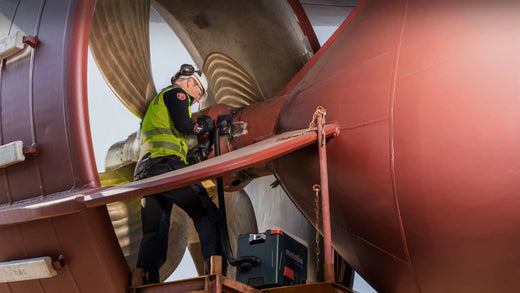
At the 15th Zukunftskonferenz Wind & Maritim in Rostock (5–6 May 2026), Fraunhofer IGP presented something we find quietly remarkable: a robot arm driving a Subsea Bristle Blaster® across coated steel underwater, as the preparation stage of a planned ROV-based coating repair process for offshore structures. This article summarises the research; the full presentation by M.Sc. Julia Schubert (Fraunhofer IGP) is available as a PDF (German).
The problem: small damage, deep water
Corrosion protection of offshore structures stands or falls with an intact coating. Transport, installation and operation cause local damage, and the underwater and splash zones are where damage matters most and access costs most: high corrosion rates, short diver windows, high cost and elevated safety risk. Inspection has already moved to ROVs; repair, so far, has not. The scale of the offshore-wind repair problem is also covered in our summary of the RepaKORR repair coatings study.
The lab rig
Fraunhofer IGP's test setup pairs a Universal Robots UR10e arm with the Subsea Bristle Blaster® and a MontiPower® high-pressure pump (HPCT 250-21), working on 500 × 500 mm plates coated with a realistic offshore system: two epoxy layers plus a PU topcoat, roughly 1,200 µm in total. The robot varies what an operator would: tool standoff (48 and 50 mm), number of passes (6, 10 and 18), travel speed (39 mm/s) and track spacing (2.5 mm), on treated fields of about 60 × 60 mm. That turns technique into measurable process parameters.
The measured results
- Preparation: the bristle tool removed the coating system underwater and roughened the steel, with roughness (Rz) verified by stylus measurement. In the parameter sets presented, Rz rose with the number of passes and the shorter standoff but stayed in the tens of micrometres, below the 65–85 µm Rz anchor profile that the tool typically produces in air. Optimising this is part of the ongoing work.
- Repair coating: an underwater repair coating was applied underwater in two layers (693 ± 72 µm).
- Adhesion: pull-off adhesion (ISO 4624) was measured at three positions: 5.7 ± 1.4 MPa, 6.5 ± 2.6 MPa and 13.5 ± 1.3 MPa. The spread shows a process still being tuned; the best position shows what well-prepared steel can achieve underwater.
From lab to sea
A prototype ROV with an application tool exists, and a first field trial has run in the Warnow river, applying coating by brush. The stated goal is one combined ROV process covering de-coating, surface preparation and repair coating on offshore structures, with further optimisation and systematic parameter studies on the lab rig under way. This continues earlier research on bristle blasting for underwater corrosion protection, summarised in our page on the 2016 underwater preparation study, and the development of the water-driven Subsea tool, first presented as MontiPower's new hydraulic underwater device in 2019.
Why we're sharing it
Because it is independent research: Fraunhofer ran the measurements and reported position-dependent scatter alongside the best number. That is how surface preparation claims should be made. It also points at where this field is going. Robotic preparation is already real above water with the Prepper® systems and the Aeroblaster® drone; below the waterline is next. For current underwater applications see Subsea preparation and wind and renewable energy.
Frequently asked questions
Can coating repairs on offshore structures be done by robots underwater?
That is what Fraunhofer IGP is developing: an ROV-based process that prepares the damaged surface underwater with a Subsea Bristle Blaster® and applies the repair coating in the same campaign. It aims to replace diver deployments that are weather-limited, expensive and higher-risk. So far the work is at lab and first field-trial stage.
What results has the Fraunhofer underwater repair research shown so far?
In lab trials on plates with about 1,200 µm of epoxy/PU coating, a robot-guided Subsea Bristle Blaster® removed the coating and roughened the steel underwater. Underwater-applied repair coating reached pull-off adhesion of 5.7, 6.5 and 13.5 MPa (ISO 4624) at three positions. A first brush-application field trial ran in the Warnow river.
Why does underwater coating repair matter for offshore wind?
Corrosion protection of offshore structures depends on intact coatings, and the underwater and splash zones are the most damage-prone and least accessible areas. Inspections already run by ROV, but repairs still mostly need divers. Closing that gap would shorten response times and help extend the service life of offshore structures.
Sources
- J. Schubert, Fraunhofer IGP, Verfahren zur Unterwasser-Beschichtungsreparatur an Offshore-Strukturen mittels ROV, 15. Zukunftskonferenz Wind & Maritim, Rostock, 5–6 May 2026. PDF (German)
- R. J. Stango et al., Fundamentals of Bristle Blasting Process for Removing Corrosive Layer, NACE CORROSION 2009. AMPP abstract
- MontiPower, Bristle Blaster® Subsea product specifications.