Short answer: MontiPower® makes hand-held rotary tools for surface preparation without loose abrasive. The Bristle Blaster® cleans steel and creates an anchor profile in one pass, with cleanliness comparable to Sa 2½ to Sa 3 in documented tests. The MBX® removes rust, paint and underseal from vehicle body panels, and the Vinyl Zapper® removes decals and adhesive without damaging paint.
This article explains what MontiPower® surface preparation tools do, how the rotary bristle principle works, which tool fits which job, and why they are used as an alternative to sandblasting. The Bristle Blaster® and MBX® are rotary belt tools for surface preparation. Both remove corrosion and coatings quickly and thoroughly without blast media, but they are built for different substrates. The Bristle Blaster® is designed for steel that will receive a protective coating: in documented tests it produces surface preparation grades comparable to ISO 8501-1 Sa 2½ (SSPC-SP 10 / NACE No. 2) to Sa 3 (SSPC-SP 5 / NACE No. 1), with roughness of 65–85 µm Rz and up to 120 µm Rz. The MBX® is designed for vehicle body panels and is not intended for preparing steel to a coating specification.
Mechanical tools for surface preparation
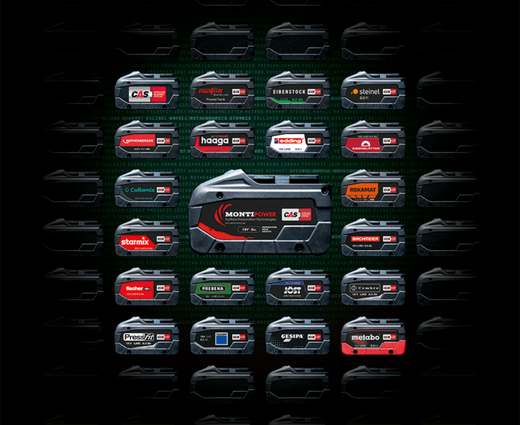
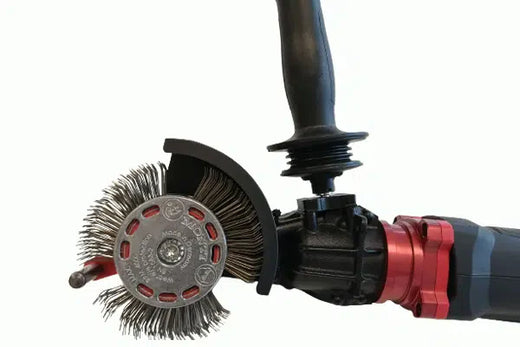
MontiPower®'s surface preparation tools avoid several drawbacks of traditional abrasive blasting: the compressor and blast pot, the containment, the spent media to collect and dispose of, and the health risks of airborne abrasive. The Bristle Blaster® was developed as a portable belt system that produces a surface texture and visual cleanliness comparable to grit blasting. It works in two ways at once. First, it removes paint, coatings, mill scale, rust and other contamination from metal surfaces. Second, while removing them, it generates an anchor profile — the roughness a coating needs to adhere. The working element is a belt of forward-curved, hardened steel wire bristles, dynamically tuned for portable drive units and driven at a speed matched to the belt (the Bristle Blaster® Ultimate Cordless, for example, runs at 2,200 rpm).
How do surface preparation tools work?
The Bristle Blaster® is a rotating belt of specially shaped wire bristles, driven electrically, pneumatically, by an 18 V battery or — for the Subsea model — hydraulically. An accelerator bar holds the bristles back and releases them, so the tips strike the surface with kinetic energy comparable to the impact of abrasive grit, rather than rubbing across it. Immediately after striking the steel, the tips rebound from the surface. Each strike removes corrosion and leaves a small crater, exposing fresh metal. As a result, a bristle-blasted surface has a texture and visual cleanliness that closely resemble a grit-blasted one. Results vary with steel grade, rust grade, belt and technique, so the profile is measured rather than assumed. The NACE paper summarized on our bristle blasting fundamentals page documents the mechanism.
The MBX® uses flexible wire belts in a patented housing that spin outward under centrifugal force. It removes rust, paint, underseal, sealants and adhesives from car, truck and train body panels without heat or warping. Its belts are color-coded by task — black for underseal, ocher for rust, green for paint, and blue stainless steel belts for aluminum and stainless surfaces.
Which tool for which job?
| Tool | Typical job | Result |
|---|---|---|
| Bristle Blaster® (Electric, Cordless, Pneumatic, Double, Axial, Subsea) | Steel before protective coating: spot repairs, weld seams, field joints, in-service assets, ATEX zone 1 (Pneumatic) | Cleanliness comparable to Sa 2½ / Sa 3; 65–85 µm Rz anchor profile in documented tests |
| MBX® (Electric, Pneumatic, Cordless, Axial) | Vehicle bodywork: rust, paint, underseal, sealant and gasket removal | Clean panel without heat or warping; not a steel-profiling tool |
| Vinyl Zapper® | Decals, vinyl, adhesive residue and double-sided tape | Removes film and adhesive without damaging the paint below |
| Prepper® Q4 / Q10 | Large areas: decks, walls, beams, pipelines (project-specific) | Automated, repeatable profile and cleanliness |
The Bristle Blaster® Pneumatic is fully pneumatic with no electrical parts and has an ATEX conformity evaluation for zone 1 gas and zone 21 dust. Working speed depends on steel, rust grade and coating; on API 5L X42 pipe steel with rust grade B, about 1.1 m² per hour was recorded. For a fuller overview of the categories, see Tools for Surface Preparation: What Each One Actually Does.
Tools for surface preparation without blasting
MontiPower®'s power tools offer grit-free surface preparation, and they are widely used as an alternative to sandblasting. Sandblasting has been practiced for many years, but its disadvantages are well known. It needs specialist equipment and operators, which makes even small jobs expensive and slow to mobilize. It can damage delicate substrates. And it carries serious health and environmental risks: blasting with silica sand releases respirable crystalline silica, which causes silicosis and lung cancer.
The dangers of sandblasting led Great Britain to prohibit crystalline silica for blast cleaning in 1950, and other European countries followed in the 1960s, according to NIOSH. NIOSH has recommended since 1974 that silica sand be replaced with less hazardous media, and non-silica abrasives such as steel grit and shot, slags and corundum are now common. Even so, any abrasive blasting still requires containment, respiratory protection and waste handling — see our article on blasting with copper slag.
Bristle blasting removes the loose abrasive from the process, but grit-free is not dust-free: the removed rust and coating still become particles, so appropriate dust control and personal protective equipment remain necessary, especially when old coatings may contain lead or chromium. For large, open new-build areas, blasting is usually still the faster method; MontiPower® tools are strongest where mobilization, containment and access dominate the cost.
Frequently asked questions
What tools are used for surface preparation of steel?
Hand tools and power wire brushes for loose material (SSPC-SP 2 / SP 3), grinders and impact tools such as needle guns and rotary flaps for bare metal (SSPC-SP 11), abrasive blasting for the blast grades, and water jetting for coating removal. The Bristle Blaster® is a hand-held impact tool that cleans and profiles steel in one pass.
Can the MBX® prepare steel to SSPC-SP 10?
No. The MBX® is designed for vehicle body panels, where it removes rust, paint and underseal and can leave a finish similar to sandblasting. For steel that must meet a coating specification with an anchor profile, use the Bristle Blaster®, which produces cleanliness comparable to Sa 2½ / SP 10 in documented tests.
Is bristle blasting dust-free?
No. Bristle blasting uses no loose abrasive, so there is no spent media and far less airborne material than open blasting, but the rust and coating it removes still become particles. Use dust extraction and suitable respiratory protection, particularly where old coatings may contain lead or chromium.
Sources
- NIOSH, Preventing Silicosis and Deaths From Sandblasting, Alert 92-102 (1992). oem.msu.edu
- EU-OSHA Roadmap on Carcinogens, Respirable crystalline silica (blasting with sand releases silica dust; EU limit 0.1 mg/m³). stopcarcinogensatwork.eu
- Corrosion Alliance, Surface Preparation Standards. corrosionalliance.com
- NACE International, CORROSION 2009 conference paper on the fundamentals of bristle blasting. content.ampp.org
- MontiPower®, Bristle Blaster® and MBX® technical data sheets and product FAQs.