Short answer: Abrasive blasting is effective, but it brings silica and dust hazards, spent media, containment and a reliance on specialist crews. MontiPower®'s Bristle Blaster® and MBX® are handheld, grit-free power tools that remove rust, coatings and other contaminants on site. The Bristle Blaster® also creates an anchor profile, with cleanliness comparable to Sa 2½ / SSPC-SP 10 in documented tests.
Surface preparation solutions
Surface preparation exists in many different forms. Whenever a metal surface needs to be stripped of rust, coatings, mill scale or other contamination, there are various possibilities. The best-known form of surface preparation is abrasive blasting, such as grit blasting, bead blasting, wheel blasting and vacuum blasting. The surface is cleaned and prepared by propelling an abrasive at high velocity, usually with compressed air or a centrifugal wheel. It is a common method that has been used for many years, but it also has well-known disadvantages. With the Bristle Blaster® and MBX®, MontiPower® offers a grit-free mechanical alternative for many surface preparation jobs. This article sets out three disadvantages of traditional methods and how these tools address them.
The disadvantages and solutions for surface preparation
Although abrasive blasting has been used for a long time, several disadvantages of the method have become clear over the years. What are they, and how do MontiPower power tools address them?
Disadvantage 1: abrasive blasting can be dangerous
One of the biggest disadvantages of traditional surface preparation is that it can be hazardous. It can be hard on the surface, and frequent abrasive blasting can harm people and the environment. The best-known example is sandblasting, one of the first forms of abrasive blasting and for many years the most widely used. It used quartz sand, which breaks down into very fine particles during blasting. Inhaling this respirable crystalline silica can cause silicosis, a serious and potentially fatal lung disease. As a result, the use of crystalline silica for blast cleaning was prohibited in Great Britain in 1950 and in other European countries in 1966, and NIOSH recommended a ban in the United States in 1974. Where silica exposure still occurs, it is tightly regulated, for example under OSHA's respirable crystalline silica standard. Read more about the dangers of sandblasting.
Other forms of surface preparation can also be harmful. Chemical surface preparation is another example: the metal surface is cleaned with an acid solution, typically hydrochloric or sulfuric acid in pickling lines. These are aggressive agents that cause burns on contact, can give off harmful fumes, and leave spent acid that must be treated or disposed of as waste.
How does MontiPower address this?
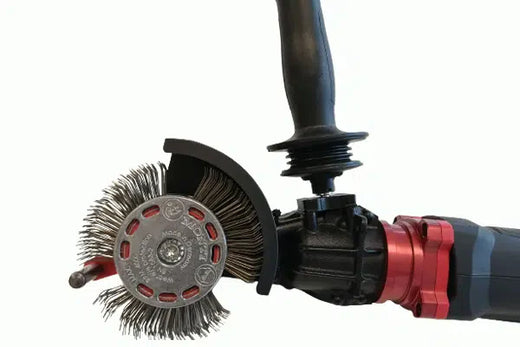
MontiPower attaches great importance to safety and health. The Bristle Blaster® and MBX® use no loose abrasive media and no chemicals, so there is no silica-bearing grit and no acid to handle. Both tools are handheld and are available as electric, cordless or pneumatic drives, and ergonomics such as vibration-reducing handles have been taken into account in their design. They are grit-free, not dust-free: the rust and coating that are removed still become particles, so dust extraction and suitable PPE remain necessary, especially where old coatings contain lead or hexavalent chromium.
Disadvantage 2: surface preparation is difficult to carry out
Preparing surfaces is work that needs to be done accurately. On the one hand, rust, coatings and dirt must be removed as effectively as possible; on the other, if the impact is too aggressive, the object can be damaged. Getting this balance right with blasting equipment takes specialist skill, containment and equipment, so blasting is usually subcontracted to a specialist company. That makes the asset owner dependent on an external party and makes surface preparation a relatively expensive job, particularly for small areas and repairs.
How does MontiPower address this?
The Bristle Blaster® and MBX® are handheld power tools, so after training, in-house maintenance crews can prepare surfaces themselves, including spot repairs and areas where setting up blasting would be impractical. The Bristle Blaster® cleans and creates an anchor profile in one step: in documented tests on standard steel it gives cleanliness comparable to ISO 8501-1 Sa 2½ / SSPC-SP 10 with a 65–85 µm Rz (2.6–3.3 mil) anchor profile, and it is cold-working, with no heat input. Results vary with steel grade, rust grade, belt and technique, so correct belt selection, air pressure or speed setting, and operator technique still matter. The MBX® is designed for removing rust, paint, adhesives, gaskets and underbody coatings and for dressing weld seams, for example on vehicle bodywork.
Disadvantage 3: surface preparation can harm the environment
Traditional forms of surface preparation can affect not only human health but also the surrounding environment. Released abrasive and removed coating can pollute soil and water if they are not contained, spent abrasive contaminated with old coating can become hazardous waste, and chemical treatments produce spent acids and sludges that need treatment.
How does MontiPower address this?
The Bristle Blaster® and MBX® address these environmental disadvantages in several ways. First, they do not use loose abrasives, so there is no spent media stream to contain, collect and dispose of; only the removed rust and coating need to be captured. Second, no chemical agents are used. Third, through MontiPower's circularity programme, used belts can be returned for recycling. Together, this makes the Bristle Blaster® and MBX® a practical, lower-waste option for many surface preparation tasks, while blasting remains the faster choice for large, open new-build areas.
Frequently asked questions
Why is sandblasting with silica sand restricted?
Blasting with silica sand releases respirable crystalline silica, which can cause silicosis and other serious lung disease. Great Britain prohibited crystalline silica for blast cleaning in 1950, other European countries followed in 1966, and NIOSH recommended a ban in the US in 1974. Today exposure is tightly regulated, for example under OSHA 29 CFR 1926.1153.
Does the Bristle Blaster® replace grit blasting?
For many maintenance, repair and spot-preparation jobs, yes. In documented tests on standard steel it gives cleanliness comparable to ISO 8501-1 Sa 2½ / SSPC-SP 10 with a 65–85 µm Rz anchor profile, and results vary with steel grade, rust grade, belt and technique. On large, open new-build areas, blasting usually remains faster.
What is the difference between the Bristle Blaster® and the MBX®?
The Bristle Blaster® is built to clean steel and create an anchor profile for protective coatings. The MBX® is a lighter one-step tool for removing rust, paint, adhesives, gaskets, sealers and underbody coatings and for dressing weld seams, used widely on vehicle bodywork and smaller components.
Is bristle blasting dust-free?
No. It is grit-free, so there is no spent abrasive to collect, but the rust and coating that are removed still become particles. Use dust extraction and suitable respiratory protection, and treat coatings containing lead or hexavalent chromium as hazardous material.
Sources
- NIOSH, Alert: Preventing Silicosis and Deaths from Sandblasting, Publication 92-102 (1992). PDF copy
- OSHA 29 CFR 1926.1153, Respirable crystalline silica. osha.gov
- American Galvanizers Association, The HDG Process (acid pickling with sulfuric or hydrochloric acid). galvanizeit.org
- R. Dankiw, D. Fosdike, Defining Mechanical Surface Preparation Standards with Power Tools, Corrosion & Prevention 2018, Paper 74. PDF
- MontiPower, Bristle Blaster® and MBX® technical data sheets.