Short answer: A coating only performs as well as the surface under it. Preparation has two jobs: remove contamination to the specified cleanliness grade, and leave a surface profile that suits the coating’s adhesion mechanism. Profile is more than one number — peak height (Rz), average roughness (Ra) and peak count (Rpc) together describe how well a coating can grip.
Preparation is everything
Every coating system, however advanced, depends on the surface it is applied to. A coating can only be as good as its bond to the substrate, and that bond is decided before the first coat is mixed: by how clean the surface is, and by the shape of the profile left behind. This article explains what “good preparation” means in measurable terms, which roughness parameters describe a profile, and why different coatings need different surfaces.
Two conditions matter, and both are set during surface preparation:
- Cleanliness — rust, mill scale, old coating, oil and soluble salts removed to the grade the specification requires, for example ISO 8501-1 Sa 2½ or SSPC-SP 11. Anything left on the surface sits between coating and steel and weakens the bond.
- Surface profile — the microscopic peaks and valleys that give the coating a mechanical key. Too little and the coating has nothing to grip; too much and peaks can stand proud of a thin film.
Neither can be corrected once the coating is on. That is why surface preparation is usually the step that decides whether a coating reaches its design life. For the full picture of methods, see what is surface preparation.
Surface preparation for coatings and sealants
Every coating, depending on its adhesion mechanism, has its own needs for surface profile. We like a profile to be uniform in density, regularity and angularity. Using Keyence 3D optical scans, a prepared surface can be characterized by hundreds of roughness parameters; in our Dr. Prepper® material we concentrate on three: Rpc, Rz and Ra.
How adhesion mechanisms differ
Coatings, sealants and adhesives bond to steel in different ways, and the profile they need follows from that:
- Mechanical interlock. Most protective coatings — epoxies, zinc-rich primers, polyurethanes over a primer — rely heavily on flowing into the valleys of the profile and locking around the peaks as they cure. They need a defined profile depth and enough peaks to spread the load.
- Chemical bonding. Some coatings, sealants and adhesives also form chemical bonds with the clean metal or oxide surface. They can tolerate smoother substrates, but they still need a clean, freshly exposed surface, and a profiled substrate generally gives better adhesion and better resistance to rust creep.
- Thick and visco-elastic systems. Thick-film and visco-elastic coatings, wraps and composite repairs need a profile that matches their manufacturer’s instructions; see bristle blasting and visco-elastic coatings.
- Thermal spray. Metallizing relies almost entirely on mechanical interlock of molten particles, so it needs a sharp, angular profile; see bristle blasting as preparation for thermal spraying.
The coating manufacturer’s technical data sheet (TDS) is always the reference: it states the cleanliness grade and the minimum and maximum profile the product was tested on.
The three roughness parameters: Rz, Ra and Rpc
A surface profile is three-dimensional, but specifications usually reduce it to a single depth figure. Looking at three parameters together gives a much better picture of how a coating will grip.
| Parameter | What it describes | Why it matters for coatings |
|---|---|---|
| Rz | Average peak-to-valley height, taken over several sampling lengths | The usual measure of anchor profile depth; compared with the min/max in the coating TDS |
| Ra | Arithmetic average deviation of the profile from its mean line | Describes general roughness; two surfaces with the same Ra can have very different peak heights and shapes |
| Rpc | Peak count: number of peak-and-valley pairs per unit length that cross a band around the mean line | Describes how dense the profile is; more peaks means more surface area and more anchoring points |
Rz: depth of the profile
Rz is the parameter most coating specifications work with, because it relates directly to the dry film thickness of the primer. MontiPower® reports its anchor profile results as Rz. In the field, peak-to-valley height is measured with comparators, depth micrometers or replica tape to ASTM D4417; since the 2021 edition the standard also covers stylus instruments as Method D, which can report Rz and peak count directly. See the anchor profile measurement field guide.
Ra: average roughness
Ra is the classic engineering roughness value, used for machined parts. On its own it says little about coating performance: a surface with a few deep scratches and a surface with many fine, sharp peaks can share the same Ra. It is still useful as a quick check of overall roughness and for comparing preparation methods on the same steel.
Rpc: density of the profile
Peak count tells you how many anchoring points a coating has per unit length. Research published in the Journal of Protective Coatings & Linings (Roper, Weaver and Brandon, 2005) showed that higher peak count significantly improves adhesion to steel and resistance to corrosion undercutting. Later replica tape work by DeFelsko found a strong positive correlation between peak density and pull-off adhesion, and the highest adhesion in the 2–3 mil (about 50–75 µm) peak height range for the systems tested — adhesion fell as profiles grew deeper than 3 mil. Peak count is still rarely written into specifications, but it explains why two surfaces with the same Rz can perform differently.
Why we want a uniform profile: density, regularity, angularity
From these parameters follow the three qualities we look for in a prepared surface:
- Density — many peaks per unit length or area (high Rpc), so the coating is anchored at many points rather than a few.
- Regularity — consistent peak height across the area, so the primer covers every peak at its specified film thickness and there are no isolated rogue peaks.
- Angularity — sharp, crater-like peaks and valleys rather than rounded or polished ones. Angular profiles offer more surface area and a better mechanical key. Very deep, narrow valleys are not the aim either: the coating has to wet them out completely, or voids remain at the valley bottoms.
3D optical analysis makes these qualities visible. MontiPower’s 3D analysis of the bristle-blasted surface profile shows the measured texture behind the anchor profile figures, and the anchor profile page explains how profile and adhesion are linked.
How bristle blasting creates the profile
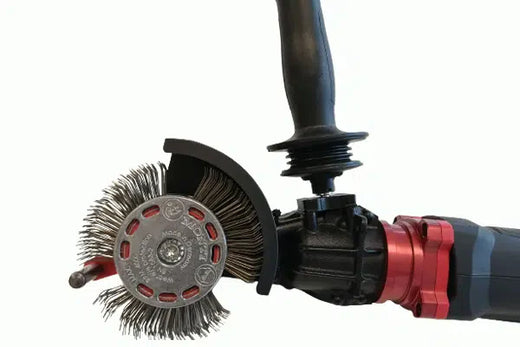
Conventional abrasive blasting creates profile by throwing grit at the steel; the size, shape and hardness of the abrasive set the result. Many power tools, by contrast, clean without creating new profile: wire brushes and abrasive discs can even polish an existing profile. The Bristle Blaster® works differently. Its hardened, forward-angled bristle tips strike the surface, rebound, and leave crater-like impressions that resemble a grit-blasted texture, while removing rust and coatings in the same pass.
In documented tests on standard steel this produces a 65–85 µm Rz (2.6–3.3 mil) anchor profile — up to 120 µm Rz in some tests — with cleanliness comparable to ISO 8501-1 Sa 2½ / SSPC-SP 10. No loose abrasive is used and the substrate is cold-worked, not heated. Results vary with steel grade, rust grade, belt and technique, so the profile should be measured on site like any other prepared surface.
A practical preparation checklist
- Read the coating TDS first: cleanliness grade, profile range, maximum flash rust and soluble salt limits.
- Remove oil and grease before mechanical preparation, so it is not spread across the surface.
- Choose a method that reaches both the cleanliness grade and the profile — not just one of them.
- Measure the profile (replica tape or stylus) and record the readings; check salts where the specification requires it.
- Coat within the time window the specification allows, before the surface deteriorates.
For training on technique and standards, see the Dr. Prepper® Academy.
Frequently asked questions
Why is surface preparation so important for coatings?
Coatings fail most often at the interface with the substrate. Rust, mill scale, salts or old coating left under the film weaken adhesion and let corrosion creep beneath it, and an unsuitable profile reduces the mechanical grip. Preparation sets both conditions — cleanliness and profile — before the first coat is applied, and neither can be corrected afterwards without removing the coating.
What is the difference between Rz, Ra and Rpc?
Rz is the average peak-to-valley height over several sampling lengths and is the usual measure of anchor profile depth. Ra is the arithmetic average deviation from the mean line and describes general roughness, not depth. Rpc, peak count, is the number of peak-and-valley pairs per unit length and describes how dense and regular the profile is.
Does a deeper profile always give better adhesion?
No. Research on replica tape parameters found the highest pull-off adhesion in the 2–3 mil (about 50–75 µm) peak height range for the systems tested, with adhesion decreasing above 3 mil. Peak density correlated positively with adhesion. The right profile is the one in the coating data sheet, with enough peaks to give a dense, uniform key.
What surface profile does the Bristle Blaster® create?
In documented tests on standard steel the Bristle Blaster® produces a 65–85 µm Rz (2.6–3.3 mil) anchor profile with cleanliness comparable to ISO 8501-1 Sa 2½. The bristle tips strike, rebound and leave crater-like impressions similar to grit blasting. Results vary with steel grade, rust grade, belt and technique, so the profile is measured on site.
Sources
- KTA-Tator (W. Corbett), Let’s talk about surface profile: angularity and measuring peak count/density (2023). kta.com
- DeFelsko (D. Beamish), Replica tape: relating 3 surface profile parameters to pull-off adhesion. defelsko.com
- ASTM International, D4417-21 Field Measurement of Surface Profile of Blast Cleaned Steel (2021). astm.org
- MontiPower®, Bristle Blaster® technical data and 3D surface profile analysis (2015).