Short answer: Steel preparation means removing mill scale, rust, old coating and contamination and creating an anchor profile so a new coating can bond. Abrasive blasting is the traditional method. The MontiPower® Bristle Blaster® cleans and profiles steel in one pass without grit, with cleanliness comparable to Sa 2½ / SSPC-SP 10, while the MBX® is designed for thin bodywork panels.
This article explains what steel preparation involves, the common methods and their drawbacks, how the MontiPower® Bristle Blaster® and MBX® work, and how to approach carbon steel, stainless steel and galvanized steel before painting.
What is steel preparation?
Steel is used in many industries for its strength and versatility. To keep steel structures and products in good condition, they need to be cleaned and protected, and preparation is essential before applying any new paint or other coating. Before coating, you must first remove any mill scale and thoroughly clean the existing steel surface. This removes rust and other contamination and creates an anchor profile, a micro-roughness the new paint or coating can grip. The quality of this preparation has a major impact on how long the coating, and the steel under it, lasts.
Ways to prepare steel
Preparing steel involves several elements. First, rust, mill scale and other contamination are removed, together with any previously applied coating that is no longer sound. There are different methods to achieve this, each with advantages and disadvantages. The best known is abrasive blasting, in which an abrasive is propelled against the surface by compressed air. The best known form is sandblasting, but many other abrasives are used, such as steel grit, glass bead or corundum (aluminium oxide), as well as wet blasting with water and abrasive. All blasting methods work in essentially the same way: the abrasive strikes the steel with great force, removing coating, mill scale, rust and dirt, and at the same time creating a profile on the surface that serves as an anchor for the new coating.
Which cleanliness grade is needed depends on the coating. Hand and power tool cleaning to SSPC-SP 2 / SP 3 (ISO 8501-1 St 2 / St 3) removes only loose material; SSPC-SP 11 requires bare metal with a minimum 25 µm (1 mil) profile; and blast-cleaning grades such as SSPC-SP 10 / Sa 2½ are written for abrasive blasting. See our complete guide to surface preparation standards.
Disadvantages of grit blasting
Steel has been prepared in much the same way for a long time, and the drawbacks of blasting have become more evident over the years. Blasting is aggressive and can damage thin or delicate parts, which makes it unsuitable for some surfaces. It is also not a job for an individual: it needs trained operators, a compressor, blast pot, abrasive supply, containment and waste handling. That makes blasting relatively time-consuming and expensive, especially for small areas and repairs.
Blasting is also hard on people. This is especially true of sand as an abrasive: the sand grains break down on impact into fine particles, and when the sand contains quartz, the dust contains respirable crystalline silica, which can cause silicosis and lung cancer. For this reason many jurisdictions restrict silica sand as a blasting abrasive and set strict exposure limits: the OSHA permissible exposure limit for respirable crystalline silica is 50 µg/m³ (8-hour TWA), and the EU binding limit under Directive (EU) 2017/2398 is 0.1 mg/m³. More in the dangers of sandblasting.
Preparing steel with MontiPower® power tools
MontiPower® power tools offer an alternative to sandblasting for many steel preparation jobs. The Bristle Blaster® cleans steel and creates a roughness profile comparable to the surface left by grit blasting: cleanliness comparable to ISO 8501-1 Sa 2½ / SSPC-SP 10 and a 65–85 µm Rz anchor profile on standard steel in documented tests. Results vary with steel grade, rust grade, belt and technique. The MBX® uses the same principle with belts designed for thin sheet metal such as car body panels, removing rust, paint, underseal and sealants; MontiPower does not recommend it for preparing structural steel where a coating specification requires an anchor profile.
Because both tools are hand-held and use no loose abrasive, they avoid the blast pot, media supply, containment and spent abrasive disposal. That makes them practical to use in-house for repairs, spot work and maintenance, without depending on a blasting contractor. Removed rust and coating still become dust, so extraction and suitable PPE remain necessary. For large, open, new-build areas, blasting usually remains the faster method.
How do the Bristle Blaster® and MBX® work?
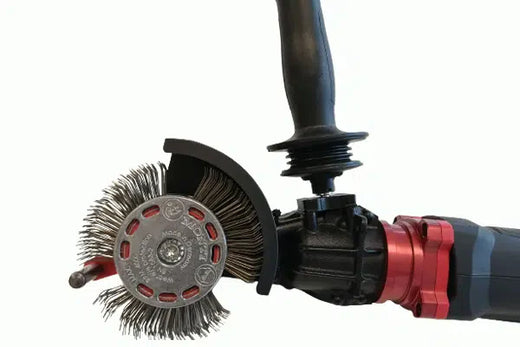
The Bristle Blaster® and MBX® use a patented technology. The tools drive a rotating belt fitted with specially shaped, forward-angled wire bristle tips. During rotation the tips are held back by an accelerator bar. When they pass the bar they are released and strike the surface with high kinetic energy, comparable to grit particles in blasting, and then rebound immediately instead of dragging. This impact strips mill scale, rust, paint and other contamination, and the micro-indentations it leaves create a fresh anchor profile for the new coating. The principle was documented in a 2009 NACE paper on bristle blasting fundamentals.
Cleaning steel before painting
Before a new coat of paint can be applied to a steel surface, old paint that is no longer sound must be removed, together with rust and other contamination that has formed over time. The question is how rusty steel should be cleaned before painting. On structural steel, the Bristle Blaster® removes rust and old coating and creates the anchor profile in the same pass, so the surface is ready for coating after dust removal and inspection. On thin body panels, the MBX® removes rust and paint without heat or warping. A step-by-step approach is described in how to prepare metal for painting.
Preparing stainless steel before painting
Stainless steel is increasingly chosen in many industries. Stainless steel often has a smoother surface than regular carbon steel, so before applying a coating it is important to roughen and clean it so that the coating can adhere. To avoid contaminating stainless steel with carbon-steel particles, which can cause rust staining, use stainless steel belts: Bristle Blaster® belts with stainless steel bristles are intended exclusively for non-ferrous metals such as aluminium and stainless steel, and blue MBX® belts are the stainless option for the MBX®. According to MontiPower application data, the Bristle Blaster® with stainless belts can produce a roughness of 50 µm or more on stainless steel, while the MBX® gives a finer roughness of approximately Ra 10–30 µm. This prepares the stainless steel for coating and also leaves it clean for welding.
Preparing galvanized steel for painting
Galvanized steel is steel coated with a layer of zinc, usually by hot-dip galvanizing, to protect it from corrosion. Galvanized steel also needs preparation before painting, otherwise the new coat of paint is likely to lose adhesion over time. The aim is to clean the zinc surface and give it a light profile without removing more zinc than necessary; SSPC-SP 16 describes this kind of brush-off blast cleaning for non-ferrous metals. Mechanical tools with the right belt and a light touch can do the same locally. Check the remaining zinc thickness afterwards and follow the coating manufacturer's instructions for painting over zinc.
Frequently asked questions
How do you prepare steel for painting?
Remove oil and grease, then remove mill scale, rust and unsound coating, and create an anchor profile that matches the coating data sheet. Blast cleaning is the traditional method; impact power tools such as the Bristle Blaster® clean and profile in one pass without grit. Remove dust, check salt levels and verify cleanliness and profile before coating.
Can I prepare steel without sandblasting?
Yes, for many jobs. The Bristle Blaster® produces cleanliness comparable to ISO 8501-1 Sa 2½ / SSPC-SP 10 and a 65–85 µm Rz anchor profile on standard steel in documented tests, with no loose abrasive. Results vary with steel grade, rust grade, belt and technique, and the coating specification must allow a power tool route.
What is the difference between the Bristle Blaster® and the MBX®?
Both use the patented accelerator-bar principle. The Bristle Blaster® is built for steel surface preparation: it removes corrosion and coatings and creates an anchor profile for protective coatings. The MBX® is designed for thin sheet metal such as car body panels, removing rust, paint, underseal and sealants without heat or warping, and is not intended for structural steel profiling.
How do you prepare stainless steel for coating?
Clean it, then roughen it with tools and belts that will not leave carbon-steel particles behind, because embedded iron can cause rust staining. Use stainless steel Bristle Blaster® belts or blue MBX® belts, measure the profile, and follow the coating manufacturer's requirements for stainless substrates, including any primer recommendation.
Sources
- SSPC-SP 3, Power Tool Cleaning. Copy of standard
- SSPC-SP 11, Power Tool Cleaning to Bare Metal. Copy of standard
- KTA-Tator, Industry Standards for Surface Preparation. kta.com
- OSHA 29 CFR 1926.1153, Respirable crystalline silica. osha.gov
- Directive (EU) 2017/2398 on carcinogens and mutagens at work, Respirable crystalline silica. stopcarcinogensatwork.eu
- R. J. Stango et al., Fundamentals of Bristle Blasting Process for Removing Corrosive Layer, NACE CORROSION 2009. AMPP abstract