Short answer: Corrosion resistant coatings protect steel by barrier, sacrificial (zinc) or inhibitive action, and all three depend on adhesion to properly prepared steel. Three surface preparation variables decide whether a system reaches its ISO 12944 durability: cleanliness grade (usually Sa 2½ / SSPC-SP 10), anchor profile depth within the data sheet range, and soluble salt levels below the specified limit.
A corrosion resistant coating is only as corrosion resistant as the surface preparation beneath it. A zinc-rich epoxy primer applied over a surface with 15% residual staining and a 28 µm profile can be expected to fail well before its rated service life, not because the coating is defective, but because inadequate preparation prevented it from reaching its designed adhesion. Corrosion resistance is a system property, not a coating property: it is the outcome of the right coating system applied correctly to the right substrate preparation in the right environment.
This article explains how corrosion resistant coatings work, how ISO 12944 links environment, durability and preparation, which three preparation variables decide performance, and how to reach them in maintenance work where blasting is not an option.
What makes a coating corrosion resistant?
Corrosion resistant coatings protect steel through one or more of three mechanisms:
Barrier protection
Most coating systems protect steel primarily by forming a physical barrier that slows the passage of water, oxygen and corrosive ions, particularly chlorides, to the steel surface. A high-build epoxy at 250 µm dry film thickness creates a long diffusion path for these species. The barrier is only effective while the film remains intact and adherent, which depends on the bond between coating and substrate. Poor surface preparation weakens that bond, leading to undercutting, delamination and osmotic blistering.
Cathodic (galvanic) protection
Zinc-rich primers, both organic (epoxy binder) and inorganic (zinc silicate), protect steel by making the zinc pigment the sacrificial anode in any galvanic cell formed when the coating is breached. Zinc corrodes preferentially, protecting the steel at the edges of damage. This mechanism requires electrical contact between the zinc particles and the steel. Inorganic zinc silicate primers react chemically with the steel surface; organic zinc-rich primers rely mainly on mechanical adhesion. Both typically require blast-cleaned steel to Sa 2½ / SSPC-SP 10 or as stated on the product data sheet. More on the mechanism in galvanic corrosion and zinc-rich primers.
Inhibitive protection
Some primer formulations contain corrosion-inhibiting pigments (chromates, now largely phased out in many jurisdictions, phosphates, borates) that slow the corrosion reaction when moisture penetrates the coating. Inhibitive primers are typically used as part of a multi-coat system and are not a substitute for adequate surface preparation.
ISO 12944: the international framework for corrosion protection of steel
ISO 12944 (Paints and varnishes — Corrosion protection of steel structures by protective paint systems) is the main international framework for specifying corrosion protection systems. Across its parts it defines:
- Corrosivity categories (C1 to C5 and CX for atmospheric exposure; Im1 to Im4 for immersion and buried service), based on the aggressiveness of the environment (ISO 12944-2)
- Durability ranges (low: up to 7 years; medium: 7–15 years; high: 15–25 years; very high: more than 25 years)
- Surface types and preparation, expressed as ISO 8501-1 preparation grades (ISO 12944-4)
- Protective paint systems: primer, intermediate and topcoat types with nominal dry film thicknesses (ISO 12944-5)
The paint systems tabulated in ISO 12944-5 generally assume blast-cleaned steel to Sa 2½ (comparable to SSPC-SP 10). For high-durability systems in aggressive environments and for immersion service, Sa 2½ is effectively the floor, and Sa 3 (SSPC-SP 5) is commonly required for thermally sprayed metal coatings and some specialist systems.
Corrosivity categories and their surface preparation implications
The environment descriptions below follow ISO 12944-2. The preparation column shows typical practice; the actual requirement is set by the chosen coating system and its data sheet.
| ISO 12944 category | Environment description | Typical examples | Typical surface prep (ISO 8501-1) |
|---|---|---|---|
| C1 — Very low | Heated buildings with clean atmospheres | Offices, schools | Sa 1 / St 2 (depends on system) |
| C2 — Low | Atmospheres with low pollution; mostly rural areas | Rural structures, unheated storage buildings | Sa 2 / St 3 |
| C3 — Medium | Urban and industrial atmospheres, moderate pollution; coastal areas with low salinity | Urban bridges, production halls with high humidity | Sa 2½ |
| C4 — High | Industrial areas; coastal areas with moderate salinity | Chemical plants, coastal shipyards, harbours | Sa 2½ |
| C5 — Very high | Industrial areas with high humidity and aggressive atmosphere; coastal areas with high salinity | Coastal industrial plants, buildings with almost permanent condensation | Sa 2½ |
| CX — Extreme | Offshore areas with high salinity; industrial areas with extreme humidity and aggressive atmosphere; subtropical and tropical atmospheres | Offshore structures, tropical industrial sites | Sa 2½ to Sa 3 |
| Im1 — Fresh water | River and freshwater structures | River installations, hydroelectric plant | Sa 2½ |
| Im2 — Sea or brackish water | Immersed structures without cathodic protection | Harbour structures, offshore jacket legs | Sa 2½ to Sa 3 |
| Im3 — Soil | Buried structures | Underground tanks, buried pipelines | Sa 2½ |
| Im4 — Sea or brackish water with cathodic protection | Immersed structures with impressed current or sacrificial anodes | Offshore structures with cathodic protection | Sa 2½ to Sa 3 |
The three surface preparation variables that determine corrosion resistance
1. Cleanliness grade
Residual rust, mill scale or old coating between the new coating and the steel acts as a weak boundary layer. It reduces adhesion and provides a reservoir of ionic contamination that drives osmotic blistering. Surface cleanliness is assessed visually against the ISO 8501-1 photographic references (Sa grades for blast-cleaned surfaces, St grades for hand and power tool cleaned surfaces). The full ladder of grades is explained in our complete guide to surface preparation standards.
2. Anchor profile depth
The anchor profile is the microscopic roughness of the prepared steel surface, commonly reported as a peak-to-valley height (for example Rz) in micrometres. A properly specified profile:
- Substantially increases the actual contact area between coating and steel compared with a smooth surface
- Creates mechanical interlocking between the coating and the steel
- Is specified in the coating manufacturer's technical data sheet as a range, commonly somewhere between 40 and 100 µm for high-performance epoxy and zinc-rich systems
Profile is measured with replica tape per ASTM D4417 Method C or with a depth micrometer per ASTM D4417 Method B. See the anchor profile measurement field guide.
3. Soluble salt contamination
Chloride and sulfate ions on the steel surface are among the most insidious causes of coating failure. They are invisible, can survive dry abrasive blasting, and cause osmotic blistering by drawing moisture through the coating film. This failure mode is predictable and preventable, but only if soluble salt levels are tested before coating application. A common field method is the Bresle patch (ISO 8502-6) with conductivity measurement (ISO 8502-9). The acceptable level is set by the specification and depends on service and coating system: the US Navy, for example, allows a maximum of 3 µg/cm² chloride for immersion service and 5 µg/cm² for non-immersion service. More in soluble salt contamination and coating failure.
Why corrosion resistant coatings fail: the surface preparation link
Coating failure investigations frequently trace premature failures in industrial and marine service back to surface preparation deficiencies rather than coating product defects. The main failure modes and their surface preparation root causes are:
| Failure mode | Appearance | Root cause in surface preparation |
|---|---|---|
| Adhesion failure / delamination | Coating lifts in sheets from the substrate | Insufficient cleanliness grade; oil or grease not removed before blasting; mill scale remaining under coating |
| Osmotic blistering | Circular blisters, often with liquid or corrosion product inside | Soluble salt contamination (chlorides/sulfates) trapped under coating; not detectable by visual inspection |
| Underfilm corrosion | Rust tracking spreading under intact coating from a defect or edge | Residual rust in profile valleys providing initiation sites; insufficient cleanliness grade |
| Zinc primer disbondment | Zinc-rich primer separates from steel; protection lost | Insufficient surface preparation for galvanic contact; contamination between zinc particles and steel |
| Pinpoint rusting through intact film | Rust spots appearing with no visible physical damage to coating | Residual mill scale or soluble salt contamination driving localised corrosion beneath intact coating |
Achieving the required surface preparation in maintenance scenarios
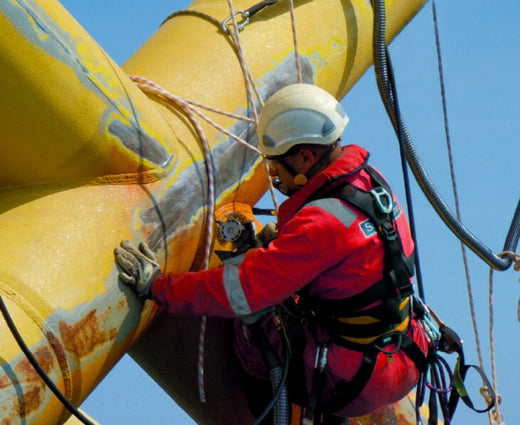
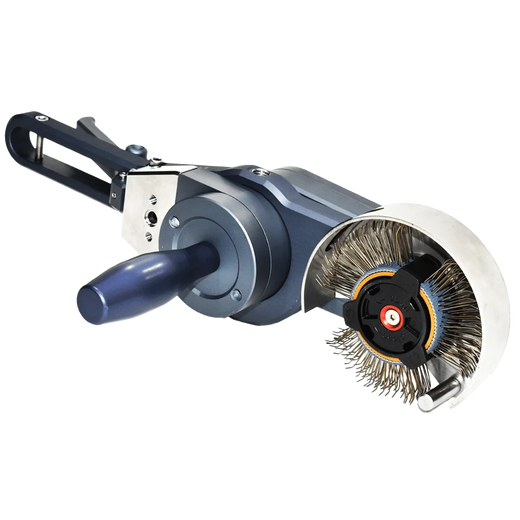
For new construction, abrasive blasting to Sa 2½ in a controlled environment is standard practice. In maintenance, particularly on operating assets, in confined spaces or in ATEX-classified zones, abrasive blasting is frequently not an option. The Bristle Blaster® mechanical preparation tool produces surface cleanliness comparable to ISO 8501-1 Sa 2½ / SSPC-SP 10 and an anchor profile of 65–85 µm Rz on standard steel in documented tests, including steel with moderate rust and partial mill scale. That meets the preparation requirements of many corrosion resistant coating systems; results vary with steel grade, rust grade, belt and technique, and the coating data sheet decides. It works without grit or blast containment, and the Bristle Blaster® Pneumatic is ATEX-evaluated (2014/34/EU, Category 2) for zone 1 gas and zone 21 dust.
Where soluble salt contamination is above the specified limit, dry mechanical preparation alone is not sufficient. A water wash or water jetting, with or without a salt remover, is usually needed to reduce salt levels before final mechanical preparation. Verify salt levels with the Bresle patch method after washing and before coating application.
Key takeaways
- Corrosion resistant coatings protect steel through barrier protection, cathodic (galvanic) protection or inhibition, and all three mechanisms depend on full adhesion to properly prepared steel.
- ISO 12944 is the international framework for corrosion protection of steel structures. It defines corrosivity categories (C1–CX and Im1–Im4), durability ranges and paint systems; most systems for C3 and above assume Sa 2½.
- Three surface preparation variables decide whether a coating system reaches its rated durability: cleanliness grade, anchor profile depth and soluble salt contamination.
- Soluble salt contamination is invisible and is not reliably removed by dry abrasive blasting. It must be tested and controlled separately.
- In maintenance work where abrasive blasting is not viable, impact-based mechanical preparation tools can deliver the cleanliness and profile required by many corrosion resistant coating systems.
Related articles
- Performance Coatings: Surface Preparation Requirements
- SSPC-SP10 Near-White Metal Blast: Complete Guide
Frequently asked questions
What surface preparation do corrosion resistant coatings need?
Most high-performance systems need blast-cleaned steel to ISO 8501-1 Sa 2½ / SSPC-SP 10, an anchor profile within the range on the coating data sheet (commonly 40–100 µm), and soluble salts below the specified limit. Thermally sprayed metal coatings commonly require Sa 3. The coating data sheet and project specification always take precedence over general guidance.
What are the ISO 12944 corrosivity categories?
ISO 12944-2 defines atmospheric categories C1 (very low) to C5 (very high) plus CX (extreme, for example offshore and tropical industrial sites), and immersion or buried categories Im1 (fresh water), Im2 (sea or brackish water), Im3 (soil) and Im4 (sea or brackish water with cathodic protection). The category drives coating system selection and durability.
Why do corrosion resistant coatings fail early?
Most premature failures trace back to the substrate, not the paint: residual rust or mill scale under the film, a profile that is too shallow or too deep for the system, and soluble salts that draw moisture through the coating and cause osmotic blistering. Correct cleanliness, profile and salt testing before application prevent most of these failures.
Can corrosion resistant coatings be applied without abrasive blasting?
Yes, where the coating data sheet and specification allow a power tool route. Impact tools such as the Bristle Blaster® produce cleanliness comparable to Sa 2½ / SSPC-SP 10 and a 65–85 µm Rz profile on standard steel in documented tests. Salt contamination still needs washing, and the result must be verified by inspection and profile measurement.
Sources
- ISO 12944-1:2017, Corrosion protection of steel structures by protective paint systems — Part 1: General introduction. iso.org
- ISO 12944-2:2017, Corrosion protection of steel structures by protective paint systems — Part 2: Classification of environments. iso.org
- KTA-Tator, Industry Standards for Surface Preparation. kta.com
- KTA-Tator, Surface Soluble Salt Remediation Practices. kta.com
- R. Dankiw, D. Fosdike, Defining Mechanical Surface Preparation Standards with Power Tools, Corrosion & Prevention 2018, Paper 74. PDF
- MontiPower technical data sheets: Bristle Blaster® Pneumatic, Ultimate Electric, Bristle Blaster® Belts Steel; product pages (specifications).