Short answer: Industrial coatings are protective systems such as epoxies, zinc-rich primers, polyurethanes, thermal spray metals, intumescents, high-temperature silicones and polyureas. Each family has its own surface preparation requirement, set by the primer and the product data sheet. Most high-performance systems call for SSPC-SP 10 / Sa 2½ with a defined anchor profile; thermal spray needs SP 10 to SP 5.
Industrial coatings are protective coating systems applied to steel and other substrates in manufacturing, processing, energy, marine and infrastructure environments to prevent corrosion, resist chemical attack, withstand elevated temperatures or provide passive fire protection. Unlike architectural paints, they are selected for measurable performance in defined service conditions, and each system type carries specific surface preparation requirements that must be met before application. This guide covers the main coating families, the preparation grade and profile each typically needs, how multi-coat systems work, and the methods used to reach those requirements. Selecting the wrong surface preparation for an industrial coating system is one of the most reliable ways to make it fail ahead of schedule.
The major industrial coating system types
Epoxy coatings
Two-component epoxy coatings are among the most widely specified industrial coating technologies. They consist of an epoxy resin component (Part A) and a polyamine or polyamide hardener (Part B) that cross-link on mixing to form a dense, chemically resistant film. Key characteristics:
- Excellent adhesion to properly prepared steel
- Strong barrier protection against water, oxygen and chloride penetration
- Resistant to many acids, alkalis and solvents
- Limited UV resistance — epoxies chalk in sunlight, so a polyurethane or polyaspartic topcoat is applied where UV resistance matters
- Dry film thickness typically 100–400 µm per coat for high-build systems
Surface preparation: SSPC-SP 10 / Sa 2½ is typical for high-performance applications. Surface-tolerant epoxy mastics are formulated to accept lower grades such as SSPC-SP 6 / Sa 2, and some accept hand or power tool cleaning (SSPC-SP 2/SP 3) for maintenance. Anchor profile: typically 40–100 µm per the product technical data sheet (TDS).
Zinc-rich primers
Zinc-rich primers protect steel through cathodic (galvanic) protection. With a high zinc loading in the dry film (commonly specified from about 65% to more than 85% by weight), zinc becomes the sacrificial anode and corrodes preferentially, protecting the steel at coating breaches. There are two categories:
- Organic zinc-rich primers (epoxy or urethane binders): the galvanic mechanism depends on particle-to-particle electrical contact between zinc pigments and direct contact between zinc and steel. Typically specified over SSPC-SP 10 / Sa 2½, because residual contamination interrupts electrical continuity; check the TDS, as some products accept SP 6.
- Inorganic zinc silicate primers: form a chemical (silicate) bond with the steel surface rather than a purely physical bond. They typically require SSPC-SP 10 / Sa 2½ up to SSPC-SP 5 / Sa 3, because the bond chemistry needs a reactive, uncontaminated steel surface.
Zinc-rich primers are frequently the first coat in a multi-coat system, followed by an epoxy intermediate coat and a polyurethane topcoat — a common offshore, bridge and structural steel specification.
Polyurethane coatings
Two-component polyurethane topcoats are applied over epoxy or zinc-rich primer systems to add UV resistance, colour retention and abrasion resistance. In most industrial specifications they are not applied directly to bare steel; the primer beneath them drives the surface preparation requirement. Polyaspartic coatings are a fast-curing variant of polyurethane chemistry, increasingly used where rapid return to service is needed.
Thermal spray coatings (TSA and TSZ)
Thermally sprayed aluminium (TSA) and thermally sprayed zinc (TSZ) are applied by arc spray or flame spray to bare steel, creating a metallic coating that provides both barrier and cathodic protection. TSA is widely used for long-life corrosion protection of offshore structures and risers. The bond between the sprayed metal and the substrate is mechanical, which makes thermal spray one of the most demanding coating systems for surface preparation. Under SSPC-CS 23.00 / NACE No. 12 / AWS C2.23M:
- The minimum cleanliness is SSPC-SP 10 / NACE No. 2 (near-white) for mild atmospheric exposure; SSPC-SP 5 / NACE No. 1 (white metal, Sa 3) is typically specified for more demanding service such as immersion and marine exposure
- Surface profile: 63–125 µm (2.5–5.0 mil), angular — produced with angular abrasive
- Spraying should start as soon as possible after blast cleaning, within the time limit in the specification and before any flash rust appears
Bristle blasting has also been studied as a preparation method for thermal spraying on repair areas; see bristle blasting as surface preparation for thermal spraying.
Coal tar epoxy
A combination of coal tar pitch and epoxy resin, producing a very high-build system with excellent water resistance. Historically it was a dominant coating for buried pipelines, underground structures and submerged steel. It has largely been superseded by modern epoxy systems in many applications because of health and environmental restrictions on coal tar. Surface preparation: typically SSPC-SP 10 / Sa 2½.
Intumescent coatings
Passive fire protection coatings that expand when exposed to heat, forming an insulating carbonaceous char that delays the temperature rise of structural steel in a fire. Fire ratings are specified in minutes (typically 30, 60, 90 or 120 minutes). Two main types:
- Cellulosic intumescents: designed for building fires with a comparatively gradual temperature rise. Thin-film systems, typically applied at up to a few millimetres DFT.
- Hydrocarbon intumescents: designed for petrochemical and offshore fires (pool fires, jet fires) with very rapid temperature rise and very high temperatures. Usually epoxy-based and considerably thicker, often many millimetres. Dominant in oil and gas.
Surface preparation: intumescents are applied over a compatible primer, and SSPC-SP 10 / Sa 2½ is typical for that primer. Uniform adhesion across the whole surface is critical because the fire rating depends on the coating staying bonded throughout the fire.
High-temperature coatings
Silicone-based and inorganic coatings for substrates operating above about 200 °C — exhaust systems, heat exchangers, fired heaters and boiler exteriors. Temperature resistance ranges from around 200 °C for modified alkyd/silicone blends to 600 °C and above for pure silicone and some inorganic or ceramic-filled systems. Surface preparation requirements vary with the product, but SSPC-SP 10 / Sa 2½ is typical for higher-temperature service.
Polyurea coatings
Fast-curing, high-build elastomeric coatings applied with plural-component spray equipment. They are used for secondary containment, water storage, pipeline rehabilitation and applications needing impact resistance and flexibility. Pure polyureas are relatively insensitive to humidity during cure, but they still need clean, dry, profiled steel (typically SSPC-SP 10 and a profile of about 40–75 µm) for adequate adhesion.
Industrial coating surface preparation requirements: reference table
| Coating system | Typical SSPC grade | ISO 8501-1 equivalent | Typical profile (µm) |
|---|---|---|---|
| Surface-tolerant epoxy mastic | SP 6 (some products SP 2/SP 3) | Sa 2 (St 2/St 3) | 40–75 |
| High-build epoxy (atmospheric) | SP 10 | Sa 2½ | 40–100 |
| High-build epoxy (immersion) | SP 10 | Sa 2½ | 50–100 |
| Organic zinc-rich epoxy primer | SP 10 | Sa 2½ | 40–75 |
| Inorganic zinc silicate primer | SP 10 to SP 5 | Sa 2½ to Sa 3 | 40–75 |
| Thermal spray aluminium (TSA) | SP 10 (mild) to SP 5 (severe) | Sa 2½ to Sa 3 | 63–125 |
| Intumescent (cellulosic/hydrocarbon) | SP 10 | Sa 2½ | 40–75 |
| High-temperature silicone | SP 10 | Sa 2½ | 40–75 |
| Coal tar epoxy | SP 10 | Sa 2½ | 40–100 |
| Polyurea (immersion/containment) | SP 10 | Sa 2½ | 40–75 |
Note: these values represent typical industry practice. Always consult the coating manufacturer's TDS for the specific product. Where the TDS and the project specification differ, apply the more stringent requirement.
Soluble salt limits
Salt contamination limits matter as much as the cleanliness grade, because chlorides left under a coating cause osmotic blistering and under-film corrosion. Limits are set by the specification or TDS and are stricter for immersion than for atmospheric service. As a reference point, the IMO Performance Standard for Protective Coatings (PSPC) for ballast tanks allows no more than 50 mg/m² (5 µg/cm²) of soluble salts as NaCl. Test with the Bresle patch method and wash the surface where results exceed the limit. See soluble salt contamination and coating failure.
Multi-coat industrial coating systems
Most industrial coating specifications use a multi-coat system rather than a single thick coat. The typical structure is:
- Primer — bonds to the prepared steel; provides initial corrosion protection or cathodic protection (zinc-rich). The primer determines the surface preparation requirement.
- Intermediate coat(s) — builds total film thickness, enhances barrier protection and ties the primer to the topcoat. Often a high-build epoxy.
- Topcoat — UV resistance, colour and abrasion resistance. Polyurethane or polyaspartic for atmospheric exposure; modified epoxy or polyurethane for splash zone service.
The surface preparation requirement for the entire system is set by the primer. A polyurethane topcoat over an organic zinc-rich primer still requires the steel to be prepared to the primer's grade (typically SP 10); the topcoat's own chemistry does not change the steel preparation requirement.
Surface preparation methods for industrial coatings
The two main routes to SSPC-SP 10 / Sa 2½ cleanliness, or cleanliness comparable to it, are:
- Abrasive blasting — the reference method; it delivers consistent results at high production rates in controlled environments and is the conventional method for thermal spray preparation (SP 10 to SP 5). It has limited applicability for maintenance on operating assets, in confined spaces and in ATEX-classified zones.
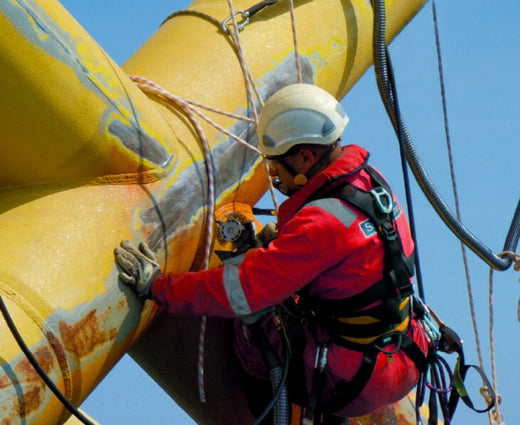
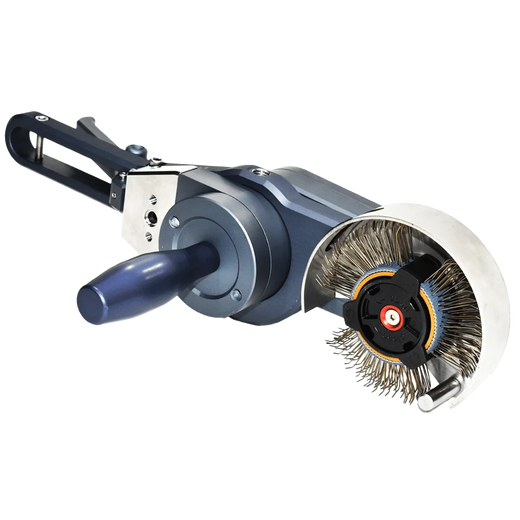
- Mechanical preparation with bristle blasting — the Bristle Blaster® produces cleanliness comparable to ISO 8501-1 Sa 2½ / SSPC-SP 10 with an anchor profile of 65–85 µm Rz on standard steel in documented tests (results vary with steel grade, rust grade, belt and technique). That fits the profile range of many of the systems above, subject to the coating manufacturer's acceptance. The pneumatic version is ATEX 2014/34/EU-evaluated for zone 1 explosive gas and zone 21 explosive dust. It suits patch repairs, field joints, maintenance on operating assets and locations where grit blasting is not viable.
Key takeaways
- Industrial coatings span several distinct technology families — epoxy, zinc-rich, thermal spray, intumescent, high-temperature, polyurea — each with different protection mechanisms and surface preparation requirements.
- SSPC-SP 10 / Sa 2½ is the typical requirement for most high-performance industrial coating systems. Thermal spray coatings require SP 10 for mild exposure and typically SP 5 / Sa 3 for severe service, with a 63–125 µm angular profile.
- The surface preparation requirement for a multi-coat system is set by the primer, not the topcoat.
- Verify anchor profile requirements in the product TDS; different formulations in the same category can have different requirements.
- Soluble salt limits are as important as cleanliness grade. Test with the Bresle patch method and treat before coating where required.
- In maintenance situations where abrasive blasting is not viable, the Bristle Blaster® provides cleanliness comparable to SSPC-SP 10 and a 65–85 µm Rz profile without grit or blast containment.
Frequently asked questions
What surface preparation do most industrial coatings require?
Most high-performance industrial coating systems, such as epoxies, zinc-rich primers and polyureas, are typically specified over SSPC-SP 10 / ISO 8501-1 Sa 2½ near-white cleanliness with a defined anchor profile, commonly 40–100 µm. Surface-tolerant mastics accept lower grades. The product data sheet and project specification always take precedence.
Does the topcoat or the primer decide the surface preparation grade?
The primer. It is the only coat in contact with the steel, so its adhesion mechanism sets the cleanliness grade, profile and salt limit. A polyurethane topcoat applied over an organic zinc-rich primer still needs the steel prepared to the zinc primer's requirement, typically SSPC-SP 10.
What surface preparation does thermal spray aluminium need?
Under SSPC-CS 23.00 / NACE No. 12 / AWS C2.23M, the minimum is SSPC-SP 10 near-white cleanliness for mild atmospheric exposure, with SSPC-SP 5 white metal typically specified for more severe service. The angular surface profile should be 63–125 µm (2.5–5.0 mil), because the sprayed metal bonds mechanically.
Can bristle blasting replace abrasive blasting before industrial coatings?
For maintenance, repairs, field joints and areas where blasting is impractical, often yes. Documented tests show cleanliness comparable to Sa 2½ / SSPC-SP 10 and a 65–85 µm Rz profile on standard steel, though results vary with steel grade, rust grade, belt and technique. Confirm acceptance with the coating manufacturer and verify the result at inspection.
Related articles
- SSPC surface preparation standards: complete guide
- Performance coatings: surface preparation requirements
- Corrosion resistant coatings: the role of surface preparation
- SSPC-SP 10 near-white metal blast: complete guide
- How to write a surface preparation specification
Sources
- KTA-Tator, Surface preparation of steel for thermal spray coatings (SSPC-CS 23.00 / NACE No. 12 / AWS C2.23M). kta.com
- KTA-Tator, Industry standards for surface preparation. kta.com
- IMO, Resolution MSC.215(82): Performance Standard for Protective Coatings (2006). dl.defelsko.com
- Corrosion Alliance, Surface preparation standards. corrosionalliance.com
- MontiPower®, Bristle Blaster® technical data sheets and ATEX conformity evaluation (Bristle Blaster® Pneumatic).