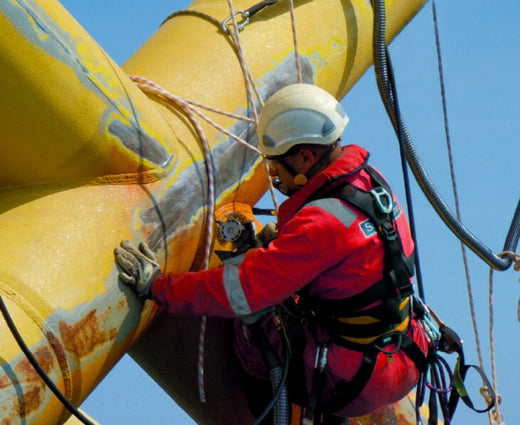
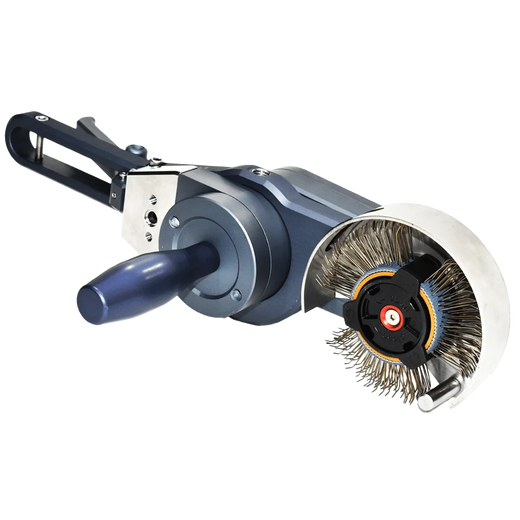
Short answer: Blast-less surface preparation lets coating companies prepare steel with hand-held impact tools instead of mobilising a blast rig. Bristle blasting gives cleanliness comparable to SSPC-SP 10 / Sa 2½ with a 65–85 µm Rz anchor profile on standard steel, meets SSPC-SP 11, and needs one operator, no loose abrasive and no blast containment. It suits repairs, in-service work and restricted sites.
For a coating company, surface preparation is rarely the technical problem: it is the line item that decides whether a small job is worth bidding. This guide is the blast-less toolkit from the contractor side: what it does to the quote, which specifications it meets, the kit a crew needs, and the scopes it opens up.
How does blast-less preparation change the economics?
A blast crew on a small repair spends much of its day on setup, containment and cleanup. In the documented Wales & West Utilities field trial, the same small-area scope took 45 person-minutes with bristle blasting against 260 with grit blasting. The difference was not that the tool cuts six times faster, but that most of the work around the cutting disappeared. That is the number that changes bids: the minimum callout shrinks, small scopes stop being loss-leaders, and one van replaces a rig.
The trade-off is area rate. On large open areas, abrasive blasting is usually faster per square metre; a single Bristle Blaster® belt typically covers about 1–1.5 m² of corroded steel, and a working speed of about 1.1 m²/h was recorded on rust grade B pipe. Blast-less tools pay off where mobilisation, containment and access dominate the cost.
Does blast-less preparation meet the specification?
Blast-less does not mean spec-less. Bristle blasting delivers visual cleanliness comparable to SSPC-SP 10 / ISO 8501-1 Sa 2½ with a 65–85 µm Rz profile on standard steel in documented tests, inside the profile window of most heavy-duty coatings. It also meets SSPC-SP 11, the power tool standard that requires bare metal and a minimum 25 µm (1 mil) profile. Results vary with steel grade, rust grade, belt and technique, which is why every area is still inspected.
Where the specification names a method (abrasive blasting) rather than a result, bring the 2018 paper on defining surface preparation standards with power tools to the conversation, and check whether the coating manufacturer accepts bristle blasting; Jotun, for example, has published a surface preparation standard for bristle blast cleaning. Then verify as you would after blasting: profile tape, visual comparator, climate readings. The Coating Inspector's Handbook covers the full sequence.
What kit does a blast-less crew need?
What a two-person coating crew actually carries:
- A Bristle Blaster® Ultimate Cordless for access work at height or in confined spaces (18 V CAS battery, about 25 minutes of preparation per 8 Ah pack, so carry spares), plus a Bristle Blaster® Ultimate Electric for sustained running where mains power is available.
- The Bristle Blaster® Pneumatic where the site is ATEX-classified: it is fully air-driven and has been ATEX-evaluated for zone 1 gas and zone 21 dust.
- Bristle Blaster® belts in steel and stainless. Stainless belts are for stainless steel and non-ferrous metals only; never use the same belts across both, to avoid contamination.
- Tercoo® discs for the heavy first pass on thick coatings and heavy rust.
- An MBX® where the substrate is thin.
- Dust extraction for occupied sites. Grit-free is not dust-free: the removed rust and coating still become particles.
- The inspection instruments that turn "prepared" into "signed off": replica tape and micrometer, visual comparator, dew point meter.
Which scopes does it open up?
In-service work without shutdowns, spark-free preparation in ATEX zones (subject to the site's permit rules), occupied facilities without containment, pipeline field joints, tank externals and weld repairs. These are scopes coating companies used to decline or subcontract; blast-less preparation brings them in-house at service margins. The two-step approach with Tercoo® followed by the Bristle Blaster® extends this to heavily corroded steel.
How to start: one crew, one quarter
The pattern that works: equip one crew, run it on your spot-repair backlog for a quarter, and compare cost per m² against your blast subcontracting. Request a quote for a starter kit, and train the crew first: technique determines results with any preparation method.
Frequently asked questions
Why do coating contractors switch to blast-less preparation?
Because on maintenance and repair scopes, much of the cost of blasting is logistics: mobilisation, containment, media handling, permits and disposal. Hand-held bristle blasting tools clean and profile with one operator and a case of equipment, so small scopes become quotable. In the Wales & West Utilities trial, bristle blasting took 45 person-minutes against 260 for grit blasting.
Can blast-less tools meet SSPC and ISO specifications?
Bristle blasting produces cleanliness comparable to SSPC-SP 10 / ISO 8501-1 Sa 2½ with a 65–85 µm Rz profile on standard steel in documented tests, and meets SSPC-SP 11 (bare metal, minimum 25 µm profile). Results vary with steel, rust grade, belt and technique, so verify with replica tape and visual standards like any preparation method.
What belongs in a blast-less surface prep kit?
A Bristle Blaster® (cordless for access work, electric for sustained running, pneumatic for ATEX areas), steel and stainless belts kept separate, Tercoo® discs for heavy build-up, an MBX® for thin substrates, dust extraction for occupied sites, and inspection instruments: replica tape, visual comparator and dew point meter.
What are the long-term benefits of blast-less preparation?
A correct anchor profile and clean steel give the coating the adhesion its design life assumes, which reduces premature failures and rework. Because bristle blasting cold-works the surface, a NACE study measured compressive residual stress in bristle-blasted steel, which resists crack initiation. Consumable cost per square metre is also predictable for budgeting.
Sources
- MontiPower, Peak Times Moments: Wales & West Utilities field trial (bristle blasting vs grit blasting).
- SSPC-SP 11, Power Tool Cleaning to Bare Metal.
- R. Dankiw, D. Fosdike, Defining Mechanical Surface Preparation Standards with Power Tools, Corrosion & Prevention 2018. PDF
- Jotun, Surface Preparation Code and Standard for Bristle Blast Cleaning and Profiling Process. PDF
- R. J. Stango, Compressive Residual Stress Generated by Bristle Blasting Process with Implication upon SCC, NACE CORROSION 2014. Semantic Scholar
- MontiPower technical data: Bristle Blaster® Ultimate Electric, Ultimate Cordless and Pneumatic; Bristle Blaster® Belts.