Short answer: Spot blasting can limit coating performance because patch repairs tend to fail at the rim, not the center. The blast stream can undercut and lift the surrounding coating, the profile fades out exactly where new coating must bond to old, and moisture enters at a poorly feathered edge. Controlled mechanical preparation lets the operator taper the transition deliberately and verify the overlap.
Spot blasting looks like the conservative choice for coating repair: blast the damage, coat the patch, keep the rest intact. But the failure pattern of patch repairs tells another story, and the reason lives at the edges. This article explains why spot blasting can limit coating performance, what the transition zone actually needs, the repair-zone rules that protect the coating, and when spot blasting is still the right tool.
The repair fails at the rim, not the center
The center of a patch repair usually gets everything right: fresh profile, clean steel, full coating thickness. The rim gets several things wrong at once. Blast media can undercut the surrounding coating and lift its edge; profile fades to nothing exactly where the new coating must bond to the old; and the feathered old coating — thin, aged, and stressed by media impact — becomes the weakest interface on the asset. Moisture finds it. The rust ring that often appears around a year-old repair — sometimes called halo corrosion — is this mechanism made visible.
Why blasting makes edges hard to control
A blast stream does not stop at a line. Even with masking, the transition from full profile to untouched coating happens over a short distance — often too abrupt for the stress the interface carries. Masking tape itself can leave a hard step where new coating laps over the old, which then has to be feathered by hand. The operator cannot modulate a media stream the way a repair edge demands, and rebounding abrasive reaches places the operator never aimed at.
There is a second limitation on in-service assets: spot blasting still needs a compressor, blast pot, abrasive supply, containment and clean-up, whatever the size of the patch. On small, scattered repairs, mobilization and containment often cost more than the preparation itself — which is one reason crews substitute wire brushes and grinders, and end up with an SSPC-SP 11 requirement they cannot meet.
The controlled-edge alternative
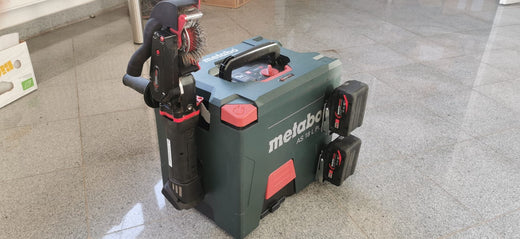
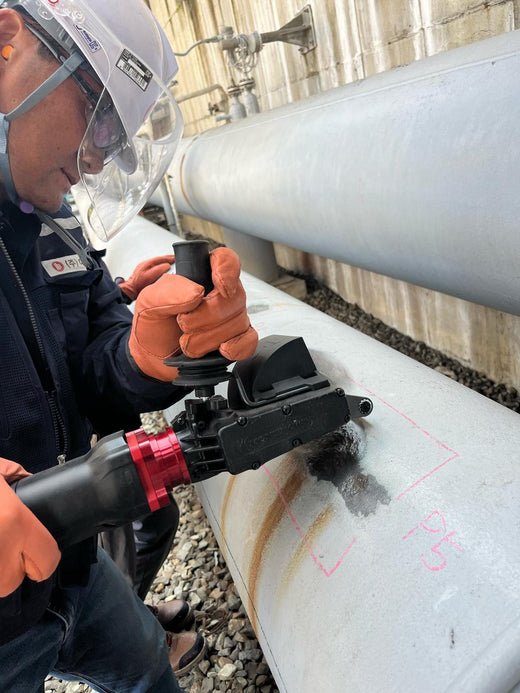
Mechanical preparation puts the transition under the operator's hand. A rotating bristle tool such as the Bristle Blaster® cleans the repair zone to bare metal and creates an anchor profile — 65–85 µm Rz on standard steel in documented tests, with cleanliness comparable to Sa 2½ / SSPC-SP 10 — then lets the operator ease off through the overlap, feathering the old coating to a gradual wedge instead of a cliff, without undercutting it. Results vary with steel grade, rust grade, belt and technique, so the profile is measured, not assumed.
The field-joint practice guide shows the technique on pipelines; the principle is the same at any scale: prepare past the damage, taper deliberately, verify the overlap. For repair strategy in general, see our spot repair overview.
Repair-zone rules that protect the coating
- Prepare past the damage. A common practice is to extend preparation about 25–50 mm beyond visible corrosion into sound coating; the project specification or coating manufacturer sets the exact margin.
- Feather the old edge. SSPC-SP 11 requires the edges of remaining intact coating to be feathered unless otherwise specified. Aim for a gradual taper the new system can bridge.
- Match the profile to the repair coating. Follow the repair coating's data sheet for the profile range — not more, not less. SSPC-SP 11 requires a minimum 25 µm (1 mil) profile with no smooth, unprofiled areas.
- Verify at the overlap, not the center. Check cleanliness, profile and dry film thickness where new coating laps onto old. That is where an adhesion test earns its minutes.
- Check compatibility. Confirm that the repair coating is compatible with the existing system, and that the old coating at the edge is sound — a quick adhesion check before preparation avoids sealing a new patch onto failing paint.
When spot blasting still fits
Large repair areas with generous transition margins, new-build touch-ups before commissioning, and yards where containment already exists. The argument here is not against blasting — it is against uncontrolled edges. Whatever cuts the profile, the transition decides the repair's life. For a broader comparison of methods, read Best Sandblasting Alternatives for Small Steel Areas.
Frequently asked questions
Why does spot blasting cause coating problems?
The edges. A spot blast can leave an abrupt transition between fresh profile and aged coating: feathered edges lift, the profile fades exactly where adhesion is weakest, and moisture creeps under the old coating rim. The result often shows up a year or so later as a rust ring, or halo, around the repair.
What is the alternative to spot blasting for repairs?
Controlled mechanical preparation. A rotating bristle tool cleans and profiles the repair zone and lets the operator feather the transition deliberately, working the overlap without undercutting the surrounding intact coating — and without blast containment on an in-service asset.
How big should a coating repair zone be?
Bigger than the damage. A common practice is to extend preparation about 25–50 mm beyond visible corrosion into sound coating, with the edge feathered to a gradual taper the new coating can bridge. The project specification or coating manufacturer sets the exact overlap.
What surface preparation standard applies to spot repairs?
Spot repairs are often specified as SSPC-SP 11, power tool cleaning to bare metal, with a minimum 25 µm (1 mil) profile and feathered edges on the remaining coating. Some systems require a result comparable to the original blast grade; the coating specification decides.
Sources
- SSPC-SP 11, Power Tool Cleaning to Bare Metal (feathering of remaining intact coating; minimum 25 µm profile; spot repair instructions, section 8.2). glavin.net
- KTA-Tator, Industry Standards for Surface Preparation. kta.com
- Dankiw, R., Defining Mechanical Surface Preparation Standards with Power Tools (2018). cactusindustrial.com