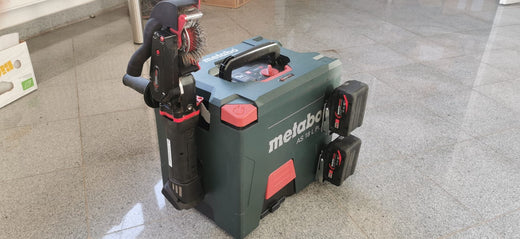
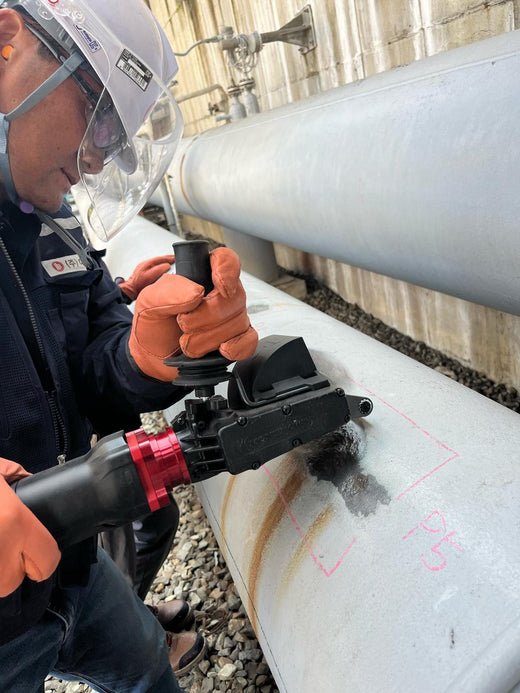
Short answer: Bristle blasting is a grit-free mechanical surface preparation method in which a rotating belt of hardened wire bristles, held back by an accelerator bar and then released, strikes steel and rebounds. Each impact removes rust, mill scale and coating and leaves a crater, so one pass gives cleanliness comparable to ISO 8501-1 Sa 2½ / SSPC-SP 10 and a 65–85 µm Rz anchor profile in documented tests.
The Grit-Free Surface Preparation Playbook includes ready-to-use specification language, standards tables, ATEX compliance guidance, and field case studies.
→ Download the PlaybookThis article explains how bristle blasting works, which surface preparation standards its results are compared against, how to measure and verify the prepared surface, when to specify it, and how to write it into a project specification. Bristle blasting is a mechanical, grit-free surface preparation method that produces cleanliness comparable to near-white metal (ISO 8501-1 Sa 2½ / SSPC-SP 10) and a controlled anchor profile without abrasive media. It is used across offshore, energy, marine and industrial maintenance where abrasive blasting is restricted, impractical or uneconomic.
What is bristle blasting?
Bristle blasting is a surface preparation technique in which a rotating belt of hardened steel wire tips strikes a steel substrate at high velocity, removing corrosion, mill scale and existing coating while creating an anchor profile in the same operation. The Bristle Blaster®, developed by MontiPower®, is the hand-held power tool built on this principle. In documented tests it produces cleanliness comparable to Sa 2½ / SSPC-SP 10 with a 65–85 µm Rz anchor profile on standard steel, without abrasive media.
The name "bristle blasting" refers to the blasting-like surface condition produced by a bristle-type tool, not to abrasive blasting. There is no grit, shot, sand or other abrasive medium involved. The surface preparation is entirely mechanical, driven by the kinetic energy of the wire tip impacts.
How bristle blasting works: the impact mechanism
Understanding bristle blasting means understanding why a rotating wire tool can achieve fundamentally different results from a wire brush. The distinction is not speed or pressure; it is mechanism.
Wire brush vs. bristle blasting: the critical difference
A conventional wire brush removes loose contamination through abrasion: the wire tips drag across the surface and scrape away what is weakly attached. Tightly adherent mill scale resists this abrasion. The result is typically SSPC-SP 2 / SP 3 (ISO 8501-1 St 2 / St 3) at best, often with a polished rather than profiled surface. SSPC-SP 3 itself states that it is not intended that adherent mill scale be removed by the process, and SSPC-SP 11 warns that power wire brushes used alone may not produce the required profile. Polishing is counterproductive for coating adhesion.
The Bristle Blaster® operates on a different principle. As the belt rotates, the wire tips are held back by an accelerator bar and then released, striking the substrate with a percussive impact rather than a dragging contact, and rebounding. Each impact is a miniature peening event: the tip fractures the mill scale or corrosion layer and creates a localised crater in the substrate surface.
What happens at the point of impact
At the instant a Bristle Blaster® tip contacts the surface, three things happen:
- Scale fracture and ejection. The impact energy fractures the brittle oxide of the mill scale or corrosion layer, and the fragment is ejected from the surface as the tip rebounds. Mill scale is hard and brittle compared with the ductile steel beneath it, so it cracks under a sharp, localised impact rather than being polished.
- Crater formation. The steel beneath the scale deforms plastically under the impact, forming a crater. The rim of the crater is displaced upward and outward, creating a peak. The combination of craters and peaks is the anchor profile, the surface texture that provides mechanical keying for the coating system.
- Compressive residual stress. The plastic deformation introduces compressive residual stress into the near-surface steel. This is the same mechanism exploited in shot peening of structural components to improve fatigue resistance. A NACE study measured compressive residual stress in bristle-blasted steel and compared it with grit-blasted references, a characteristic of the impact mechanism that wire brushing does not produce.
The Stango research: independent scientific characterisation
The bristle blasting mechanism was characterised by Professor Robert J. Stango of Marquette University in a series of conference papers published through NACE International, beginning with the 2009 paper on the fundamentals of bristle blasting and followed by a 2014 study of residual stress. This work used surface profilometry, microscopy and residual stress measurement to characterise the surface produced by the Bristle Blaster®. Key findings included a crater-based anchor profile resembling grit blasting in cleanliness and roughness, and a compressive residual stress signature. Together with independent shipyard testing (Dankiw and Fosdike, 2018) and Jotun's bristle blast cleaning standard, this is the technical basis on which bristle blasting is written into coating specifications.
Which standards are bristle blasting results compared against?
Cleanliness
Blast-cleaning grades such as ISO 8501-1 Sa 2½ and SSPC-SP 10 are defined for abrasive blast cleaning. A power tool result is therefore described as comparable to a blast grade and accepted against the project specification by the responsible inspector. In documented tests, the Bristle Blaster® produces cleanliness comparable to SSPC-SP 10 / NACE No. 2 / ISO 8501-1 Sa 2½ (near-white metal) on carbon steel with mill scale and rust grades A to D. On clean or lightly corroded steel, a result comparable to Sa 3 (SSPC-SP 5 / white metal) can be reached with additional passes. In December 2021, on a field joint coating project for Total E&P Bolivia, the specification required Sa 3 / SSPC-SP 5 and the post-preparation soluble salt reading was 1.4 µg/cm².
Results vary with steel grade, rust grade, belt condition and technique. The applicable standards definitions:
| Standard | Equivalents | Definition | Bristle Blaster® result |
|---|---|---|---|
| SSPC-SP 5 / NACE No. 1 | ISO 8501-1 Sa 3 | White metal blast: free of all visible mill scale, rust, coating and staining | Comparable result possible with additional passes; documented in field (Total E&P Bolivia) |
| SSPC-SP 10 / NACE No. 2 | ISO 8501-1 Sa 2½ | Near-white metal blast: random staining limited to 5% of each unit area | Comparable result in documented tests on API 5L steel |
| SSPC-SP 6 / NACE No. 3 | ISO 8501-1 Sa 2 | Commercial blast: staining limited to 33% of each unit area | Comparable result exceeded in normal operation |
| SSPC-SP 11 | (no direct ISO equivalent) | Power tool cleaning to bare metal: no mill scale, rust or coating; minimum 25 µm (1 mil) profile | Power tool standard; met when inspection confirms cleanliness and profile |
| SSPC-SP 3 | ISO 8501-1 St 3 | Power tool cleaning: removal of loose mill scale, rust and paint only | Exceeded in normal operation |
Anchor profile
Anchor profile is the surface texture parameter that governs mechanical adhesion of coating to substrate. Most high-performance industrial and offshore coating systems specify a minimum and maximum anchor profile on the product data sheet; the required range depends on the coating type and dry film thickness, with thicker systems and thermal spray generally calling for deeper profiles.
Bristle Blaster® anchor profile on carbon steel:
| Condition | Typical Rz (µm) | Typical Rz (mil) | Notes |
|---|---|---|---|
| Standard belt, API 5L pipe | 65–85 µm | 2.6–3.3 mil | Documented test result; within range for many epoxy systems |
| Standard belt, upper range | Up to 120 µm | Up to 4.7 mil | Depends on substrate, belt and technique |
| Mina Constancia / SEPCON (Peru, 4,100 m altitude) | SSPC-SP 10 target | — | Around 3 m²/h reported with the Bristle Blaster® Double |
Compressive residual stress
Although not typically a specification parameter in maintenance coating work, the compressive residual stress introduced by bristle blasting has engineering significance in two contexts: fatigue-sensitive pipeline or structural steel, where surface stress state affects crack initiation and growth, and rehabilitation of corroded components, where a compressive near-surface layer is beneficial. The 2014 NACE study compared the residual stress after bristle blasting with grit-blasted references; the mechanism is the same cold-working principle as shot peening.
Bristle Blaster® technical specifications
| Parameter | Single Belt | Double Belt |
|---|---|---|
| Cleanliness | Comparable to ISO 8501-1 Sa 2½ & Sa 3 / SSPC-SP 10 & SP 5 | |
| Anchor profile (typical) | 65–85 µm Rz (2.6–3.3 mil) | |
| Anchor profile (upper range) | Up to 120 µm Rz (4.7 mil) | |
| Working speed | ~1.1 m²/h (API 5L X42, rust grade B) | ~3 m²/h on flat surfaces |
| Loose abrasive | None (grit-free); cold-working, no heat input | |
| ATEX (pneumatic) | Evaluated under Directive 2014/34/EU, Category 2: zone 1 gas (IIA) and zone 21 dust (IIIC), with specified belts on the original pneumatic drive unit | |
| Drive options | Pneumatic (ATEX-evaluated); electric 230 V / 120 V; cordless 18 V (not ATEX) | |
| Compatible pre-treatment tool | Tercoo® (runs on the same drive unit) | |
| Substrate compatibility | Carbon, structural and pipeline steel with carbon steel belts; stainless steel belts and accelerator bars for aluminium and stainless steel to avoid contamination | |
Measuring and verifying bristle blasting results
All three output parameters (cleanliness, anchor profile and soluble salt contamination) should be measured and recorded before coating application. The measurement methods are standardised and the same as those used for blasted surfaces.
Cleanliness: visual comparison to ISO 8501-1
Surface cleanliness is assessed visually by comparing the prepared surface to the ISO 8501-1 photographic references for the relevant initial rust grade (A, B, C or D). For Sa 2½, the reference shows a surface free from visible mill scale, rust and coating, with any remaining traces showing only as light stains. Assessment is made in good diffuse daylight or equivalent artificial illumination, with the surface dry and free from condensation.
Because bristle blasting is a power tool method, SSPC-VIS 3 (reference photographs for power- and hand-tool cleaned steel) is a useful cross-reference alongside SSPC-VIS 1 (abrasive blast cleaning), particularly where the specification is written as SSPC-SP 11 or SP 15.
Anchor profile: replica tape method (ASTM D4417 Method C)
Anchor profile on bristle-blasted surfaces is measured using the replica tape method per ASTM D4417 Method C, the same method used for blast-profiled surfaces.
Step-by-step procedure:
- Select Testex Press-O-Film® X-Coarse grade tape (measurement range 38–115 µm / 1.5–4.5 mil); this range covers the typical 65–85 µm Bristle Blaster® result
- Peel the tape from the backing and apply to the dry, prepared surface in the area to be measured
- Burnish the tape firmly with the burnishing tool supplied in the kit until the foam has conformed to the surface and the tape appears uniformly darkened
- Remove the tape and place it between the anvils of a spring-loaded micrometer (or a digital replica tape reader)
- Read the total thickness of the foam plus the polyester carrier
- Subtract 50 µm (2 mil), the nominal incompressible carrier thickness, to obtain the surface profile (most digital readers do this automatically)
- Take the number of readings required by the specification per representative area (commonly several readings averaged per location); record the mean and range
- Retain compressed tape replicas as a record; label with date, location, operator and reading
Expected readings for Bristle Blaster® on API 5L steel: micrometer 115–135 µm, giving a profile of 65–85 µm after carrier subtraction. Readings outside this range should be investigated: consistent low readings may indicate insufficient passes or belt wear; consistent high readings may indicate a softer substrate or extra passes. Note that replica tape reports an average maximum peak-to-valley height, which is close to, but not identical with, a stylus Rz value.
Salt contamination: Bresle patch method
Soluble salt contamination should be measured after surface preparation and before coating application on any surface that has been exposed to marine, offshore or industrial atmospheric conditions. The Bresle patch method (ISO 8502-6, with conductometric analysis to ISO 8502-9) is the most widely used field method:
- Adhere the self-adhesive Bresle patch to the prepared surface
- Inject a measured volume of deionised or distilled water (typically 3 ml for a standard patch) through the foam seal
- Massage the patch to dissolve surface salts into the water, then withdraw and re-inject the solution several times
- Withdraw the solution and measure conductivity using a calibrated conductivity meter
- Convert the conductivity reading to a surface density of soluble salts using the ISO 8502-9 method or the instrument's built-in conversion
Acceptance limits are set by the coating manufacturer and the project specification and vary with service conditions; immersion service generally demands lower limits than atmospheric exposure. On the Total E&P Bolivia field joint project, 1.4 µg/cm² (14 mg/m²) was measured after Bristle Blaster® preparation. MontiPower's M-TESTCO® range includes portable inspection instruments for this work.
When to specify bristle blasting
Bristle blasting is a strong specification choice when one or more of the following conditions apply to the project.
ATEX zone 1 or zone 2 classified area
The Bristle Blaster® Pneumatic is fully pneumatic with no electrical parts and has been evaluated under ATEX 2014/34/EU as Category 2 equipment for zone 1 gas and zone 21 dust, in combination with specified belts. Few hand-held tools combine ATEX evaluation with a profiling, bare-metal result, which makes it a practical option where the coating specification asks for a result comparable to SP 10 inside a classified area. Mechanical preparation on steel can still produce sparks: whether the work proceeds is decided by the site operator's zoning, risk assessment and permit system.
No abrasive blasting infrastructure available
Remote pipeline sections, offshore in-service scopes, vessels underway and emergency repair situations where a blast pot and high-capacity compressor cannot be mobilised. The Bristle Blaster® runs from a compressed-air supply, mains power or an 18 V battery and is a single-operator, hand-held tool.
Spot repair and localised maintenance
For coating failures at welds, fasteners, support clamps, nozzle areas and damage points, which make up a large share of maintenance scopes, the mobilisation cost of abrasive blasting is high relative to the area treated. In the Wales & West Utilities field trial, a small-area corrosion repair took 45 person-minutes in total with the Bristle Blaster® against 260 person-minutes with grit blasting, mostly because of set-up and clean-up.
No containment available or permitted
Bristle blasting needs no blast enclosure because there is no abrasive stream. The debris produced (fractured scale, rust and coating particles) is largely coarse and settles close to the work area, so environmental management centres on collecting debris from the immediate work zone rather than tenting and spent-abrasive disposal. Grit-free is not dust-free, though: fine particles of the removed material still become airborne, so extraction and respiratory protection should follow the site risk assessment, especially where old coatings may contain lead or chromium-6.
Pipeline field joint coating preparation
Bristle blasting is specified as the primary or backup preparation method for field joint coating on onshore and offshore pipelines. On girth welds, it removes mill scale and weld oxidation from the weld cap and heat-affected zone, creates the anchor profile for the field joint coating system (heat-shrinkable sleeve, liquid epoxy or cold-applied tape), and provides cleanliness comparable to the SP 10 or SP 5 grade required by the joint coating procedure.
In-service maintenance on operating assets
Where production cannot be interrupted for blasting, bristle blasting allows maintenance to run adjacent to live process equipment, subject to the site's permit system. This is why it is used by operators and contractors in oil and gas, petrochemical and chemical plants for routine maintenance scopes on operating assets.
How to write bristle blasting into a project specification
The following specification language is provided as a starting point. It should be adapted to the specific coating system, substrate and project requirements. Always cross-reference with the coating manufacturer's product data sheet, which defines the required cleanliness grade, the anchor profile range and the maximum soluble salt level for the product being applied.
Surface preparation shall be carried out using a Bristle Blaster® rotary-impact power tool (MontiPower) to achieve cleanliness comparable to ISO 8501-1 Sa 2½ / SSPC-SP 10 (near-white metal) as a minimum, assessed visually by the inspector against ISO 8501-1. Anchor profile shall be measured to ASTM D4417 Method C using Testex Press-O-Film® X-Coarse replica tape and shall be within the range [x–y µm] required by the coating data sheet. Soluble salt contamination shall be tested per ISO 8502-6 / ISO 8502-9 (Bresle patch method) and shall not exceed [limit] mg/m². Coating application shall commence within [time] of surface preparation completion, or before visible re-rusting, whichever is sooner. In ATEX classified areas, only the Bristle Blaster® Pneumatic with its specified ATEX belts shall be used, subject to the site permit.
Notes for specifiers:
- If the coating system requires Sa 3 / SSPC-SP 5, specify additional Bristle Blaster® passes and include a hold point for QC inspection before coating.
- For surfaces with heavy pre-existing corrosion or thick coating build-up, specify Tercoo® pre-treatment (same drive unit as the Bristle Blaster®) before Bristle Blaster® profiling. This is the Two-Step Method.
- Cite the Stango/NACE papers, the Dankiw and Fosdike (2018) study and Jotun's bristle blast cleaning standard in the specification basis document to establish the technical foundation for the method.
- Verify that the coating system product data sheet accepts a mechanically prepared surface at the specified anchor profile. Many modern epoxy systems do; some older zinc silicate systems were written assuming blast-only preparation.
Common misunderstandings about bristle blasting
"It's just a fancy wire brush"
The most common misconception. A wire brush removes loose contamination through dragging abrasion and reaches SSPC-SP 2 to SP 3. The Bristle Blaster® removes tightly adherent mill scale through percussive impact and produces a result comparable to SP 10. The mechanism, and the result, are categorically different. The Stango research characterised this distinction at a materials science level, and shipyard tests by Dankiw and Fosdike measured 30–40 µm with a grinder and flap disc against 50–80 µm with a bristle blasting tool on the same steels.
"It won't hold up on heavy corrosion"
On surfaces with heavy laminated corrosion, a single Bristle Blaster® pass takes longer and consumes belt life faster. The practical approach is the Two-Step Method: Tercoo® pre-treatment to remove bulk corrosion, followed by the Bristle Blaster® for cleanliness and profile. The Tercoo® mounts on the same drive unit, so it is not a separate mobilisation.
"The profile isn't as good as blast"
On standard API 5L carbon steel, the Bristle Blaster® produces 65–85 µm Rz in documented tests, within the profile range specified for many high-build epoxy and intermediate coat systems. Blast profile depends heavily on the abrasive: steel shot gives a rounded, generally shallower profile and angular grit a deeper, sharper one. The Bristle Blaster® profile is not identical in morphology to a blast profile, but it falls within the profile specification of the coating systems it is used with. Always confirm the measured profile against the coating data sheet.
"It doesn't work in zone 1 — all power tools are excluded"
ATEX evaluation is product-specific, not a generic property of pneumatic tools. The Bristle Blaster® Pneumatic has undergone an ignition-hazard assessment and ATEX 2014/34/EU conformity evaluation as Category 2 equipment for zone 1 gas and zone 21 dust, with the marking applying to specified belts in combination with the original pneumatic drive unit. Site rules and hot-work permits still apply.
Frequently asked questions
Does bristle blasting meet SSPC-SP 10?
SSPC-SP 10 / Sa 2½ is written for abrasive blast cleaning, so a bristle-blasted surface is assessed as comparable to SP 10 rather than as SP 10 itself. Documented tests show cleanliness comparable to Sa 2½ / SP 10 on carbon steel with mill scale and rust. Acceptance is set by the coating specification and the inspector; results vary with steel grade, rust grade, belt and technique.
What anchor profile does bristle blasting produce?
In documented tests on API 5L pipeline steel, the Bristle Blaster® produces 65–85 µm Rz (2.6–3.3 mil), with up to 120 µm Rz possible depending on substrate and belt. Measure it to ASTM D4417 Method C with X-Coarse replica tape (38–115 µm range), subtracting the 50 µm (2 mil) incompressible film from the gauge reading.
Is bristle blasting ATEX certified?
The Bristle Blaster® Pneumatic has been evaluated under ATEX Directive 2014/34/EU as Category 2 equipment for zone 1 gas (IIA) and zone 21 dust (IIIC), in combination with specified belts. The electric and cordless models are not ATEX-evaluated. Whether work may proceed in a classified area is still decided by the site's zoning, risk assessment and permit system.
How long does bristle blasting take?
MontiPower quotes around 1.1 m² per hour for a single-belt unit on API 5L pipe (rust grade B) and around 3 m² per hour for the double-belt units on flat surfaces. Actual rates depend on steel hardness, rust grade, coating type and thickness, and operator technique. On small repairs the time saved is mostly in set-up and clean-up.
What is the difference between bristle blasting and wire brushing?
A wire brush drags across the surface and removes loose material, typically to SSPC-SP 2 / SP 3, and can polish the steel. Bristle blasting uses accelerated wire tips that strike and rebound, fracturing tightly adherent mill scale and rust and leaving a crater-type anchor profile. It is an impact method, not an improved brush.
Can bristle blasting replace sandblasting in a coating specification?
Often, for maintenance, spot repair and field joints, where the specification is written around the result: cleanliness grade, anchor profile and soluble salt limit. Where a specification names abrasive blasting as the method, the owner or coating manufacturer must approve the change. Confirm that the coating data sheet accepts a power-tool-prepared surface at the measured profile.
Who uses bristle blasting?
Bristle blasting is used by pipeline operators, coating contractors, shipyards and plant maintenance teams in oil and gas, petrochemical, marine, offshore and infrastructure work. Published MontiPower case studies include field joint coating for Total E&P Bolivia, weld-seam preparation on a Shell unit and a Wales & West Utilities field trial.
Related resources
- How to Remove Mill Scale from Steel: Tools, Methods, and Specifications — Why mill scale must be removed and which tools reach bare-metal grades.
- Alternatives to Sandblasting Steel: Complete Method Comparison — Every alternative compared across ATEX suitability, standards, production rate and cost.
Our technical team can provide project-specific guidance on cleanliness requirements, anchor profile targets, ATEX compliance documentation, and coating system compatibility.
→ Request Technical SupportSources
- R.J. Stango et al., Bristle blasting fundamentals, NACE CORROSION 2009 conference paper, and NACE residual stress study (2014); summaries on the MontiPower bristle blasting fundamentals and residual stress pages. content.ampp.org
- R. Dankiw, D. Fosdike, Defining Mechanical Surface Preparation Standards with Power Tools, Corrosion & Prevention 2018. cactusindustrial.com
- Jotun, Surface Preparation Code and Standard for Bristle Blast Cleaning and Profiling Process (BIPoT). cactusindustrial.com
- SSPC-SP 11, Power Tool Cleaning to Bare Metal, and SSPC-SP 3, Power Tool Cleaning. glavin.net
- KTA-Tator, Industry Standards for Surface Preparation. kta.com
- DeFelsko, Testex replica tape (Coarse 20–50 µm, X-Coarse 38–115 µm). defelsko.com
- MontiPower, Bolivia, ready for coating No. 2 (Total E&P Bolivia, Dec 2021) and Peru, ready for coating No. 3 (Mina Constancia / SEPCON) case reports; Bristle Blaster® technical data sheets and ATEX documentation.