Short answer: The main alternatives to sandblasting are other blast media (soda, glass bead, dry ice), water jetting and grit-free power tools. For steel that needs both a clean surface and an anchor profile, the MontiPower® Bristle Blaster® gives cleanliness comparable to Sa 2½ / SSPC-SP 10 with a 65–85 µm Rz profile in documented tests. The MBX® is designed for vehicle body panels.
Preparing and cleaning surfaces can be a difficult and time-consuming job, for example when removing corrosion, paint or other coatings. These layers are often removed by sandblasting. Blasting with sand has been used for many years, but it has drawbacks. This article explains what sandblasting is, why many users look for an alternative, how soda blasting compares, and where MontiPower® power tools fit: the Bristle Blaster® for steel and the MBX® for vehicle bodywork.
What is sandblasting?
Sandblasting is the cleaning and preparation of surfaces to remove rust, paint, mill scale or other contamination. It is the best-known form of abrasive blasting, a family that also includes blasting with grit, steel shot or copper slag. By propelling a mixture of abrasive and compressed air at high velocity against an object, an abrasive effect is created that breaks the layer away from the surface.
In addition to the cleaning effect, blasting roughens the surface. As a result, it is used not only for cleaning but also for creating an anchor profile: the impact of the abrasive leaves a textured surface that gives a new coating a good mechanical key. This is why abrasive blasting is the traditional method for preparing steel before painting.
Why use an alternative to sandblasting?
Although sandblasting has been done for a long time, its dangers are now well documented. Firstly, sandblasting is not suitable for every surface. It is aggressive, so thin or soft objects can be damaged quickly. This is one reason why it needs careful set-up and trained operators.
Secondly, it is harmful to health. When sand hits the surface at high speed, the grains break up into fine particles. Where the sand contains crystalline silica, inhaling the respirable fraction can cause silicosis and other serious lung disease. Exposure is regulated: in the US, OSHA sets a permissible exposure limit for respirable crystalline silica of 50 µg/m³ (8-hour TWA), and in the EU, Directive (EU) 2017/2398 sets a binding limit of 0.1 mg/m³. Several countries restrict or prohibit silica sand as a blasting abrasive, so other blast media are used instead.
Thirdly, every blasting method creates a waste stream of spent abrasive mixed with the removed coating, and needs containment, a compressor, a blast pot and clean-up. Changing the abrasive does not remove those costs. That is why grit-free power tools are now a practical alternative for many jobs.
Is soda blasting better than sandblasting?
One alternative blasting technique is soda blasting. It uses sodium bicarbonate granules instead of sand. Is it better? It depends on the job:
- Advantages: no crystalline silica; the media is relatively soft, so it can strip paint from delicate substrates with little damage; and the media is water-soluble.
- Disadvantages: it still produces dust from the media and the removed coating, so respiratory protection is still needed; residue must be rinsed off before painting; and it does not create an anchor profile on steel.
- Productivity: on rust and tight coatings on steel, harder abrasives work considerably faster, especially in industrial applications.
So soda blasting has advantages, but also clear limits compared to sandblasting. MontiPower® takes a different route with the Bristle Blaster® and the MBX®: mechanical tools that remove corrosion and coatings without any loose blast media.
The alternative to sandblasting: Bristle Blaster® and MBX®
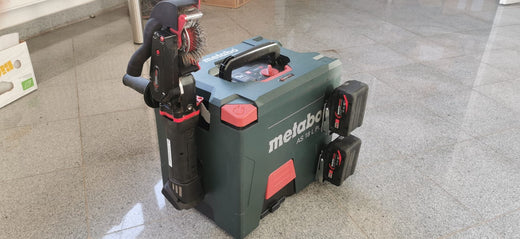
With MontiPower® power tools there is no sand, no blast pot and no abrasive to collect. The Bristle Blaster® and the MBX® remove corrosion and other layers quickly, and their patented belt technology also leaves a surface that is ready for coating. The two tools are designed for different substrates:
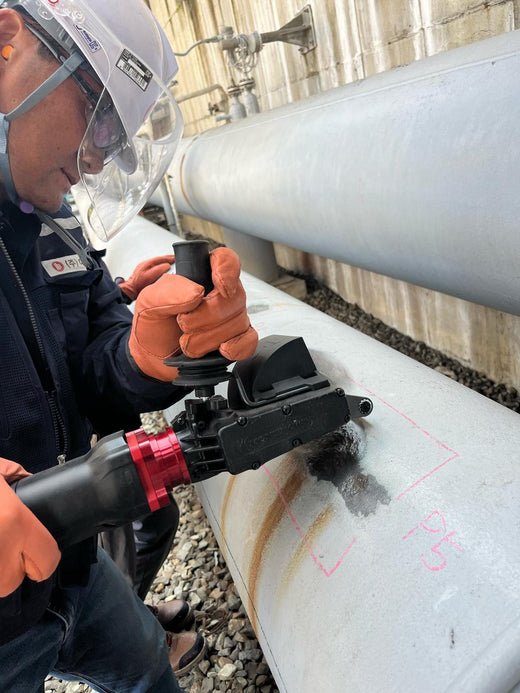
- Bristle Blaster®: for steel. It removes rust, coatings and mill scale and creates an anchor profile in one pass, with cleanliness comparable to ISO 8501-1 Sa 2½ / SSPC-SP 10 and a 65–85 µm Rz (2.6–3.3 mil) profile on standard steel in documented tests.
- MBX®: for vehicle body panels and similar thin substrates. It removes rust, paint, underseal, sealants and adhesives without heat or warping. It is not intended for preparing structural steel to a profiled grade.
Results vary with steel grade, rust grade, belt and technique. Where a specification calls for a blast grade, the result of a power tool is assessed as comparable to that grade, and the specification should name it as an accepted method.
How do the alternative sandblasting tools work?
Both tools are hand-held and drive a rotating belt of hardened, curved wire bristles, but the mechanism differs:
- On the Bristle Blaster®, an accelerator bar holds the bristles back and then releases them, so the tips strike the surface with kinetic energy comparable to grit blast media. Immediately after impact the tips rebound. This removes corrosion and leaves micro-indentations that form the anchor profile, a texture and visual cleanliness similar to grit blasting.
- On the MBX®, the flexible bristles spin outward by centrifugal force and work on a cushion of air. This cleans evenly over uneven panels without grinding away the substrate. MBX® belts are color-coded: black (coarse) for underseal, ocher (medium) for rust, green (fine) for paint, and blue (stainless steel bristles) for non-ferrous metals.
Each belt type only works on its matching drive unit, because the speed and, on the Bristle Blaster®, the accelerator bar are matched to the belt.
Alternative to sandblasting metal and rust
In the metal industry, sandblasting has been the standard for preparing metal products for decades. However, it is no longer the only way to clean metal. On steel structures, pipelines and tanks, the Bristle Blaster® removes rust and mill scale and profiles the steel in one step, without containment or abrasive disposal. It is particularly useful for spot repairs, weld seams, field joints, confined spaces and live plant, where setting up a blast operation costs more than the preparation itself. The Bristle Blaster® Pneumatic is fully pneumatic and ATEX-evaluated for zone 1 explosive gas and zone 21 explosive dust.
For large, open, new-build areas, abrasive blasting is usually still faster. For a full comparison of every method, see alternatives to sandblasting steel.
Alternative to sandblasting cars
Sandblasting is also used in vehicle restoration and repair to strip paint from the body before refinishing. However, it carries risks: thin body panels can warp or be damaged, and abrasive gets into seams and cavities. So what is the alternative to sandblasting cars?
MONTI has been developing surface preparation tools since 1987 and has long worked with the automotive sector, so we know how vulnerable body panels are during repair and surface preparation. The MBX® range, available in pneumatic, electric and cordless versions, is our alternative to sandblasting cars. It removes paint, rust and underseal without heat and without loose media, and leaves a surface that paint adheres to. That means a more controlled process and less rework. See mobility and OEM applications.
How do I remove paint without sandblasting?
Not just in the automotive industry, but in other markets too, removing paint and other coatings is a delicate job that must be done with precision. It is often done by blasting, although that is not possible on every surface, and stubborn coatings can tempt the operator into an aggressive approach that damages the object. So how do you remove paint without sandblasting?
With the MBX® and its green paint-removal belt, paint and lacquer come off body panels in a controlled way, and the surface is cleaned without being ground away. On steel that will be recoated with a protective system, the Bristle Blaster® removes the coating and creates a fresh anchor profile in the same pass. For vinyl, decals and adhesive residue on intact paint, such as on signage and vehicle fleets, the Vinyl Zapper® removes the film without damaging the paint underneath.
MontiPower® power tools are also used in weld cleaning, oil and gas, pipelines, and the marine and offshore sector.
Frequently asked questions
What is the best alternative to sandblasting steel?
It depends on the grade the coating specification requires. For bare metal with an anchor profile, impact tools such as the Bristle Blaster® are the closest alternative, with cleanliness comparable to Sa 2½ / SSPC-SP 10 and a 65–85 µm Rz profile in documented tests. For removing loose rust and old paint only, conventional power tools are often enough.
Is soda blasting safer than sandblasting?
Soda blasting avoids silica sand, which removes the main silica exposure risk, but it is not hazard-free. It still produces dust from the media and the removed coating, needs respiratory protection, and leaves sodium bicarbonate residue that must be rinsed off. It also does not create an anchor profile on steel.
Can the MBX® replace sandblasting on steel structures?
No. The MBX® is designed for cleaning car body panels and similar thin substrates, where it removes rust, paint, underseal and sealants without heat or warping. It is not intended to prepare structural steel to a profiled grade. For steel that needs an anchor profile, use the Bristle Blaster®.
How do I remove paint from a car without sandblasting?
Use a tool that removes paint without heat and without loose media. The MBX® with a green (fine) belt is intended for paint removal on body panels, the ocher (medium) belt for rust and the black (coarse) belt for underseal. For vinyl, decals and adhesive residue on intact paint, the Vinyl Zapper® is the better choice.
Sources
- OSHA 29 CFR 1926.1153, Respirable crystalline silica. osha.gov
- Directive (EU) 2017/2398, respirable crystalline silica limit value. stopcarcinogensatwork.eu
- R. Dankiw, D. Fosdike, Defining Mechanical Surface Preparation Standards with Power Tools, Corrosion & Prevention 2018, Paper 74. PDF
- R. J. Stango et al., Fundamentals of Bristle Blasting Process for Removing Corrosive Layer, NACE CORROSION 2009. AMPP abstract
- MontiPower®, Bristle Blaster® and MBX® product data and FAQs; Bristle Blaster® Pneumatic ATEX evaluation (2014/34/EU).