Short answer: For coating-ready results on small steel areas, bristle blasting is the closest rotating alternative to sandblasting: documented tests show cleanliness comparable to ISO 8501-1 Sa 2½ and a 65–85 µm Rz anchor profile with no loose media. Tungsten carbide discs remove heavy build-up first; MBX® suits thin sheet; wire brushes, flap discs and needle scalers rarely meet a coating profile spec on their own.
Sandblasting a 2 m² repair means mobilizing a blast pot, media, containment and often a second operator, for a job where the actual cleaning takes minutes. That mismatch is why small-area steel work has moved to rotating rust removal alternatives. Below are the options that work, the honest limits of each, a side-by-side comparison and a short FAQ.
What a coating specification asks of a small area
The tool has to meet the preparation grade on the coating data sheet, not just remove visible rust. For most protective coatings that means two things: cleanliness (bare metal, comparable to ISO 8501-1 Sa 2½ or SSPC-SP 11 for power tools) and an anchor profile, at least 25 µm (1 mil) under SSPC-SP 11 and often more on the product data sheet. SSPC-SP 11 itself warns that power wire brushes or sanding discs used alone may not produce the required profile and may degrade an existing one. That is the yardstick for every tool below.
1. Bristle Blaster®: the coating-ready one
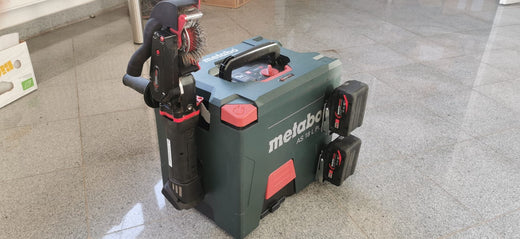
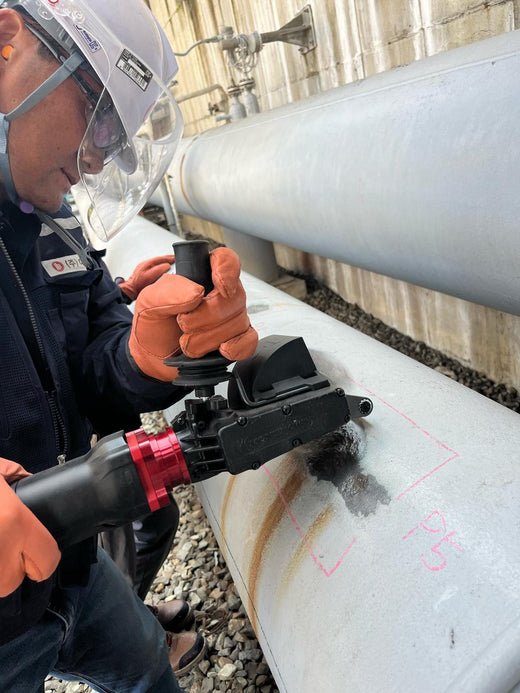
Forward-angled bristle tips, held back by an accelerator bar, strike the steel with kinetic energy comparable to grit impact, then rebound. The result is what most other rotating tools cannot produce: simultaneous rust removal and a measured 65–85 µm Rz anchor profile on standard steel, described in NACE conference research on bristle blasting. Cleanliness is comparable to ISO 8501-1 Sa 2½ (up to Sa 3 depending on belt and technique); results vary with steel grade, rust grade, belt and technique. It is hand-held and single-operator, with electric, pneumatic and cordless drives; the pneumatic version is ATEX-evaluated for zone 1 gas and zone 21 dust, for areas where blasting would need hot-work or containment permits. This is the tool for local rust removal where a coating follows: pipeline spot repair, weld zones, flange faces, touch-ups. See the Ultimate Electric or the full Bristle Blaster® range.
2. Tercoo® rotating discs: the heavy-removal pre-step
Tercoo® tungsten carbide pin discs strip thick rust, scale, bitumen and multi-layer coatings without generating heat, leaving a roughened surface. On heavy build-up they remove bulk faster than bristles, which load up on thick material. Where the coating needs a defined, uniform anchor profile, follow with a profiling pass, as step one of the MontiPower two-step preparation method.
3. MBX® with coarse belts: thin coatings and sheet metal
The MBX® system removes rust, paint, underseal, sealants and adhesives from car body panels and other thin substrates without heat or warping. Color-coded MBX® belts match the grade to the job: black for underseal, ocher for rust, green for paint, blue stainless for aluminium and stainless. On body panels the coarse and medium belts leave a finish similar to sandblasting. MBX® is not designed for preparing structural steel to a protective coating specification; use the Bristle Blaster® for that.
4. Rotating wire brushes: cleaning, not preparation
Cheap and everywhere, but the honest engineering: wire brushes burnish. They polish rust and mill scale as often as they remove it, and SSPC-SP 11 notes that power wire brushes used alone may not produce the required profile and may degrade an existing one. See the full wire brush vs preparation machine comparison. Fine for de-rusting a gate hinge; wrong for anything that gets a protective coating.
5. Flap discs and grinders: metal removal, limited profile
Fast on welds and edges, but they abrade the substrate itself, put heat into the steel and leave a shallow, irregular scratch pattern rather than a uniform profile. In an independent shipyard comparison (Dankiw and Fosdike, ASC Shipbuilding, 2018), a #36 grit grinder and a #40 flap disc produced 30–40 µm, against 50–80 µm from a bristle blasting tool on the same steels. Use them for fabrication finishing and weld dressing; check the profile before relying on them for coating preparation.
6. Needle scalers: impact, but uneven
Needle guns are impact tools named in SSPC-SP 11 and work well on heavy scale, weld spatter and corners. The profile they leave is coarser and less predictable than bristle blasting, and they are slow on open areas and noisy and vibrating to use. They fit small, awkward areas of heavy scale rather than general coating preparation. How rotating tools compare is covered in removing mill scale from small steel areas.
Side by side
| Tool | Blast-like profile | Dust | Coating-ready |
|---|---|---|---|
| Bristle Blaster® | Yes: 65–85 µm Rz (documented tests) | Low (extraction hood available) | Yes, comparable to Sa 2½ |
| Tercoo® discs | Roughened, not a defined profile | Low–medium | After profiling pass where a profile is specified |
| MBX® | Light; sandblast-like finish on body panels | Low | Body panels and thin sheet, not structural steel specs |
| Wire brush | No: burnishes | Low | No |
| Flap disc / grinder | Partial: 30–40 µm in one shipyard test | Medium | Only if the profile meets the spec |
| Needle scaler | Coarse, uneven | Medium | Heavy scale and corners; check profile |
When small-area blasting still wins
If the specification demands a specific blast media signature, or the small area is actually hundreds of square metres of continuous plate, conventional blasting keeps its place; see the full alternative-to-sandblasting comparison for the economics. For local work, rotating preparation removes the mobilization problem. Whatever the method, grit-free is not dust-free: the removed rust and coating still become particles, so use extraction and appropriate PPE, especially on old coatings that may contain lead or hexavalent chromium.
Frequently asked questions
What is the best alternative to sandblasting for small steel areas?
For small, local steel areas that will be coated, rotating bristle blasting tools are the closest functional replacement. The Bristle Blaster® produces cleanliness comparable to ISO 8501-1 Sa 2½ and a 65–85 µm Rz anchor profile in documented tests, with no loose media and no blast containment. Results vary with steel grade, rust grade, belt and technique.
Do rotating rust removal tools achieve blast-like roughness?
Only tools designed for impact. Bristle tips held back by an accelerator bar strike and rebound, producing measured 65–85 µm Rz profiles. Wire brushes mainly burnish, and grinders and flap discs gave only 30–40 µm in one shipyard comparison, so they may miss a coating specification that calls for a deeper, uniform profile.
Which sandblasting alternative produces the least dust?
Mechanical rotating tools produce far less airborne dust than open blasting because there is no media stream. Grit-free is not dust-free, though: the removed rust and coating still become particles. Use a dust extraction hood, and treat old coatings that may contain lead or hexavalent chromium as hazardous whatever the method.
Does a bristle-blasted surface meet SSPC-SP 10?
SSPC-SP 10 and Sa 2½ are defined for abrasive blast cleaning, so a power-tool result is described as comparable to those grades and accepted against the project specification by the inspector. Power-tool work is typically specified under SSPC-SP 11, which requires bare metal and at least a 25 µm (1 mil) profile.
Sources
- SSPC, SSPC-SP 11, Power Tool Cleaning to Bare Metal. glavin.net
- R. Dankiw, Defining Mechanical Surface Preparation Standards with Power Tools (2018). cactusindustrial.com
- NACE International, CORROSION 2009 conference paper on bristle blasting fundamentals (2009). content.ampp.org
- MontiPower, Bristle Blaster®, MBX® and Tercoo® product pages and technical data sheets (65–85 µm Rz on API 5L steel in documented tests; Pneumatic ATEX-evaluated zone 1 / zone 21).