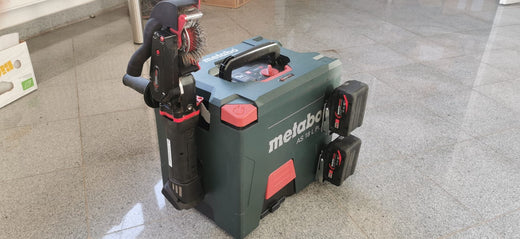
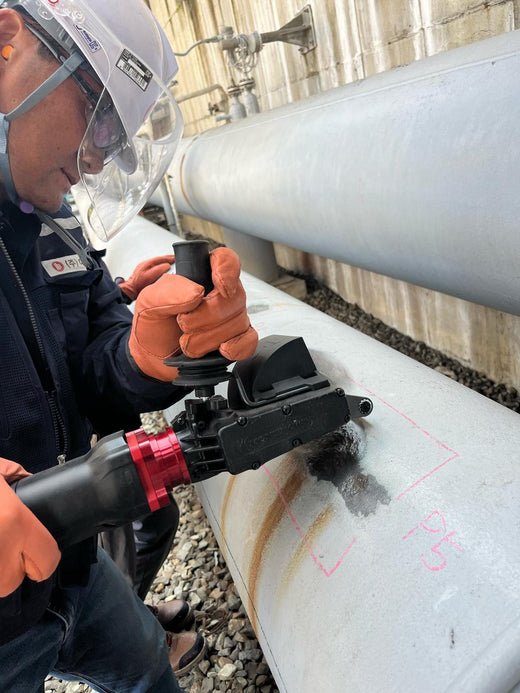
Short answer: Sandblasting is the reference method and remains faster on large open areas, but SSPC-SP 10 is written for blast cleaning. The Bristle Blaster® gives cleanliness comparable to Sa 2½ / SSPC-SP 10 and a 65–85 µm Rz anchor profile on API 5L steel in documented tests, without abrasive or blast containment. It is the better fit for spot repairs, field joints, live plant and ATEX zones.
When a project specification calls for SSPC-SP 10 and abrasive blasting is not available, restricted or excluded, engineers and maintenance managers face a straightforward question: can the Bristle Blaster® from MontiPower® replace sandblasting, and how do the results compare?
This comparison is based on published independent research, a coating manufacturer's published standard and documented field results. It covers the parameters that matter to coating specifiers: cleanliness grade, anchor profile, adhesion pull-off, hazardous-area use and operational logistics.
The core difference: impact vs. abrasion
Sandblasting propels abrasive particles (steel grit, aluminium oxide, garnet, copper slag) at high velocity against the steel surface. The particles cut and abrade the metal, removing corrosion products and roughening the surface. It is a well-established, reliable method, but it needs abrasive media, containment of spent media, dust control and significant logistics.
The Bristle Blaster® works by a different mechanism: wire tip impact. Hardened steel wire bristles on a rotating belt run at an operating speed of 2,300 rpm (±5%). An accelerator bar holds the bristles back and releases them, so the tips strike the surface and rebound, each strike leaving a small crater. The cumulative effect of a very large number of impacts is a non-directional, peak-dense anchor profile, produced without any abrasive media.
The practical consequence: the Bristle Blaster® can be used without blast containment and without spent media disposal, and the ATEX-evaluated pneumatic version can be used in explosive atmospheres where open blasting is normally only possible under a hot-work permit.
Side-by-side technical comparison
| Parameter | Sandblasting | Bristle Blaster® |
|---|---|---|
| Maximum cleanliness grade | SSPC-SP 5 / Sa 3 (white metal) | Comparable to Sa 2½ (ISO 8501-1) / SSPC-SP 10 in documented tests; results comparable to Sa 3 / SP 5 reported in field use (Total E&P Bolivia, 2021) |
| Anchor profile | Wide range, set by abrasive type, size and blast pressure | 65–85 µm Rz (2.6–3.3 mil) on API 5L steel in documented tests; up to 120 µm Rz possible. Values vary with steel grade, rust grade, belt and technique |
| Profile pattern | Angular (grit) or rounded (shot), non-directional | Crater-like impact profile, non-directional |
| Hazardous areas (ATEX zone 1) | Normally treated as hot work; gas-free area and hot-work permit required | Pneumatic model ATEX-evaluated for zone 1 gas (IIA, T4) and zone 21 dust; marking II 2G c IIA T4 X for specific belts on the original Pneumatic drive |
| Abrasive media required | Yes: grit, sand, garnet, slag | No |
| Containment required | Yes: blast enclosure, vacuum blasting or containment sheeting | No blast containment; removed debris and dust controlled per the risk assessment |
| Dust generation | High: abrasive dust plus removed rust and coating | Lower: removed rust and coating particles only, no abrasive dust. Grit-free is not dust-free |
| Spent media disposal | Required; can be classified as hazardous waste where old coatings contain lead or chromates | No spent media; removed material and worn belts only |
| Portability | Low: compressor, blast pot, hose, nozzle, operator PPE, containment | High: single hand-held tool with an air line, mains or 18 V battery |
| Productivity on flat steel | Typically several times higher per hour on large open areas | About 1.1 m²/h with a single belt (API 5L X42, rust grade B); around 3 m²/h with the double-belt models on flat surfaces. Varies with steel condition |
| Operational availability | Blast crew, equipment mobilisation and containment set-up | One operator, short set-up |
| Residual chloride contamination | Can recontaminate if abrasive is recycled or contaminated | MontiPower reports 0 µg/cm² chlorides with surfactant pre-treatment and <5 µg/cm² total salts by bristle blasting alone (MTEST laboratory study, Dr. Prepper No. 4; limited study on NaCl-salted rusted panels) |
| Flash rust risk | Higher with wet methods; bare steel exposed to atmosphere | Same bare-steel exposure; the same recoat window applies |
What independent testing and field data show
Bristle blasting has been studied in published research since Prof. Robert Stango's NACE papers at Marquette University, which describe the resulting surface as resembling grit blasting in cleanliness and roughness. Key results relevant to SP 10:
- ASC Shipbuilding / Asset Inspection Consultants (Adelaide, 2018): Dankiw and Fosdike compared three power tool methods on 250 grade carbon steel, DH36 and DH55 shipbuilding steel. A #36 grit grinder and a #40 flap disc each gave 30–40 µm of profile; the Bristle Blaster® gave 50–80 µm, consistently above 50 µm, on all grades. All methods exceeded the 5 MPa pull-off minimum, with less variation for bristle blasting (about 2–3 MPa) than for the grinding methods (about 5 MPa). Abrasive blasting was not part of this comparison.
- Jotun BIPoT standard: Jotun has published a surface preparation code for bristle blast cleaning (Bristle Impact Power Tool cleaning) with grades muA to muD mapped to Sa 3, Sa 2½, Sa 2 and Sa 1, and a typical profile of 50–85 µm. See Jotun introduces BIPoT.
- Total E&P Bolivia (2021): on pipeline field joints where 3LPE coating was removed before a Covalence heat-shrink sleeve was applied, MontiPower's field report records a white-metal standard (Sa 3 / SP 5) and soluble salt contamination of 1.4 µg/cm², with non-destructive testing confirming the work.
- GASNORP / Quavii, Piura, Peru (2021): for the 1,100 km Piura natural gas distribution network (277 km of it steel), the Bristle Blaster® Electric was used to prepare steel pipe surfaces for coating, with profile testing to ASTM D4417 Method C by a NACE-certified inspector.
When sandblasting is the better choice
The Bristle Blaster® is not a replacement for sandblasting in every scenario. Conventional blasting remains the more appropriate choice in these cases:
- Large new fabrication areas. For continuous plate preparation in a workshop, such as hull blocks and structural steel fabrication, automated shot blasting lines prepare far more area per hour at a lower cost per square metre than any hand-held method. The Bristle Blaster® is not designed to compete with blast rooms or wheel-blast lines.
- Very aggressive profile requirements. For thermal spray coatings (arc spray, HVOF) that need profiles consistently above 80 µm Rz, or for SSPC-SP 5 white metal over large areas of heavy mill scale, coarse grit blasting at high pressure is more reliable on large continuous areas.
- When blast infrastructure is already mobilised. If a blast crew and equipment are already on site, extending their scope is usually more economical than deploying a separate hand-tool operation for the same surfaces.
When the Bristle Blaster® is the better choice
The Bristle Blaster® has clear operational advantages in four situations:
- ATEX zone 1 environments. Open blasting is normally only possible in a gas-free area under a hot-work permit. The Bristle Blaster® Pneumatic is ATEX-evaluated for zone 1 gas (group IIA, T4) and zone 21 dust, and gives grit-free surface preparation comparable to SSPC-SP 10 on offshore platforms, operating refineries, LNG terminals and petrochemical plants, subject to the site permit system. For the requirements, see our ATEX zone 1 surface preparation guide.
- Installed structures where blast containment is impractical. Maintenance after welding, pipe repair, and structural steel rehabilitation on bridges, offshore topsides and industrial plants where enclosing the work area is impractical or cost-prohibitive.
- Pipeline field joints. No abrasive containment, quick deployment and documented results comparable to SSPC-SP 10, and in field use SP 5, make the Bristle Blaster® a widely used field joint preparation method in pipeline construction and maintenance, especially at remote locations.
- Where abrasive contamination is unacceptable. Areas next to clean rooms, food-grade facilities, aerospace maintenance and any location where stray abrasive would damage adjacent equipment or production.
The productivity question
The most common objection to the Bristle Blaster® is production rate: about 1.1 m²/h with a single belt and around 3 m²/h with double belts, against a much higher hourly rate for a blast nozzle on open steel. That comparison only holds when the full operation is counted.
Sandblasting requires equipment mobilisation, containment construction and inspection, abrasive delivery, the blast operation itself, spent abrasive collection and disposal, dust monitoring and site clearance. On small and medium maintenance areas, set-up and clean-up often take longer than the preparation itself. In a Wales & West Utilities field trial on a small-area corrosion repair, the total was 45 person-minutes with bristle blasting against 260 person-minutes with grit blasting, mostly because of set-up and clean-up (read the field trial). The break-even area depends on access, containment needs and the steel condition, so compare total job time rather than square metres per hour.
For a step-by-step guide to achieving results comparable to SSPC-SP 10 with the Bristle Blaster®, including verification and documentation, see how to achieve SSPC-SP 10-comparable results without sandblasting. For the full definition of SSPC-SP 10, see our SSPC-SP 10 complete guide.
Frequently asked questions
Is the Bristle Blaster® equivalent to sandblasting for coating warranties?
Coating data sheets usually specify a cleanliness grade and a profile range rather than a method, and Jotun has published a dedicated bristle blast cleaning standard (BIPoT). Where the prepared surface meets the specified grade and profile, the method is not normally grounds for refusal, but acceptance is at the manufacturer's discretion. Confirm with the coating supplier for your system.
Can the Bristle Blaster® achieve SSPC-SP 10?
SSPC-SP 10 is a blast cleaning standard, so a power tool result is described as comparable to SP 10 rather than as SP 10 itself. Documented tests show cleanliness comparable to Sa 2½ / SP 10 with a 65–85 µm Rz profile on API 5L steel. Acceptance is set by the coating specification and the inspector.
Can the Bristle Blaster® be used on stainless steel?
Yes, with stainless steel belts and the matching stainless steel accelerator bar. Using stainless components prevents iron contamination of the prepared surface, which would otherwise cause rust spotting and contact corrosion. Keep stainless tools separate from carbon steel work, for example in food, pharmaceutical and chemical plant maintenance.
Does the Bristle Blaster® work on heavily corroded steel (rust grade D)?
Yes, but heavily corroded, pitted steel benefits from a pre-treatment pass with a Tercoo® disc to remove the bulk of loose rust and coating before the Bristle Blaster® belt gives the final, profiled finish. This Two-Step Method, with both steps run on the same drive unit, is MontiPower's recommended approach for rust grades C and D.
MontiPower technical team: method selection, specification review and tool configuration for your project.
→ Request technical consultationSources
- R. Dankiw, D. Fosdike, Defining Mechanical Surface Preparation Standards with Power Tools, Corrosion & Prevention 2018, Paper 74. cactusindustrial.com
- Jotun, Surface Preparation Code and Standard for Bristle Blast Cleaning and Profiling Process. cactusindustrial.com
- R. J. Stango et al., Fundamentals of Bristle Blasting Process for Removing Corrosive Layer, NACE CORROSION 2009. content.ampp.org
- MontiPower, Peak Times Moments: Bolivia, ready for coating No. 2 (2021). montipower.com (PDF)
- MontiPower, Peak Times Moments: Peru, ready for coating No. 1 (2021). montipower.com (PDF)
- MontiPower technical data sheets: Bristle Blaster® Pneumatic, Ultimate Electric, Bristle Blaster® Belts Steel; Dr. Prepper No. 4 (MTEST salt study).