Short answer: The main alternatives to sandblasting steel are bristle blasting, water jetting, wet and vacuum blasting, needle guns, grinders, chemical stripping and laser cleaning. Only impact power tools such as bristle blasting remove tightly adherent mill scale and create an anchor profile without loose abrasive. Choose by the cleanliness standard the coating specification requires, what the site permits and the size of the job.
The Grit-Free Surface Preparation Playbook covers every alternative method — with standards tables, method selection matrix, ATEX compliance guide, and field case studies.
→ Download the PlaybookAbrasive blasting steel to SSPC-SP 10 / ISO 8501-1 Sa 2½ is the benchmark. It is also, in a growing share of real maintenance work, impractical — or unacceptably expensive. Hazardous-area (ATEX) rules often exclude it on live offshore and downstream assets. Permit systems restrict it in operating process areas. Containment requirements make it uneconomic for spot repair. And where the existing coating contains lead or chromates, the spent abrasive can be classified as hazardous waste, with disposal costs that change the project economics.
This article compares eight alternatives to sandblasting for steel surface preparation — achievable cleanliness, anchor profile, production rate, portability, hazardous-area suitability and waste — and ends with a selection guide and FAQ. The goal is to give specifiers and maintenance engineers a factual basis for method selection, not a sales pitch for any single approach.
When sandblasting is not available — the four blockers
Understanding why a project needs an alternative is the first step toward selecting the right one. The four most common blockers are distinct — and each points toward a different solution.
1. ATEX and hot-work restrictions
In ATEX Zone 1 and Zone 2 classified areas — offshore splash zones, process decks, refinery units, pipeline corridors in gas service — abrasive blasting is usually excluded because abrasive impact on steel can generate sparks and static that may ignite a flammable atmosphere. Whether any work may proceed is decided by the site's zoning, risk assessment and permit system. The alternative must itself be evaluated for the applicable zone (for example under ATEX Directive 2014/34/EU).
2. Absence of infrastructure
Abrasive blasting requires a high-capacity compressor, a blast pot, blast hose, nozzle, abrasive supply, air-fed PPE and a trained blast operator. On remote pipeline sections, offshore in-service scopes, or emergency maintenance situations, that equipment chain is not available. The alternative must be portable enough to get to the work with the existing site infrastructure.
3. Containment economics on small scopes
For spot repairs — corrosion patches, weld zone prep, localised damage — the cost of erecting and certificating blast containment, managing abrasive waste, and demobilising exceeds the cost of the preparation work itself. The alternative must operate without containment or with minimal environmental management.
4. In-service restriction
On live assets — vessels in service, pipelines carrying product, operating plant — downtime for blast preparation is not available. The alternative must allow maintenance to proceed adjacent to live service without process interruption.
Every alternative to sandblasting: method-by-method comparison
Bristle blasting (rotary impact tool)
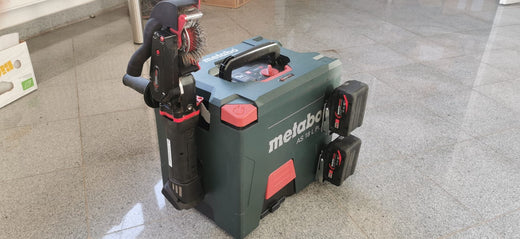
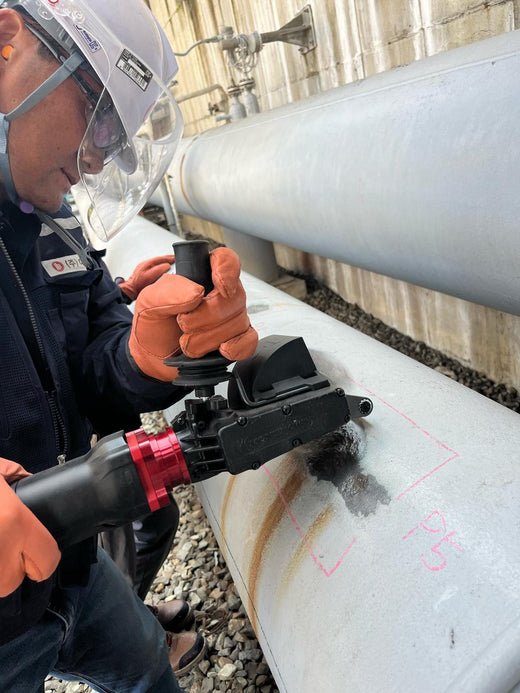
Bristle blasting uses a rotating belt of hardened-steel wire bristles that an accelerator bar holds back and releases, so the tips strike the substrate rather than drag across it. Each impact fractures and ejects corrosion, mill scale and existing coating while leaving a small crater — producing both cleanliness and anchor profile without abrasive media. In documented tests on API 5L steel, the Bristle Blaster® produces cleanliness comparable to Sa 2½ / SSPC-SP 10 with a 65–85 µm Rz (2.6–3.3 mil) anchor profile. Results vary with steel grade, rust grade, belt and technique.
| Parameter | Bristle blasting (Bristle Blaster®) |
|---|---|
| Maximum cleanliness standard | Comparable to Sa 2½ / SSPC-SP 10; comparable to Sa 3 / SP 5 depending on belt, substrate and technique |
| Anchor profile | 65–85 µm Rz (2.6–3.3 mil) on API 5L steel in documented tests; up to 120 µm Rz |
| Production rate | ~1.1 m²/hr (single belt, API 5L X42, rust grade B); around 3 m²/hr on flat surfaces (Double models) |
| ATEX compliance | Pneumatic models: ATEX 2014/34/EU-evaluated as Category 2 equipment for zone 1 gas (IIA) and zone 21 dust; fully pneumatic |
| Media waste | No spent abrasive; removed rust and coating particles still need collecting |
| Containment required | No blast containment; dust extraction available, and hazardous coatings still need controls |
| Portability | Hand-held; compressed air (pneumatic, 6.2 bar / 90 psi, ~0.5 m³/min), mains power (electric) or 18 V battery (cordless) |
| Substrate suitability | Carbon, structural and pipeline steel; stainless steel and aluminium with stainless-steel belts and accelerator bars. Thin vehicle body panels are better suited to MBX® |
| Limitations | Production rate lower than blast on large continuous areas; belt wear on heavily corroded surfaces (use the Two-Step Method with Tercoo® pre-treatment); average belt life about one hour |
Best fit: In-service maintenance, ATEX environments, spot repair, confined spaces, pipeline field joints, offshore topside work, weld zone preparation.
Ultra-high-pressure (UHP) water jetting
UHP water jetting — defined in the joint SSPC/NACE waterjetting standards as pressures above 210 MPa (30,000 psi) — removes rust, coating and soluble salts through hydraulic force. Cleanliness is graded WJ-1 to WJ-4 (SSPC-SP WJ-1 to WJ-4 / NACE WJ-1 to WJ-4). Critically, the standard states that waterjet cleaning "does not provide the primary anchor pattern": on previously blasted steel it re-exposes the existing profile, but on new mill-scaled steel a separate profiling operation is required. More detail: water jetting standards WJ-1 to WJ-4 explained.
| Parameter | UHP water jetting |
|---|---|
| Maximum cleanliness standard | SSPC-SP WJ-1 (clean to bare substrate); visually bare metal, but no profile is created |
| Anchor profile | Restores existing profile; does not create new profile on mill-scaled steel |
| Production rate | Variable; high on large horizontal areas; slow on complex geometry |
| ATEX compliance | Site-specific — the pump unit is a potential ignition source and must be sited or certified according to the site's hazardous-area rules |
| Media waste | High-volume contaminated water — requires collection, treatment, and disposal |
| Containment required | Yes — water and stripped coating must be contained and managed |
| Portability | Requires large mobile unit (pump truck or large skid); not hand-portable |
| Limitations | No profile creation on bare steel; flash rust forms as the surface dries (graded light, moderate or heavy in the WJ standards; the coating specification sets the acceptable level); high mobilisation cost; water management burden |
Best fit: Large-area coating stripping on structures with existing profile (bridges, tanks, vessels); recoat preparation on previously blast-profiled steel; substrates where dust generation is prohibited.
Wet abrasive blasting
Wet abrasive blasting — also called slurry blasting or vapour blasting — injects water into the abrasive stream to suppress dust and reduce abrasive rebound. It reaches the same cleanliness grades as dry blasting — specified as wet abrasive variants such as SSPC-SP 10 (WAB) — and creates an anchor profile. Dust is suppressed but not eliminated; abrasive waste is now contaminated slurry.
| Parameter | Wet abrasive blasting |
|---|---|
| Maximum cleanliness standard | SSPC-SP10 / SP5 — same as dry blasting |
| Anchor profile | Similar to dry blast with equivalent media; 40–100 µm Rz depending on media and pressure |
| ATEX compliance | Normally not permitted in zone 1 — abrasive impact can still generate sparks and static |
| Media waste | Abrasive/water slurry — contaminated; regulated waste |
| Containment required | Yes — slurry management required |
| Portability | Similar to dry blast — blast pot, compressor, hose train required |
| Limitations | Flash rusting on steel surface immediately after blasting unless inhibitor is used; slurry waste management; not ATEX compliant |
Best fit: Environments where dust suppression is required but abrasive profile creation is still needed; sites near occupied areas or sensitive equipment.
Vacuum blasting (closed-cycle blast)
Vacuum blasting uses a shrouded blast head that simultaneously blasts and recovers spent abrasive through a vacuum system. It is the cleanest form of abrasive blasting — very little dust escapes at the point of work while the head seals against the surface — but the head geometry limits it to flat surfaces and the equipment is heavy and slow.
| Parameter | Vacuum blasting |
|---|---|
| Maximum cleanliness standard | SSPC-SP10 / SP5 — same as conventional blasting |
| Anchor profile | 40–80 µm Rz depending on media |
| ATEX compliance | Not Zone 1 — abrasive impact still generates sparks |
| Media waste | Recovered and recycled in closed loop; contaminated media still requires disposal |
| Containment required | Minimal — dust is contained within the head shroud |
| Portability | Self-contained unit but heavy; best on large flat surfaces (decks, floors, hulls) |
| Limitations | Poor coverage on curved, complex, or confined geometry; slow production rate; high equipment cost |
Best fit: Flat structural surfaces (ship decks, tank floors, bridge flanges) where dust and abrasive containment is the primary concern.
Needle gun / needle scaler
A needle gun uses a bundle of hardened steel pins driven by compressed air that rapidly hammer the surface. It is effective at removing heavy rust, weld spatter, and loose mill scale from welds and irregular geometry. SSPC-SP 11 lists the needle gun among its impact media, so bare metal with a profile is possible where the needles reach, but it does not give a blast-comparable (SP 10) finish and the profile is irregular rather than controlled.
| Parameter | Needle gun |
|---|---|
| Maximum cleanliness standard | SSPC-SP 3 / St 3 typical; SSPC-SP 11 possible where the ≥ 25 µm (1 mil) profile is verified |
| Anchor profile | Irregular; typically 30–60 µm Rz — difficult to control or verify |
| ATEX compliance | Pneumatic models available; check individual ATEX rating — not all are Zone 1 approved |
| Media waste | None |
| Containment required | No |
| Portability | Hand-held; requires compressed air |
| Limitations | No blast-comparable finish; profile is irregular; slow on large areas; hand-arm vibration (HAV) exposure is a significant operator health concern on extended use |
Best fit: Weld seam cleaning, heavy corrosion pre-treatment before Bristle Blaster® profiling, tight internal geometry where rotary tools cannot reach.
Angle grinder with disc or flap disc
Angle grinders fitted with grinding discs, flap discs, or fibre discs are the most widely available mechanical preparation tool on any fabrication or maintenance site. They are genuinely useful for localised spot prep and edge feathering but do not give a blast-comparable finish, produce an inconsistent profile, and create a directional grinding pattern that can compromise coating adhesion on weld caps and edges.
| Parameter | Angle grinder (disc/flap) |
|---|---|
| Maximum cleanliness standard | SSPC-SP 3 / St 3 typical; bare metal on small spots. Dankiw and Fosdike (2018) measured only 30–40 µm with a #36 grit grinder and a #40 flap disc |
| Anchor profile | Directional grooves; inconsistent Rz; grinding disc may polish rather than profile |
| ATEX compliance | Not Zone 1 — spark generation is a classification failure mode |
| Media waste | Grinding dust — regulated like any coating dust if the coating contains lead or chromates |
| Containment required | No — but personal respiratory protection required |
| Portability | Fully portable |
| Limitations | No blast-comparable finish; profile is directional and non-uniform; high disc wear cost on corroded surfaces; vibration and noise exposure |
Best fit: Feathering existing coating edges; pre-grinding weld caps to remove high spots before profiling; localised spot prep to SP 3 where a lower standard is acceptable.
Chemical stripping and paint removers
Chemical paint removers — solvent-based, caustic, or bio-based — soften and lift existing coating layers for scraping or washing. They address coating removal only, not surface profiling, and leave a surface that still requires mechanical or blast preparation to meet any SSPC cleanliness standard.
| Parameter | Chemical stripping |
|---|---|
| Maximum cleanliness standard | Coating removal only — no SSPC standard equivalent for bare steel prep |
| Anchor profile | No profile created |
| ATEX compliance | Solvent-based: flammable vapour is itself a hazard in classified areas. Water-based/bio-based: possible, check flash point |
| Media waste | Chemical waste — regulated disposal in most jurisdictions |
| Containment required | Yes — surface runoff must be contained |
| Portability | Portable application; dwell time required (30 min to several hours) |
| Limitations | Coating removal only — still requires a follow-on mechanical or blast preparation step to achieve any SSPC standard; chemical waste cost; dwell time reduces throughput |
Best fit: Stripping thick or multi-layer coating systems prior to mechanical preparation; lead-paint removal where dust containment is critical and abrasive blasting is excluded.
Laser cleaning
Pulsed laser ablation removes rust, mill scale, and coating by delivering concentrated optical energy that vaporises contamination without mechanical contact. It is precise and uses no blast media, although the ablated material becomes fume and particulate that must be captured by extraction. It is also expensive to deploy, slow in production, and currently limited to specialist applications where cost is secondary to precision — aerospace components, heritage structures, thin-wall precision tubing.
| Parameter | Laser cleaning |
|---|---|
| Maximum cleanliness standard | Comparable to Sa 3 on small areas |
| Anchor profile | Minimal — laser ablation does not create a mechanical anchor profile comparable to blasting |
| ATEX compliance | Not Zone 1 — high-powered laser is an ignition source |
| Media waste | Vapour — fume extraction required |
| Portability | Mobile units available but heavy; fibre-delivery hand tools emerging |
| Limitations | Very high capital and operating cost; low production rate on industrial areas; no anchor profile creation; limited to premium/specialist applications |
Best fit: Aerospace, precision engineering, heritage metalwork — not current industrial maintenance at commercial production rates.
Side-by-side comparison: all methods
| Method | Max SSPC standard | Anchor profile | ATEX Zone 1 | No containment | No media waste | Hand-portable |
|---|---|---|---|---|---|---|
| Bristle Blaster® | Comparable to SP 10 / Sa 2½, up to SP 5 / Sa 3 | 65–85 µm Rz controlled | ✓ (pneumatic) | ✓ | ✓ | ✓ |
| Dry abrasive blasting | SP5 / Sa 3 | 40–100 µm Rz | ✗ | ✗ | ✗ | ✗ |
| UHP water jetting | WJ-1 (no profile) | Restores existing only | Site-specific | ✗ | ✗ | ✗ |
| Wet abrasive blasting | SP10 / Sa 2½ | 40–100 µm Rz | ✗ | ✗ | ✗ | ✗ |
| Vacuum blasting | SP10 / Sa 2½ | 40–80 µm Rz | ✗ | ✓ (dust only) | ✗ | ✗ |
| Needle gun | SP 3 – SP 11 | 30–60 µm (irregular) | Partial (check cert) | ✓ | ✓ | ✓ |
| Angle grinder (disc) | SP 3 – SP 11 (spots) | Inconsistent | ✗ (sparks) | ✓ | ✓ | ✓ |
| Chemical stripping | Coating removal only | None | ✗ (solvent) | ✗ | ✗ | ✓ |
| Laser cleaning | Sa 3 (small areas) | Minimal | ✗ | ✓ (fume only) | ✓ | Emerging |
Power tool results are described as comparable to blast grades because SSPC-SP 5/10 and Sa 3/Sa 2½ are written for abrasive blasting. ATEX column: ✓ = equipment evaluated for zone 1; ✗ = normally not permitted without a site-specific assessment. Results vary with steel grade, rust grade and technique.
How to select the right alternative
Method selection comes down to three questions: What standard does the coating specification require? What does the site environment permit? And what is the economics of mobilisation relative to the scope of work?
If you need an SP 10- or SP 5-comparable finish without blasting
Bristle blasting is a hand-held method documented to give cleanliness comparable to SP 10 together with an anchor profile in field conditions. For larger flat areas where abrasive blasting infrastructure is absent but power is available, the Ultimate Electric Double raises the rate to around 3 m²/hr. Where a finish comparable to SP 5 / Sa 3 is needed (immersion service, pipeline field joints), additional passes with the right belt can reach it: on a Total E&P Bolivia field-joint coating project, results comparable to Sa 3 / SP 5 were reported, with 68 µm roughness and a salt reading of 1.4 µg/cm².
If you need an SP 10-comparable finish in an ATEX zone 1 area
The Bristle Blaster® Pneumatic is fully pneumatic with no electrical parts and has been evaluated under ATEX 2014/34/EU as Category 2 equipment for zone 1 gas (group IIA) and zone 21 dust. It combines SP 10-comparable cleanliness and a controlled anchor profile in a hand-held tool. Abrasive blasting methods — wet, dry or vacuum — are normally excluded from zone 1 by site permit systems.
If you need to strip thick coating before re-profiling
Two-step approach: chemical strip or UHP water jetting to remove bulk coating, followed by bristle blasting to clean and re-profile to an SP 10-comparable finish. On heavily corroded surfaces with laminated corrosion over mill scale, the Tercoo® tungsten-carbide pin disc removes the bulk material first (Step 1), and the Bristle Blaster® belt then cleans and profiles the surface (Step 2).
If you need SP 3 on a budget and the environment is benign
A power wire brush or needle gun will achieve SP 3. Recognise the trade-off: SP 3 leaves tightly adherent mill scale, rust and paint in place and creates no profile, so most high-performance coatings perform better — and many data sheets require — SP 11, SP 10 or a documented equivalent. The coating data sheet and any warranty terms set the minimum.
If production rate is the primary constraint
On large areas, dry abrasive blasting has the highest production rate where it is available and permitted. If blasting is excluded, the Double Bristle Blaster® models, at around 3 m²/hr on flat surfaces, are the fastest hand-held bristle blasting option. On small repairs, set-up and clean-up dominate: in a Wales & West Utilities field trial, a small-area corrosion repair took 45 person-minutes in total with bristle blasting against 260 with grit blasting. For coating stripping alone (not profiling), UHP water jetting has higher throughput but requires follow-on profiling on previously un-blasted steel.
The ATEX question: which alternatives are safe in hazardous areas?
In classified hazardous areas — gas zones 0, 1 and 2 (dust zones 20, 21 and 22) classified by the employer under Directive 1999/92/EC, with equipment placed on the market under Directive 2014/34/EU, or NEC Class I Division 1 and 2 in North America — a surface preparation tool is an ignition source until proven otherwise. Abrasive impact against steel can generate sparks. Many solvent-based strippers have low flash points. Electrical tools with brushed motors generate arcing. The list of methods that fail ATEX assessment is longer than the list that pass.
For zone 1 — common on offshore operating assets, refinery process areas and gas service installations — the tool must be evaluated for that zone and still deliver the specified finish. The Bristle Blaster® Pneumatic meets both conditions: it has undergone an independent ignition-hazard analysis and ATEX conformity evaluation for zone 1 gas (IIA, EPL Gb) and zone 21 dust (IIIC, EPL Db), and it produces an SP 10-comparable finish with an anchor profile. Its ATEX marking (II 2G c IIA T4 X) applies to specific Bristle Blaster® belts on the original Pneumatic drive unit only, and it does not replace the site permit. If the work is in zone 1 and the specification requires an SP 10-level finish, tool selection is determined by the intersection of those two requirements.
For Zone 2 — occasional hazardous atmosphere — the range of options widens slightly, but blast methods remain excluded on most operators' safety management systems due to spark generation. Consulting the site safety case and hot-work permit system will define which specific tools are authorised before method selection is finalised.
Abrasive waste, regulatory compliance, and the hidden cost of blasting
In the UK, EU and US, spent abrasive contaminated with existing coating — particularly if that coating contains lead chromate, zinc chromate or other regulated pigments — can be classified as hazardous waste: in the US under RCRA when it fails the toxicity characteristic for lead (D008) or chromium (D007); in the EU when it has hazardous properties under the Waste Framework Directive 2008/98/EC; and in England and Wales under the Hazardous Waste Regulations 2005. The practical implication: blast pots on maintenance sites generate a regulated waste stream that requires licensed containers, manifests, licensed transporter, and licensed disposal facility. The cost of this compliance — plus the cost of containment to prevent abrasive escape to the environment — is often underestimated in maintenance budget planning.
Grit-free methods produce no spent abrasive. The Bristle Blaster® generates steel debris (removed rust, mill scale, and coating chips) and wire tips worn from the belt. The debris is non-hazardous unless the existing coating contains regulated heavy metals — in which case surface preparation dust of any kind carries the same classification regardless of method. The belt tips are steel and non-hazardous.
Frequently asked questions
What is the best alternative to sandblasting for steel?
It depends on the required standard. Where an SP 10-level finish is specified for maintenance or offshore work, bristle blasting is the strongest grit-free option: cleanliness comparable to Sa 2½ with a 65–85 µm Rz profile, no abrasive or containment, and a pneumatic version evaluated for ATEX zone 1. For coating stripping alone, UHP water jetting is faster but needs a follow-on profiling step.
Can I achieve SSPC-SP10 without sandblasting?
Strictly, SSPC-SP 10 is a blast-cleaning standard, so a power tool result is described as comparable. Bristle blasting produces cleanliness comparable to SP 10 / Sa 2½ with a 65–85 µm Rz profile in documented tests, without abrasive. Research by Prof. Robert Stango (Marquette University), published through NACE from 2009, describes the surface as resembling grit blasting. Confirm acceptance with the coating manufacturer.
Is bristle blasting as good as sandblasting?
For spot repair, in-service maintenance, ATEX environments, confined spaces and pipeline field joints, bristle blasting gives comparable results on the two parameters that matter most for coating performance: cleanliness (comparable to Sa 2½ / SP 10) and anchor profile (65–85 µm Rz). It is slower on large continuous areas, where blasting in a blast room remains more efficient.
Does UHP water jetting create an anchor profile?
No. The SSPC/NACE waterjetting standards state that waterjet cleaning does not provide the primary anchor pattern. On previously blast-profiled steel it re-exposes the existing profile by removing what covers it. On new mill-scaled steel, a follow-on profiling step — mechanical or blast — is required before profile-sensitive coatings such as high-build epoxy or thermal spray.
What is the cheapest alternative to sandblasting?
By purchase price, power wire brushes and needle guns are cheapest, but wire brushes reach only SP 3, which many high-performance coatings do not accept. Once early coating failure, re-preparation, recoating mobilisation and downtime are included, the preparation that lets the coating reach its design life is usually cheaper. Compare total cost of ownership, not tool cost.
Can bristle blasting be used underwater or in a splash zone?
Yes, with the right drive. The electric, cordless and pneumatic Bristle Blaster® models are for surfaces above water, so splash-zone work is done at low water or in dewatered conditions. Below the waterline, the hydraulic, water-driven Bristle Blaster® Subsea prepares steel to a finish comparable to Sa 2½ or Sa 3 using a single neutrally buoyant hose.
How does bristle blasting compare to sandblasting in terms of dust?
Bristle blasting generates far less airborne dust than abrasive blasting because there is no abrasive cloud; the debris is removed rust, scale and coating. Grit-free is not dust-free, so respiratory and eye protection are still required, and extraction is available. Old coatings containing lead or chromates need the same controls whatever the method.
Related resources
- The Complete Guide to Blasting Alternatives for Steel — Standards ladder, mill scale and profile gaps, and documented results for each method.
- What is Bristle Blasting? How It Works, Standards It Achieves, and When to Use It — The mechanism, the independent research, and the specification language.
MontiPower®'s technical team can advise on method selection, tool specification, ATEX compliance, and coating system compatibility for your project environment.
→ Talk to a SpecialistSources
- SSPC/NACE joint standards: SSPC-SP 11, Power Tool Cleaning to Bare Metal (copy) and SSPC-SP WJ-1/NACE WJ-1, Clean to Bare Substrate (copy); ISO 8501-1.
- European Union, Directive 2014/34/EU on equipment and protective systems intended for use in potentially explosive atmospheres (2014), eur-lex.europa.eu; and Directive 1999/92/EC on the protection of workers potentially at risk from explosive atmospheres, eur-lex.europa.eu
- US EPA hazardous waste codes, including D007 (chromium) and D008 (lead). Code list
- R. Dankiw, D. Fosdike, Defining Mechanical Surface Preparation Standards with Power Tools, Corrosion & Prevention 2018, Paper 74. PDF
- R. J. Stango et al., Fundamentals of Bristle Blasting Process for Removing Corrosive Layer, NACE CORROSION 2009. AMPP abstract
- MontiPower technical data sheets (Bristle Blaster® Ultimate Electric, Pneumatic, Double, Subsea) and ATEX conformity evaluation summary; MontiPower field records: Total E&P Bolivia field joint coating, Wales & West Utilities field trial. KTA-Tator, Surface Preparation of Steel by Laser Ablation, kta.com