Short answer: Remove heavy rust without sandblasting in two mechanical steps: strip the laminar corrosion mass first (for example with a Tercoo® pin disc or needle scaler), then impact-profile the cleared steel with a Bristle Blaster® belt. On standard steel this gives cleanliness comparable to Sa 2½ / SSPC-SP 10 and a 65–85 µm Rz anchor profile. Check soluble salts and coat promptly.
Abrasive blasting is the reference method for removing heavy rust from steel, but in many field maintenance situations it is unavailable, impractical or not permitted. Blast equipment must be mobilised, grit must be contained and disposed of, and in classified hazardous areas such as refineries and offshore platforms open blasting normally needs gas-free conditions, hot-work permits or a shutdown. This leaves maintenance engineers with a common problem: heavily corroded steel that must reach a near-white, profiled condition before recoating, with no access to a blast facility.
This guide covers the practical methods for removing heavy rust from steel without sandblasting, the standards that define what "clean" means after treatment, and the step-by-step Two-Step MontiPower® procedure that produces cleanliness comparable to SSPC-SP 10 on heavily corroded (ISO 8501-1 rust grade C and D) steel in field conditions.
Why heavy rust is harder to remove than surface oxidation
Not all rust is the same. ISO 8501-1 classifies the initial condition of uncoated steel in four rust grades, and the distinction matters for method selection:
| Rust condition | ISO 8501-1 rust grade | Characteristics | Removal difficulty |
|---|---|---|---|
| Intact or flaking mill scale, little rust | Grade A / B | A: adhering mill scale with little if any rust. B: rust has begun and mill scale has begun to flake | Low to medium — the challenge is the tight mill scale; Bristle Blaster® removes it in one step |
| Uniform rust, slight pitting | Grade C | Mill scale has rusted away or can be scraped off; slight pitting visible | Medium — Bristle Blaster® typically sufficient |
| Laminar / layered rust | Severe grade C to D | Multiple corrosion layers; scale build-up; tightly adherent inner layers | High — two-step mechanical treatment recommended |
| General pitting with deposits | Grade D | Mill scale rusted away; general pitting clearly visible; possible salt contamination within layers | Very high — two-step treatment; verify salts after treatment |
Laminar rust — the characteristic build-up on grade C/D steel that has been exposed without protection — is mechanically different from surface oxidation. The outer layers are friable and loosely adherent, the inner layers are more tightly bonded, and the entire mass is often contaminated with chloride and sulphate salts that have been deposited and concentrated over years of atmospheric exposure. Wire brushing removes only the outer friable layers. Grinding removes material but burnishes the surface. Neither achieves the combination of cleanliness and surface profile that high-performance coating systems require.
Methods for heavy rust removal without sandblasting
Method 1: Two-step mechanical (Tercoo® disc + Bristle Blaster® belt) — recommended
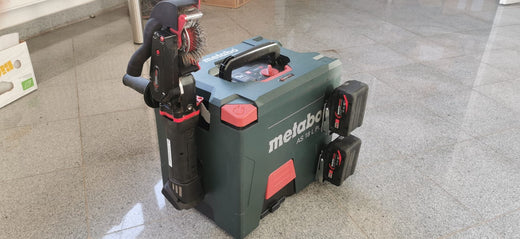
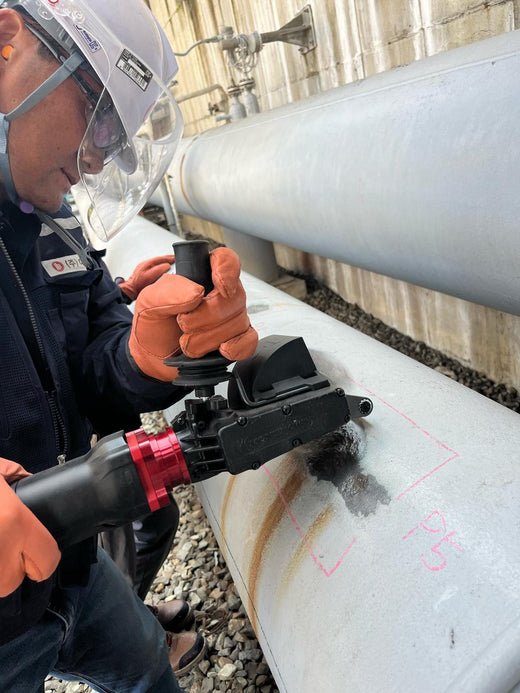
The most complete method for removing heavy rust and producing a result comparable to SSPC-SP 10 — or to SP 5 / Sa 3 where required — without blasting. The Tercoo® disc mounts on the Bristle Blaster® drive unit and removes the corrosion mass in Step 1; the Bristle Blaster® belt is fitted to the same drive unit for Step 2, creating the near-white cleanliness and the 65–85 µm Rz anchor profile documented on standard steel. Changeover between steps is quick because the drive unit stays the same. For hazardous areas, the Bristle Blaster® Pneumatic has an ATEX conformity evaluation for zone 1 gas and zone 21 dust in combination with specified belts; confirm ATEX suitability of the Tercoo® disc directly with MontiPower before use in a classified zone. No grit and no blast containment are required. Suitable for offshore, refinery, pipeline and structural applications. The full procedure is documented in the Two-Step MontiPower Method case study.
Method 2: Mechanical descaling tools (needle gun / chipping hammer)
Pneumatic needle guns and chipping hammers remove heavy scale and laminar rust effectively on structural steel. They are well-established tools in shipyard and infrastructure maintenance, and SSPC-SP 11 names needle guns among the impact tools it covers. Limitations: they do not reliably create a consistent anchor profile, so the surface after needle gun treatment often needs a separate profiling step (for example the Bristle Blaster®) and the profile must be measured rather than assumed. On heavily pitted steel, needle guns can compact rust into pit bottoms rather than removing it. They are also loud and transmit high vibration, so hand-arm vibration exposure must be managed on extended use.
Method 3: High-pressure water jetting (hydroblasting)
Water jetting at sufficient pressure removes rust, scale, coatings and soluble contamination without leaving abrasive grit. The cleanliness grades are defined by SSPC-SP WJ-1 to WJ-4 / NACE WJ-1 to WJ-4, which replaced the older SSPC-SP 12/NACE No. 5 (see our guide to water jetting standards WJ-1 to WJ-4). Water jetting does not create an anchor profile on its own — it reveals the profile already present in the steel from prior blasting or from corrosion pitting, but does not generate a new profile on smooth steel. Significant water volume, drainage management, flash rust control after treatment and corrosion re-formation between jetting and coating application are the primary challenges. Not suitable where water use is restricted.
Method 4: Chemical rust treatment (rust converters)
Rust converters chemically transform iron oxide (rust) into a more stable compound — typically iron tannate or iron phosphate — that can be overcoated. They do not remove the rust: they convert it. Their use is limited to thin rust films and light corrosion on surfaces that cannot be mechanically treated. Chemical treatment alone does not meet any bare-metal cleanliness grade, does not produce a fresh-steel anchor profile, and is generally not an accepted preparation for high-performance two-pack epoxy or polyurethane systems in demanding service. Check the coating manufacturer's data sheet: many do not support overcoating converter-treated rust.
Step-by-step: two-step mechanical procedure for heavy rust
Step 1: Surface assessment
Before starting, assess the rust grade according to ISO 8501-1. Photograph representative areas. Identify areas of grade C and grade D corrosion — these require the full two-step treatment. Note any areas of deep pitting, weld seam corrosion or areas where previous coating has failed over corroded steel. Record the pre-treatment condition for quality documentation.
Step 2: Soluble salt pre-check (if applicable)
On steel with a marine or industrial atmospheric exposure history, measure soluble salt contamination before mechanical treatment. Use the Bresle patch method (ISO 8502-6) with conductivity measurement (ISO 8502-9). If salt levels are high, consult the coating specification — some projects require a water wash or water-jetting step to reduce the salt load before dry mechanical treatment. Mechanical treatment alone does not reliably remove chloride contamination embedded deep in pitting. Background: soluble salt contamination and coating failure.
Step 3: Tercoo® pass — corrosion removal
Apply Tercoo® to all grade C/D areas in systematic overlapping passes. The objective is to remove all loose, laminar and loosely adherent corrosion, leaving bare steel — even if stained or pitted — at the surface level. Work in sections. Collect and dispose of removed corrosion material as work progresses — do not leave loose material on adjacent cleaned areas.
Step 3 is complete when: no loose or flaking rust remains; the surface is firm bare steel throughout the treated area; the Bristle Blaster® can be applied without its wire tips rolling over loose material.
Step 4: Bristle Blaster® pass — near-white finish and profile
Apply the Bristle Blaster® to all Tercoo®-treated areas in systematic overlapping passes. The rotating wire tips, released by the accelerator bar, strike the cleared steel, removing residual oxidation and creating the anchor profile. Work in passes until the surface matches the visual standard for SSPC-SP 10 / Sa 2½: free of all visible oil, grease, dust, dirt, mill scale, rust, coating, oxides and other foreign matter, with only random staining on no more than 5% of each unit area.
Step 5: Verification
After the Bristle Blaster® pass, verify the surface before coating application:
- Visual cleanliness: compare against SSPC-VIS 1 or ISO 8501-1 reference photographs for SP 10 / Sa 2½
- Anchor profile: measure with Testex Press-O-Film® X-Coarse replica tape (range 38–115 µm / 1.5–4.5 mil) per ASTM D4417 Method C, correcting for the 50.8 µm (2 mil) incompressible film if your gauge does not do so automatically; take at least three readings per representative area. Note that replica tape reports peak-to-valley height, whereas MontiPower's 65–85 µm figure is expressed as Rz — use the method named in the specification
- Soluble salt: measure with Bresle patch per ISO 8502-6/9 and compare against the coating specification maximum
Document all readings. Do not apply coating until all three parameters are within specification.
Step 6: Apply coating promptly
After mechanical surface preparation without blasting, apply the first coat within the time specified by the coating manufacturer — often within about 4 hours in moderate conditions, and sooner in high-humidity or marine environments where flash rusting can start quickly. The two-step method does not inhibit flash rust: the same coatability window applies as for any surface preparation method that exposes bare steel.
Method comparison: sandblasting vs. two-step mechanical for heavy rust
| Factor | Sandblasting | Two-step mechanical (Tercoo® + Bristle Blaster®) |
|---|---|---|
| Near-white cleanliness (SSPC-SP 10 / Sa 2½)? | Yes — SP 10 is written for blast cleaning | Comparable to SP 10 / Sa 2½ — documented field results; acceptance by the specification and inspector |
| Anchor profile | Typically 50–100 µm depending on abrasive type and size | 65–85 µm Rz on standard steel in documented tests; varies with steel grade, rust grade, belt and technique |
| ATEX zone 1 use | Normally excluded without gas-free conditions and hot-work controls | Bristle Blaster® Pneumatic with specified belts carries ATEX marking II 2G c IIA T4 X; site permit system still applies |
| Grit containment required | Yes — containment, collection, disposal | No blast media; removed rust and coating debris still needs collecting |
| Confined space use | Severely restricted — dust hazard, media handling | Yes — with ventilation, extraction and PPE per the risk assessment |
| Operational during maintenance | Usually requires shutdown / plant isolation | Often compatible with live operational environments, subject to site permits |
| Production rate (grade D steel) | High at a properly equipped facility | Lower m²/hour, but viable in locations where blasting cannot operate |
Grit-free is not dust-free: the rust and old coating you remove still become particles, so respiratory protection and, where available, extraction remain part of the method statement. See surface preparation safety for dust, operator and ATEX considerations.
Frequently asked questions
Can wire brushing achieve the same result as the two-step method on heavy rust?
No. Hand and power wire brushing (SSPC-SP 2 / SP 3) remove loose rust but are not intended to remove tightly adherent corrosion and do not create the anchor profile high-performance coatings need. On grade D steel wire brushing reaches SP 2 or SP 3 at best, and it can polish rust into the surface so it looks cleaner than it is.
What is the most severe rust grade the two-step method can handle?
The two-step method is designed for ISO 8501-1 grade D, the most severe rust grade, with general pitting and layered corrosion. Where pitting may have reduced wall thickness to near minimum, assess structural integrity first: take ultrasonic thickness readings before mechanical treatment on any asset where material loss is a structural concern.
Does the two-step method require special training?
Both tools require standard power tool operator training. Operators also need to understand ISO 8501-1 rust grades, the SP 10 / Sa 2½ visual standard and replica tape measurement. Experienced maintenance technicians usually achieve the required results after a short familiarisation with the tools. No blasting certification is required.
Can a power tool achieve SSPC-SP 10?
SSPC-SP 10 is a blast-cleaning standard, so a power tool result is assessed as comparable to SP 10 rather than as SP 10 itself. Bristle blasting has documented results comparable to Sa 2½ / SP 10 with a 65–85 µm Rz profile on standard steel. Acceptance is set by the coating specification and the inspector.
MontiPower technical team — tool selection, method guidance and the two-step procedure for your specific surface condition and environment.
→ Contact technical teamSources
- Fitz Coatings, Blast it! ISO 8501-1 — rust grades A–D and blast-cleaning grades (2021). fitz-coatings.com
- SSPC-SP 11, Power Tool Cleaning to Bare Metal (impact tools, profile requirements). Copy of standard
- SSPC-SP WJ-1/NACE WJ-1, Clean to Bare Substrate (replaces SSPC-SP 12/NACE No. 5; water jetting does not create profile). Copy of standard
- KTA-Tator, Industry Standards for Surface Preparation (SP 10 definition). kta.com
- DeFelsko, Testex Press-O-Film replica tape — grade ranges. defelsko.com
- MontiPower, Bristle Blaster® technical data sheets and ATEX documentation for the Bristle Blaster® Pneumatic.