Short answer: A rotating tool can replace sandblasting on steel only if it works by impact, not rubbing. In bristle blasting, tensioned wire tips are released by an accelerator bar, strike the steel and rebound, cleaning it to a level comparable to Sa 2½ / SSPC-SP 10 and leaving a 65–85 µm Rz anchor profile in documented tests. Grinders and wire brushes clean but polish.
A rotating tool usually means grinding or brushing, processes that rub. Blasting works by impact. One family of rotating tools can replace sandblasting on many steel jobs because it was engineered to impact, not rub. This article explains the mechanism, the published evidence, what it replaces in practice and where blasting still wins.
Why impact matters
Coatings anchor mechanically. Grit blasting works because each particle strike leaves a microscopic crater; millions of strikes produce the rough texture, commonly specified somewhere in the 50–100 µm range, that acts as a mechanical key. A tool that rubs, such as a grinder, wire brush or sander, removes rust but tends to leave a smeared, polished surface with little for the coating to grip. SSPC-SP 11 itself warns that power wire brushes or sanding discs used alone may not produce the required profile and can degrade an existing one. That is why many power tools fail coating specifications even when the steel looks clean. Shipyard tests by Dankiw and Fosdike (2018) measured 30–40 µm with a grinder and flap disc, against 50–80 µm with a bristle blasting tool on the same steels.
The rebound principle
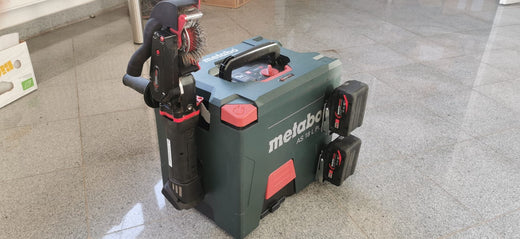
The Bristle Blaster® bristles are angled forward and tensioned against an accelerator bar. As the belt rotates, at an operating speed of about 2,300 rpm, each tip is bent back, loaded like a spring, then released just before contact. It strikes the surface with kinetic energy comparable to a grit particle and rebounds immediately instead of dragging. One strike, one micro-crater, repeated by every tip on every revolution: impact physics from a rotating machine. SSPC-SP 11 recognises this family of tools, naming "wire bristle impact" assemblies among its impact media.
The measured evidence
This is documented, not only claimed:
- The 2009 NACE paper on bristle blasting fundamentals described the working principle and the crater-like impressions it leaves.
- A 3D optical analysis (2015) characterised the crater texture behind the 65–85 µm Rz anchor profile.
- A NACE comparison against grinders and needle guns showed the difference panel by panel.
- Residual-stress research (NACE, 2014) found that the process cold-works the surface into compressive residual stress, which resists crack initiation and can improve fatigue performance.
Across these sources, bristle blasting produces cleanliness comparable to ISO 8501-1 Sa 2½ / SSPC-SP 10 with a 65–85 µm Rz profile on standard steel. Results vary with steel grade, rust grade, belt and technique, so the profile should be measured on each job.
What this replaces in practice
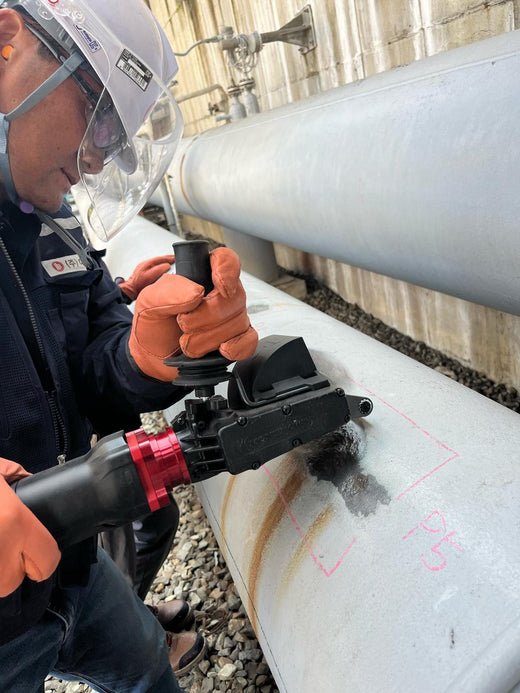
Everything that makes small-scale blasting disproportionate: the pot, the media, the containment, the disposal and often the permits. One operator with a power, air or battery supply cleans and profiles the surface in the same pass, including at height, on in-service assets and, with the ATEX-evaluated pneumatic version, inside ATEX zones (zone 1 gas, zone 21 dust). Grit-free is not dust-free: removed rust and coating still become particles, so extraction and PPE remain part of the job. For which tool fits which job, start with the small-areas comparison or the Belt Selector.
And what it does not
On large, continuous open surfaces, such as new-build plate in a blast shop or yard, blasting throughput wins; a hand-held tool is slower per square metre than a blast nozzle. If a specification names a media type rather than a surface result, the conversation is with the specifier, not the toolbox. Honest boundaries make the rest of the claim credible. For the wider picture, read what to know about blasting alternatives for steel.
Frequently asked questions
How can a rotating tool replicate grit blasting?
By reproducing the impact, not the media. Forward-angled bristle tips are tensioned by an accelerator bar, released, and strike the steel with kinetic energy comparable to a grit particle before rebounding immediately. Each strike leaves the same class of crater-like indentation that gives blasted steel its anchor profile, while removing rust and coating.
Is the roughness from bristle blasting really comparable to blasting?
It is measured: 3D optical analysis and NACE conference papers document 65–85 µm Rz profiles and cleanliness comparable to ISO 8501-1 Sa 2½, and independent shipyard tests measured 50–80 µm. That is within the range many heavy-duty coating systems specify, but results vary with steel, rust grade, belt and technique, so verify on site.
What can rotating tools not replace?
Blasting on large, continuous open areas such as new-build plate, where blast throughput is far higher, and specifications that explicitly demand a particular blast media. Local repairs, weld seams, field joints, in-service assets and containment-constrained sites are where impact-based rotating tools are the practical choice.
Sources
- SSPC-SP 11, Power Tool Cleaning to Bare Metal. Copy of standard
- R. J. Stango et al., Fundamentals of Bristle Blasting Process for Removing Corrosive Layer, NACE CORROSION 2009. AMPP abstract
- R. J. Stango et al., Compressive Residual Stress Generated by Bristle Blasting. semanticscholar.org
- R. Dankiw, D. Fosdike, Defining Mechanical Surface Preparation Standards with Power Tools, Corrosion & Prevention 2018, Paper 74. PDF
- Jotun, Surface Preparation Code and Standard for Bristle Blast Cleaning and Profiling Process. PDF
- DeFelsko, 3D Surface Analysis of Bristle Blasting (2015), summarised on MontiPower's 3D profile analysis page.