Short answer: MontiPower®'s metal cleaning machines are handheld power tools rather than blasting systems. The Bristle Blaster® removes rust, mill scale and coatings from steel and leaves an anchor profile, with cleanliness comparable to Sa 2 up to Sa 3 depending on belt and conditions. The MBX® cleans rust, paint, underseal and sealants from thin panels such as vehicle bodywork without heat or warping.
Metal is affected by many factors. Rust develops on the surface, mill scale forms during hot rolling, and dirt, grease and old coatings build up. To keep metal in good condition, the surface has to be cleaned regularly, and before recoating it has to be stripped of rust, scale, paint and other coatings. This protects the metal and maintains the appearance of the object. This article explains the main types of metal cleaning machines and how MontiPower®'s handheld tools work and compare.
What types of metal cleaning machines are there?
Several techniques remove dirt, rust and coatings from metal. Abrasive blasting is the most common. A blasting medium is propelled with compressed air at high velocity against the metal, and the impact releases contamination from the surface. Traditionally sand was the most common medium, but because of the dangers of sandblasting, above all respirable crystalline silica, sand has largely made way for other media such as steel grit, garnet and aluminium oxide.
Metal can also be cleaned with wet methods. In vapor blasting (wet abrasive blasting), water is added to the abrasive. At low pressure with fine media it is gentle and suits fragile surfaces and light contamination; at full blast pressure with angular abrasive it can clean steel to the SSPC/NACE wet abrasive blast grades. Either way it produces slurry to collect and, on carbon steel, flash rust as the surface dries.
The third family is power tools: wire brushes, grinders, flap discs, needle scalers and rotary impact tools. They are portable and need no blast set-up, but they differ widely in result. Rubbing and grinding tools clean without creating a useful anchor profile; impact tools can clean and profile.
Portable metal cleaning machines from MontiPower®
The Bristle Blaster® and MBX® are portable machines for cleaning and preparing metal surfaces. They avoid the main drawbacks of blasting: no blast pot, no loose abrasive to contain or dispose of, and no chemicals. They are easy to operate, fast on rust and coatings, and can be used for spot repairs and in-service work where blasting is impractical. For steel that needs a protective coating, this makes the Bristle Blaster® a practical alternative to sandblasting and other abrasive blasting methods, particularly on smaller areas, weld seams and difficult geometry. On large, open, new-build areas, blasting usually remains the more productive method.
How do MontiPower®'s metal cleaning machines work?
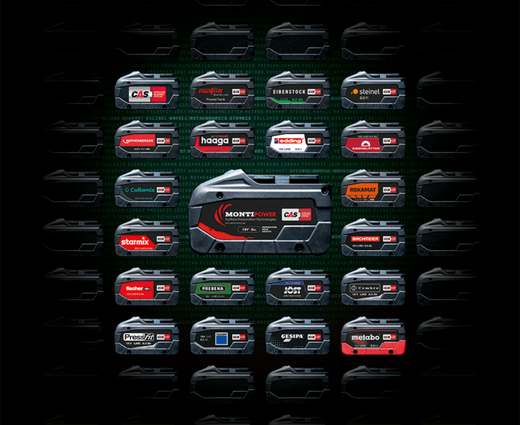
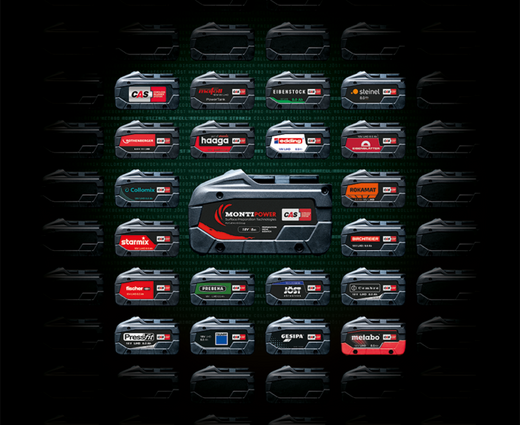
MontiPower®'s handheld rust and paint removal tools differ from other metal cleaning methods in several ways. They are available with electric (230 V / 120 V), cordless 18 V and pneumatic drives, and are easy to use yourself. Both tools work with a rotating belt of wire bristles, but they work in different ways:
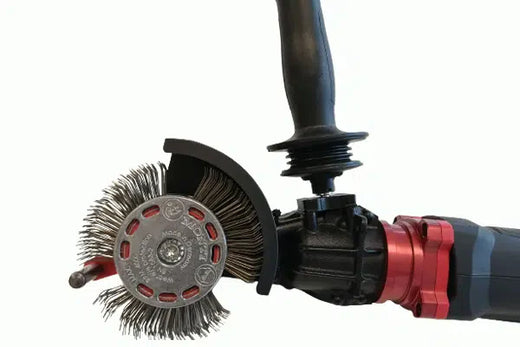
- Bristle Blaster®: the belt carries specially shaped, hardened bristle tips. An accelerator bar holds the tips back and then releases them, so they strike the surface with kinetic energy comparable to grit-blast media and immediately rebound. Each strike removes corrosion and leaves a small crater, which builds up an anchor profile comparable to abrasive blasting. That profile is what new coating or paint keys into.
- MBX®: flexible-wire belts rotate in a patented housing and spin outward by centrifugal force, removing rust, corrosion, paint, underseal, sealers, adhesives and gaskets from car body panels and similar thin substrates. Colour-coded belts match the job: black (coarse), ochre (medium), green (fine) and blue stainless belts for non-ferrous metals. MBX® cleans; it is not intended for preparing steel surfaces to a coating profile.
Which drive suits which site is explained in Bristle Blaster® options: electric, pneumatic or cordless.
Which cleanliness standards can be reached?
The degree of cleaning varies with belt type, machine, substrate and initial condition. Cleanliness is assessed against ISO 8501-1, whose blast-cleaning grades run from Sa 1 (light) to Sa 3 (visually clean steel). Because these grades are defined for blast cleaning, a power tool result is described as comparable to a grade. Jotun's bristle blast cleaning standard (BIPoT) maps its grades muA to muD to Sa 3, Sa 2½, Sa 2 and Sa 1. In documented tests on standard steel, the Bristle Blaster® produces cleanliness comparable to Sa 2½ and Sa 3 with a 65–85 µm Rz profile; results vary with steel grade, rust grade, belt and technique.
Commercial blast cleaning and the Bristle Blaster®
A widely used grade is commercial blast cleaning, SSPC-SP 6 / NACE No. 3, broadly comparable to Sa 2. It removes all visible rust, mill scale, paint and foreign matter, but allows staining or shadows on up to 33% of each unit area. The power-tool counterpart is SSPC-SP 15, commercial grade power tool cleaning, which has the same 33% staining allowance and requires a minimum surface profile of 25 µm (1 mil). SSPC-SP 11 (power tool cleaning to bare metal) allows no staining.
Because the Bristle Blaster® creates a profile as it cleans, it can meet SP 15 and SP 11 requirements and produce results comparable to commercial blast cleaning and higher grades. That makes it well suited to specifications that call for commercial-grade cleanliness on spot repairs, welds and in-service steel. For how the commercial and near-white grades differ, see SSPC-SP 6 vs SP 10.
Safety and waste
Neither tool uses loose abrasive, so there is no spent media stream and no blast containment. That does not make the work dust-free: the rust, paint and coating removed become particles, and old coatings may contain lead or chromates. Use extraction where available and the eye, hand, hearing and respiratory protection your risk assessment requires.
Frequently asked questions
What is the difference between the Bristle Blaster® and the MBX®?
The Bristle Blaster® uses an accelerator bar to make hardened bristle tips strike steel and rebound, so it cleans and creates an anchor profile for protective coatings. The MBX® uses flexible-wire belts without that impact action to clean rust, paint, underseal and sealants from thin panels such as car bodies. MBX® is not intended for preparing structural steel.
Can a power tool achieve commercial blast cleanliness?
Blast grades such as SSPC-SP 6 / Sa 2 are defined for abrasive blasting, so a power tool result is described as comparable. The power-tool counterpart is SSPC-SP 15, commercial grade power tool cleaning, which allows staining on up to 33% of each unit area and requires at least a 25 µm (1 mil) profile. The Bristle Blaster® can produce results comparable to SP 6 and higher.
Are MontiPower® metal cleaning machines electric?
Some are. The range includes electric (230 V / 120 V), cordless 18 V and pneumatic drive units. The Bristle Blaster® Pneumatic is fully air-driven with no electrical parts and is ATEX-evaluated for zone 1 gas and zone 21 dust, which makes it the choice for refineries and other hazardous areas.
Do these machines produce dust?
They use no loose abrasive, so there is no spent media to contain or dispose of. The rust, paint and coating removed from the surface still become particles, which may be hazardous if the old coating contains lead or chromates. Use extraction where available and the respiratory protection your risk assessment requires.
Sources
- KTA-Tator, Industry Standards for Surface Preparation (SSPC-SP 6, SP 10, SP 11 and SP 15 definitions). kta.com
- KTA-Tator, New SSPC/NACE Wet Abrasive Blast Cleaning Standards. kta.com
- Jotun, Surface Preparation Code and Standard for Bristle Blast Cleaning and Profiling Process (BIPoT). PDF
- OSHA 29 CFR 1926.1153, Respirable crystalline silica. osha.gov
- MontiPower®, Bristle Blaster® and MBX® technical data sheets and product FAQs.