Short answer: The Bristle Blaster® Ultimate Cordless is an 18 V CAS battery tool that, in documented tests, produces cleanliness comparable to ISO 8501-1 Sa 2½ / SSPC-SP 10 and a 65–85 µm Rz anchor profile without grit or a power cord. It suits remote, elevated and confined non-ATEX work; classified ATEX zones call for the Bristle Blaster® Pneumatic.
This guide explains what SSPC-SP 10 requires, how the Bristle Blaster® Ultimate Cordless compares with it, how the CAS battery affects continuous work, where the tool may and may not be used (ATEX), and which field applications it is built for.
Achieving cleanliness comparable to SSPC-SP 10 / Near-White Metal in the field — away from a blast pot, without containment, in locations where running a power cord is impractical or prohibited — has historically meant accepting a compromise on surface preparation quality. The Bristle Blaster® Ultimate Cordless narrows that gap. In documented tests it produces cleanliness comparable to SSPC-SP 10 and a 65–85 µm Rz (2.6–3.3 mil) anchor profile on 18 V CAS battery power, with no abrasive media and no grit containment requirement.
It is intended for pipeline field joint coating, bridge and infrastructure spot repair, offshore structural maintenance in non-ATEX-classified areas, and other applications where blast-comparable preparation must happen in a location that blasting cannot reach or where blasting is operationally unacceptable. For work in ATEX-classified atmospheres, the Bristle Blaster® Pneumatic is the designated MontiPower® tool; the cordless Ultimate does not carry ATEX certification.
What SSPC-SP 10 requires — and what the Bristle Blaster® delivers
SSPC-SP 10 / NACE No. 2 (Near-White Metal Blast Cleaning) requires removal of all visible oil, grease, dust, dirt, mill scale, rust, coating, oxides and other foreign matter. Random staining — light shadows, slight streaks or minor discolorations from rust, mill scale or previous coating — is permitted on no more than 5% of each unit area. It is a common minimum for high-performance industrial coating systems, including many immersion-service linings and coatings used on offshore structural steel, process piping and buried pipelines. Some systems require more: thermal spray coatings for immersion or corrosive service, for example, call for SSPC-SP 5 under SSPC-CS 23.00, with SP 10 accepted only for mild atmospheric exposure.
Because SP 10 is written for abrasive blast cleaning, a power tool result is assessed as comparable to SP 10 rather than as SP 10 itself. Conventional power tools rarely get close: wire brushing and grinding typically reach SSPC-SP 2/SP 3 (hand and power tool cleaning, which do not remove tightly adherent mill scale), and only tools that also create a profile can meet SSPC-SP 11 (power tool cleaning to bare metal, minimum 25 µm / 1 mil profile). The Bristle Blaster® mechanism is different: hardened, bent wire tips are held back by an accelerator bar, released, strike the surface and rebound, removing contamination and leaving crater-like micro-indentations that form an angular profile.
MontiPower test data on API 5L-X42 pipeline steel report roughness of 65–83 µm on rust grade D, with a typical range of 65–85 µm Rz (up to 120 µm Rz depending on substrate and belt) and visual cleanliness comparable to ISO 8501-1 Sa 2½ and Sa 3. MontiPower's cordless documentation gives the same cleanliness range for the Ultimate Cordless. Results vary with steel grade, rust grade, belt and technique, so qualify the procedure on the actual substrate.
Coating manufacturer acceptance is documented, but product-specific. Jotun, for example, has published a surface preparation code for bristle blast cleaning (BIPoT) with grades mapped to ISO 8501-1 Sa 3 to Sa 1. Other manufacturers accept bristle blasting for specific products when the specified cleanliness and profile are achieved. Always confirm acceptance in the technical data sheet (TDS) or in writing from the manufacturer for the coating system on your project.
Why cordless matters for SP 10-comparable work
Power tool surface preparation has traditionally required a corded electric or pneumatic tool. Both work in fixed or well-equipped locations. In the field — on a pipeline right-of-way, at a field joint hundreds of metres from the nearest power source, on an elevated offshore structure without convenient outlet access, or in a confined space where trailing cables create entanglement and trip hazards — corded tools create real operational constraints. Pneumatic tools need a compressor nearby, which is often impractical at remote locations.
The Bristle Blaster® Ultimate Cordless removes both dependencies. On an 18 V CAS battery it works wherever the job is, with no trailing cable and no compressor. When a pack is depleted, a charged CAS pack — drawn from the same pool as the other CAS tools on site — is fitted and work continues. The tool includes a safety switch, an anti-vibration handle, a reinforced fronthead and an adjustable accelerator bar for hard-to-reach objects.
CAS battery performance for continuous surface prep
Surface preparation is a high-demand application for a battery tool. The Bristle Blaster® operates under continuous mechanical load, which draws sustained current from the pack. MontiPower recommends the 18 V 8.0 Ah pack for this work and states approximately 25 minutes of surface preparation time per charge. With a belt service life of around one hour (about 1–1.5 m² on typical corroded steel), one belt usually spans two to three battery packs — so plan spares and a charging rotation for longer shifts.
For lighter tasks, touch-up work or applications where tool weight is a primary concern — work at height, overhead prep, tight access — a smaller pack (for example 5.5 Ah) reduces weight at the cost of runtime. Higher-capacity 18 V packs are also available within the CAS platform for longer continuous work.
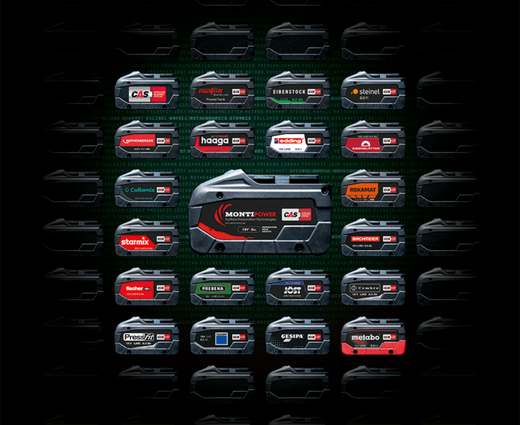
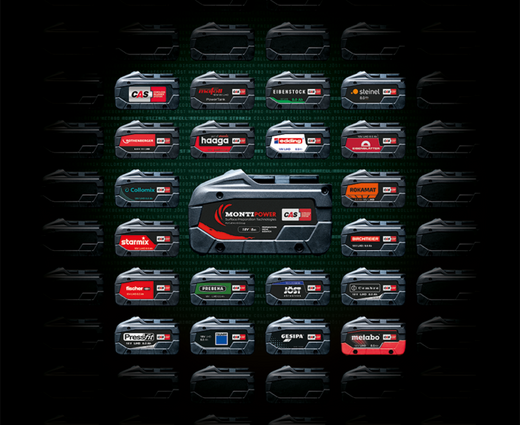
Because the Ultimate Cordless runs on the Cordless Alliance System, batteries and chargers are interchangeable with those of other CAS member brands. An operation with an existing CAS battery stock can run the Bristle Blaster® Ultimate on existing packs without buying new batteries. See the guide to the CAS Cordless Alliance System for how the platform works across brands.
ATEX environments: which tool to use
Under the ATEX framework, zone 1 is a place where an explosive gas, vapour or mist atmosphere is likely to occur occasionally in normal operation; zone 2 is a place where it is not likely to occur in normal operation and, if it does, persists only for a short time. Zone 1 requires Category 2 equipment, zone 2 Category 3. Both zones are common in offshore production facilities, refineries, petrochemical plants and gas processing infrastructure. Standard power tools — including most cordless battery tools — cannot be used in these zones without the relevant explosion-protection conformity.
The Bristle Blaster® Ultimate Cordless does not carry ATEX certification. For work in ATEX-classified areas, the correct MontiPower selection is the Bristle Blaster® Pneumatic. It is fully pneumatic with no electrical components and has undergone an ignition-hazard analysis and ATEX 2014/34/EU conformity evaluation as Category 2 equipment for zone 1 explosive gas (group IIA, EPL Gb) and zone 21 explosive dust (IIIC, EPL Db). The ATEX marking applies to the original Pneumatic drive unit with specific belts, so check the documentation for the exact configuration. For the full picture, see surface preparation in ATEX zone 1.
The Ultimate Cordless suits general industrial environments, remote locations, confined spaces without a classified atmosphere, and any non-ATEX work area where power access is limited. Many offshore and refinery maintenance tasks take place in non-classified areas adjacent to process equipment — structural steel, external pipe supports, decks away from process zones — where the cordless Ultimate is the more practical choice, subject to the site's permit-to-work system.
Primary application environments
Pipeline field joints
Field joint coating of buried and subsea pipelines typically specifies Sa 2½ / SSPC-SP 10 cleanliness at each girth weld, prepared in the field after welding and before the joint coating is applied. Abrasive blasting at a field joint is logistically difficult: it needs blast equipment, abrasive supply and containment at remote locations, and blasting in a bell hole presents serious operational constraints. Field joints are one of the established uses of bristle blasting, and the cordless Ultimate extends it by removing the power supply dependency.
Offshore structural maintenance
Offshore platforms require continuous maintenance painting, particularly in the splash zone, on deck equipment bases and at structural connections, where coating systems commonly specify Sa 2½ / SP 10 preparation. Open blasting on live platforms is often restricted because of contamination risk to equipment and operational constraints. The Ultimate Cordless delivers blast-comparable preparation without grit and without containment, on battery power that integrates with CAS tool infrastructure. ATEX-classified areas on the platform still require the Bristle Blaster® Pneumatic.
Refinery and petrochemical maintenance
Refinery structural steel, process piping and equipment supports require maintenance coating in environments where grit blasting creates contamination risk to nearby process equipment, instrumentation and operating units. Bristle blasting allows SP 10-comparable preparation adjacent to operating equipment, in short maintenance windows, without the grit contamination and large exclusion zones associated with abrasive blasting. Removed rust and coating still become particles, so dust control and PPE remain necessary.
Bridge and infrastructure spot repair
Bridge maintenance painting involves spot repair of coating failures, weld zone treatment and preparation of expansion joints and connection details where full blast mobilisation is disproportionate to the work area. The Bristle Blaster® Ultimate Cordless addresses these with SP 10-comparable preparation on battery power, anywhere on the structure, without grit containment or a power supply.
The Two-Step MontiPower Method with the Ultimate Cordless range
For surfaces with heavy corrosion or thick existing coatings, the Two-Step MontiPower Method applies: first, the Tercoo® removes bulk rust and heavy coating build-up; then the Bristle Blaster® Ultimate Cordless performs the final cleaning and profiling step to reach cleanliness comparable to SSPC-SP 10 with an anchor profile. This sequence is particularly useful in refinery and offshore maintenance, where substrates have accumulated multiple coating layers and significant corrosion over long service intervals. The two-step case study shows the method in practice.
Key takeaways
- The Bristle Blaster® Ultimate Cordless produces cleanliness comparable to Sa 2½ (ISO 8501-1) / SSPC-SP 10 and a 65–85 µm Rz anchor profile in documented tests, on 18 V CAS battery power — no abrasive media, no containment, no power cord. Results vary with steel, rust grade, belt and technique.
- The cordless Ultimate does not carry ATEX certification. For ATEX-classified environments, the Bristle Blaster® Pneumatic (ATEX-evaluated for zone 1 gas and zone 21 dust) is the correct MontiPower selection.
- The 18 V 8.0 Ah pack is recommended for continuous surface preparation, at roughly 25 minutes per charge. All CAS 18 V packs are interchangeable with MontiPower Ultimate tools.
- Primary applications: pipeline field joint preparation, offshore and refinery structural maintenance in non-ATEX areas, and bridge and infrastructure maintenance painting — locations where grit blasting is impractical, prohibited or logistically disproportionate.
- For heavily corroded or thickly coated substrates, the Two-Step MontiPower Method — Tercoo® for bulk removal, Bristle Blaster® Ultimate for final cleaning and profiling — delivers surface quality comparable to SSPC-SP 10.
Related articles
- MontiPower Ultimate Cordless Tools: Built on CAS Battery Technology
- CAS vs AMPShare: Choosing the Right Multi-Brand Battery System for Industrial Tools
Frequently asked questions
Can the Bristle Blaster® Ultimate Cordless achieve SSPC-SP 10?
SSPC-SP 10 is a blast-cleaning standard, so a power tool result is assessed as comparable to SP 10 rather than as SP 10 itself. In documented tests the Bristle Blaster® produces cleanliness comparable to Sa 2½ / SP 10 with a 65–85 µm Rz profile. Results vary with steel grade, rust grade, belt and technique, so qualify the procedure on your own substrate.
Can the cordless Bristle Blaster® be used in ATEX zones?
No. The Ultimate Cordless is battery-electric and does not carry ATEX certification. In zone 1 gas or zone 21 dust areas, use the fully pneumatic Bristle Blaster® Pneumatic, which has been evaluated to ATEX 2014/34/EU as Category 2 equipment and has no electrical components.
How long does one battery last on the Bristle Blaster® Ultimate Cordless?
MontiPower states approximately 25 minutes of surface preparation per 18 V / 8.0 Ah pack. Actual runtime depends on rust grade, coating, contact pressure and temperature, so plan on spare charged packs for continuous work. A belt typically lasts around one hour, which is roughly two to three battery packs.
Which batteries fit the Bristle Blaster® Ultimate Cordless?
Any 18 V battery pack from the Cordless Alliance System (CAS). Packs and chargers are interchangeable across CAS member brands, so a site already running CAS tools can use its existing batteries. MontiPower recommends the 8.0 Ah pack for continuous surface preparation.
Sources
- KTA-Tator, Industry Standards for Surface Preparation. kta.com
- KTA-Tator, Surface Preparation of Steel for Thermal Spray Coatings (SSPC-CS 23.00 requirements). kta.com
- SSPC-SP 11, Power Tool Cleaning to Bare Metal. glavin.net
- Jotun, Surface Preparation Code and Standard for Bristle Blast Cleaning and Profiling Process. cactusindustrial.com
- HSE (UK), Area classification for hazardous explosive atmospheres (zoning). hse.gov.uk
- Cordless Alliance System, One battery for over 50 brands. cordless-alliance-system.com