Short answer: Surface preparation is the cleaning and, where required, profiling of a substrate before coating: removing mill scale, rust, old coatings, oil, soluble salts and dust, and creating an anchor profile the coating can grip. It is one of the main factors in coating life. Methods range from solvent cleaning and power tools to abrasive blasting and water jetting, each judged against a specified standard.
This article explains what surface preparation covers, why it decides how long a coating lasts, the six phases of a typical job, the main techniques and their drawbacks, and where hand-held power tools fit.
What is surface preparation?
Surface preparation is defined as “the cleaning or preparing of the metal surface prior to the application of a coating.” In practice, many tasks fall under this term: the removal of mill scale, rust, imperfections, existing coatings and other contaminants. Creating a profile on the metal surface is also part of surface preparation. In this way a good bond is created between the object and the coating applied to it.
It can be performed with chemicals that clean and treat the surface, or with mechanical methods that change its texture or remove unwanted material such as weld spatter. Steel, stainless steel, aluminium and wood each call for different surface preparation techniques.
Why is surface preparation important?
Surface preparation is necessary before applying a new coating. Good preparation ensures the new layer adheres well, which improves the durability of any coating that depends on cleanliness and a defined surface profile for long-term adhesion. To achieve this, old paint, mill scale, rust and other contamination must be removed. Surface preparation does not only remove dirt; for most protective coatings it also creates an anchor profile, the roughness the new coating keys into.
The required result is normally written into the coating specification as a cleanliness grade, for example ISO 8501-1 St 3 (power tool), Sa 2½ (blast cleaning) or SSPC-SP 11 (power tool cleaning to bare metal, with a minimum 25 µm / 1 mil profile). The full ladder of grades is explained in our complete guide to surface preparation standards.
What are the phases of surface preparation?
Surface preparation has several phases. To achieve the best possible result, whatever technique is used, these phases should follow each other closely and be carried out properly. Six steps can be distinguished:
- Assessment of the condition
- Coating removal
- Removal of surface contaminants and repair of imperfections
- Removal of loose dirt and dust
- Creating an anchor profile on the surface
- Keeping the surface dry until coating

Assessment of the condition
Before surface preparation starts, assess the current condition of the material: the rust grade, the type and thickness of any existing coating, the presence of mill scale, and the grade the new coating requires. This determines what needs to be done and which technique to use. If this step is skipped or done carelessly, the wrong method can damage the material later in the process or fail to reach the specified grade.
Coating removal
Where the old coating has failed, is incompatible with the new system, or the specification calls for bare metal, it has to be removed. Depending on the coating type, thickness and the area involved, this is done by abrasive blasting, power tools, water jetting or chemical stripping. Any coating left in place must be sound and tightly adherent, otherwise the new system will fail with it.
Removal of surface contaminants
Besides the old coating, other contamination must be removed. Over time, rust and other deposits develop on the surface, and new steel carries mill scale. Oil, grease and soluble salts must also be removed. Oil and grease are normally removed with solvent or detergent cleaning before any mechanical preparation, so they are not spread across the surface. Soluble salts such as chlorides are invisible and can cause blistering and under-film corrosion; see soluble salt contamination. If these contaminants are not removed properly, the new coating can lose adhesion.
Removal of loose dirt
Besides rust and mill scale, a surface often carries loose material: flaking or crumbling pieces of the old coating, and the dust and debris produced by the preparation itself. These must be removed, typically by brushing, blowing down with clean, dry air or vacuuming, to ensure proper adhesion of the new coating.
Create a surface profile
Once the old coating and contamination have been removed, the surface needs the anchor profile the coating requires. A coating that depends on mechanical anchoring adheres better to a profiled surface than to a smooth one. The profile depth should match the coating data sheet: too shallow and adhesion suffers, too deep and peaks may stand proud of a thin film.
Keep the surface dry
The final step before coating is making sure the surface is, and stays, dry. Moisture on the surface reduces adhesion and lets freshly cleaned steel start to flash rust. A common rule is that coatings should not be applied unless the steel surface is at least 3 °C (5 °F) above the dew point, and coating should follow preparation quickly. If the six steps are performed accurately and carefully, the chances that the new coating will adhere well and last are greatly increased.
Which surface preparation techniques are used?
Over the years, many surface preparation techniques have been developed. Traditionally, most steel surfaces are prepared by abrasive blasting, but water jetting, flame cleaning, chemical cleaning and power tools are also used. How do these methods work, and what do they involve?
Blast cleaning methods
One of the most common methods is abrasive blasting. The surface is treated with a stream of compressed air and a loose abrasive. Originally this was mostly done with sand, but the use of silica sand is restricted or prohibited in a number of countries because of the risk of silicosis from respirable crystalline silica. Nowadays blasting is done with other abrasives such as steel grit, garnet, aluminium oxide or slags. The abrasive removes rust, mill scale and coatings, and its impact also creates an anchor profile for the new coating. Blast-cleaned grades are described in ISO 8501-1 (Sa 1 to Sa 3) and in SSPC-SP 7, 14, 6, 10 and 5.
Water jetting
Water can also be used. Low-pressure water cleaning removes loose material and salts, while high- and ultra-high-pressure water jetting (70 MPa / 10,000 psi and above) can remove coatings and rust down to the substrate, graded as WJ-1 to WJ-4. Water jetting is effective against soluble salts, but it does not create a primary anchor profile: it is mainly a method for steel that has been profiled before. More in our guide to water jetting standards WJ-1 to WJ-4.
Flame cleaning
Flame cleaning involves passing a gas flame along the surface to loosen rust and scale, followed by wire brushing. It does not remove all rust reliably and is usually combined with other techniques. Improper use of the flame can damage or distort the surface, and the method requires hot-work controls.
Chemical cleaning
Another common way of preparing surfaces is chemical cleaning, which removes oil, dirt and other materials with detergents, solvents and other cleaners. Typical techniques are:
- Degreaser/cleaner: a cleaning solution applied directly to the surface, worked in with a brush or cloth and rinsed off with water.
- Steam cleaning: useful for removing contamination from large areas. Before applying any coating, the surface must be completely dry and free from residue.
- Alkaline cleaning: effective for removing grease, fat, oil and acid residue. Here too, the surface must be completely dry and free from residue before coating.
- Acid pickling: immersion in acid to dissolve rust and mill scale, mainly used in workshops and production lines.
Chemical cleaning removes oil, grease and salts but does not create an anchor profile. Acids in particular can be harsh on the material, the environment and human health.
Preparing surfaces with power tools
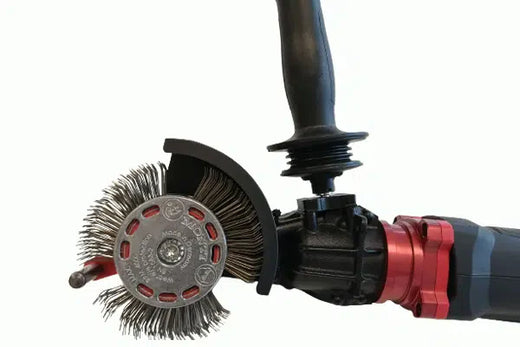
Power tools for surface preparation range from wire brushes and grinders to impact tools. Wire brushes and grinding discs clean but generally do not produce the anchor profile a protective coating needs, and they can polish an existing profile. Impact tools are different. MontiPower®’s portable, semi-automatic technology not only cleans the surface but also creates the roughness the new coating needs. That makes it an alternative to abrasive blasting for smaller areas, for spot repairs, where regulations do not allow loose abrasives in the open, or where setting up a blast operation is not productive.
For steel, the Bristle Blaster® removes rust, paint and mill scale and creates an anchor profile in one pass. In documented tests on standard steel it produces cleanliness comparable to ISO 8501-1 Sa 2½ / SSPC-SP 10 and a 65–85 µm Rz (2.6–3.3 mil) anchor profile. Results vary with steel grade, rust grade, belt and technique, and acceptance against the project specification lies with the inspector. Because the work can be done in-house with hand-held tools, many maintenance teams no longer need to bring in a blasting contractor for smaller areas. With a range of patented belts, there is a belt for most substrates and conditions.
What are the disadvantages of traditional methods?
Loose abrasive blasting and chemical cleaning have been used for many years. Over time, their disadvantages and the dangers of sandblasting and similar methods have become well documented.
Disadvantages of sandblasting
Abrasive blasting is the most widely used technique for preparing steel. However, for smaller coating jobs the set-up is cumbersome: containment, a compressor and blast pot, the abrasive supply and the collection and disposal of spent abrasive. It is skilled work that requires the necessary preparation, which makes blasting a relatively expensive method for small areas in terms of square metres per day. But that is not all.
Blasting can be harmful to people and the environment. The danger lies mainly in the dust: under the high pressure involved, abrasive particles break down, and together with the removed rust and coating they form fine airborne dust. When inhaled, this dust can cause serious health problems. Silica sand is the best-known example: respirable crystalline silica causes silicosis and lung cancer, which is why its use as a blasting abrasive is restricted or prohibited in a number of countries, and why exposure is regulated, for example by OSHA in the United States. Spent abrasive contaminated with old coatings can also be hazardous waste.
Disadvantages of chemical cleaning
With chemical surface preparation, the danger lies in the chemicals used. Pickling typically uses strong acids such as hydrochloric acid, which is corrosive and can cause serious injuries on contact. Hydrochloric acid also releases vapours that are hazardous to people, animals and the surrounding environment, and spent acid has to be neutralised and disposed of.
Surface preparation in various sectors
Their convenience and effectiveness have made MontiPower® tools and belts widely used in various markets, for example the construction and maintenance of bridges, rail tracks, rolling stock and wind turbines. Infrastructure is a sector where maintenance must be done well, safely and quickly.
Where traditional methods can be labour-intensive and hazardous, grit-free power tools can improve health, safety and economics. Grit-free is not dust-free, though: the rust and coating removed still become particles, so extraction and respiratory protection follow the site risk assessment. The same benefits apply in the industrial sector, where oil and gas are handled, in the marine sector, where environmental protection plays a major role, and in fabrication, where steel must be prepared and cleaned properly both before and after welding.
Frequently asked questions
What is the purpose of surface preparation before coating?
Surface preparation removes contaminants that prevent adhesion, such as mill scale, rust, old coatings, oil, salts and dust, and creates the anchor profile a coating needs to grip. Because adhesion governs how long a coating lasts, the specified preparation grade is usually the single most important requirement in a coating specification.
What are the main surface preparation methods?
The main methods are solvent and chemical cleaning, hand and power tool cleaning, impact power tools such as bristle blasting, abrasive blasting, and water jetting. They differ in what they remove and whether they create an anchor profile. The coating specification, not the tool, should decide which method is acceptable.
Which standards define surface preparation grades?
ISO 8501-1 defines visual grades for hand and power tool cleaning (St 2, St 3) and blast cleaning (Sa 1 to Sa 3). AMPP (formerly SSPC and NACE) publishes the SSPC-SP standards, such as SP 3, SP 11, SP 10 and SP 5, and WJ-1 to WJ-4 for water jetting.
Can surface preparation be done without sandblasting?
Yes, depending on the required grade. Impact power tools such as the Bristle Blaster® produce cleanliness comparable to Sa 2½ / SSPC-SP 10 with a 65–85 µm Rz anchor profile in documented tests, which suits spot repairs, welds and smaller areas. Large new-build areas with mill scale are usually still blasted.
Sources
- SSPC-SP 11, Power Tool Cleaning to Bare Metal. glavin.net
- KTA-Tator, Industry Standards for Surface Preparation. kta.com
- SSPC-SP WJ-1/NACE WJ-1, Waterjet Cleaning of Metals: Clean to Bare Substrate. glavin.net
- Farwest Corrosion Control, Coating Application and Dew Point. farwestcorrosion.com
- Roadmap on Carcinogens, Respirable crystalline silica. stopcarcinogensatwork.eu
- OSHA, 29 CFR 1926.1153 Respirable crystalline silica. osha.gov