Short answer: To prepare metal for painting, degrease it first (SSPC-SP 1), then remove rust, mill scale and old coating to the cleanliness grade named in the coating specification, create the required anchor profile, test for soluble salts, and coat within the open time with the steel at least 3 °C above the dew point. Blasting and bristle blasting reach bare metal with a profile; wire brushes do not.
The Grit-Free Surface Preparation Playbook covers every preparation method, standards reference, and method selection matrix — free download.
→ Download the PlaybookThis article explains what surface preparation for painting industrial steel involves, which standards define the result, which methods reach which grade, and the mistakes that cause coatings to fail years before their design life. Surface preparation is widely regarded as the biggest single determinant of how long a coating lasts. A coating applied over inadequately prepared steel usually fails at the interface between the metal and the coating — not in the coating itself. Industry training and coating-failure literature commonly attribute the majority of premature coating failures to inadequate surface preparation; the figure often quoted is 70–80%.
Why surface preparation determines coating life
A coating film does two things: it excludes moisture and oxygen from the steel surface, and it adheres to that surface well enough to maintain that exclusion over the design life. Both functions depend on what the steel surface looks like before the coating goes on.
The adhesion problem
Coating adhesion to steel is mechanical and chemical. Mechanical adhesion requires a roughened surface — an anchor profile — into which the liquid coating flows and cures. Without a profile, the coating sits on a smooth surface with little mechanical grip and is more likely to disbond under thermal cycling, impact, or moisture ingress. Chemical adhesion requires the surface to be chemically clean — free from oils, salts, oxides, and other contamination that sits between the coating and the steel and prevents direct bonding.
The contamination problem
The most dangerous contaminants are invisible. Soluble salts — chlorides, sulphates, nitrates — held in a corroded surface cannot be seen. When a coating is applied over a contaminated surface, the salts are sealed beneath the film. Osmotic pressure drives water through the coating toward the salt deposit, forming a blister. Once a blister forms, the coating around it loses adhesion, corrosion begins at the exposed steel, and the failure propagates. The solution is to remove the contamination during surface preparation — not to apply a thicker coating over it.
What the numbers say
Surface preparation is a large share of the cost of an industrial painting project — on maintenance work with access, containment and waste handling it is frequently the largest single item. The cost of failure is larger still: if the preparation fails, the coating fails, and the full cost of access, preparation and coating must be spent again, often years before the planned maintenance interval. The economics of doing preparation correctly are not marginal.
What must happen before you paint industrial steel
Every industrial coating specification — whether written to SSPC/AMPP, ISO, NORSOK, or a coating manufacturer's system — requires the same three outputs from surface preparation before the first coat of paint can be applied.
1. Cleanliness — remove all contamination
The steel surface must be free from mill scale, rust, existing coating (unless overcoating is explicitly permitted), oil and grease, weld spatter, dust, and soluble salts. The degree of cleanliness required is defined by a standard — commonly SSPC-SP 10 / Sa 2½ (near-white metal) for offshore, immersion and industrial work, and SSPC-SP 5 / Sa 3 (white metal) where the coating system or service demands it. The standard defines the permitted residue and how clean the surface must be — it is not a judgement call made on site.
2. Anchor profile — create mechanical keying for the coating
The surface must be roughened to a specified texture — the anchor profile — measured in micrometres (µm) of peak-to-valley height. Many high-build epoxy coating systems call for roughly 40–75 µm; some thermal spray and heavy-duty systems require more. The coating product data sheet sets the range. A polished surface — even a chemically clean one — has insufficient mechanical adhesion for most industrial coating systems.
3. Salt testing — verify the surface is not contaminated
After preparation and before coating, soluble salt contamination is tested and recorded, typically by Bresle patch extraction (ISO 8502-6) with conductivity measurement (ISO 8502-9). Many offshore and industrial specifications set a maximum of around 20 mg/m² (2 µg/cm²) chloride. On sites with marine exposure, contamination above this threshold is common even after thorough mechanical preparation — and water washing and re-testing may be required before coating can proceed. See our guide to soluble salt contamination and how to test for it.
Surface preparation standards: what the grades mean
The cleanliness grades used in industrial coating specifications come from two parallel standard families — SSPC/NACE (now AMPP, North American) and ISO 8501-1 (international). The blast grades are broadly comparable, but they are written differently: SSPC sets written limits on residual staining per unit area, while ISO 8501-1 relies on written definitions and reference photographs. Any coating specification or product data sheet will reference one or both.
| What the coating specifier writes | SSPC / NACE | ISO 8501-1 | What it means in plain language |
|---|---|---|---|
| White metal blast | SSPC-SP 5 / NACE No. 1 | Sa 3 | No visible mill scale, rust, coating or foreign matter on the surface |
| Near-white metal blast | SSPC-SP 10 / NACE No. 2 | Sa 2½ | Light random staining on no more than 5% of each unit area; otherwise clean |
| Commercial blast | SSPC-SP 6 / NACE No. 3 | Sa 2 | Staining permitted on up to 33% of each unit area |
| Brush-off blast | SSPC-SP 7 / NACE No. 4 | Sa 1 | Loose contamination removed; tightly adherent scale, rust and paint may remain |
| Power tool cleaning to bare metal | SSPC-SP 11 | — | Bare metal, no visible mill scale, rust or coating except in the bottom of pits; minimum 25 µm (1 mil) profile |
| Commercial grade power tool cleaning | SSPC-SP 15 | — | Bare metal with staining on up to 33% of each unit area; minimum 25 µm (1 mil) profile |
| Power tool clean | SSPC-SP 3 | St 3 | Loose rust, loose mill scale and loose paint removed; adherent material may remain |
| Hand tool clean | SSPC-SP 2 | St 2 | Loose rust and scale removed; tightly adherent material remains |
The coating product data sheet sets the minimum grade. For high-performance systems in aggressive atmospheres and immersion, SSPC-SP 10 / Sa 2½ is the most common requirement; SSPC-SP 5 / Sa 3 is specified for some tank linings, thermal-sprayed metal and other demanding systems. For repairs and maintenance, SSPC-SP 11 is often accepted. A coating applied over SP 3 on a surface specified for SP 10 typically voids the coating warranty and is a foreseeable failure. Our SSPC-SP 11 technical guide explains the power tool bare-metal grade in detail.
Surface preparation methods for industrial steel painting
Abrasive blasting
Abrasive blasting — propelling grit, steel shot, or other media at the surface using compressed air or a centrifugal wheel — is the benchmark preparation method for large-area industrial painting. In a blast room or on a site with containment and the right equipment, it achieves SP 10 and SP 5 reliably, creates a controlled anchor profile, and processes area quickly. It is the standard for new-build structural steel fabrication and large marine structures in drydock.
Its limitations are significant in maintenance contexts: it requires a large compressor and blast pot, generates a media waste stream, must be contained to prevent abrasive escape, is heavily restricted in ATEX-classified areas (typically requiring hot-work permits or shutdowns), and is uneconomic for spot repair where mobilisation cost exceeds the preparation area. Most real-world maintenance work does not take place in a blast room.
Bristle blasting
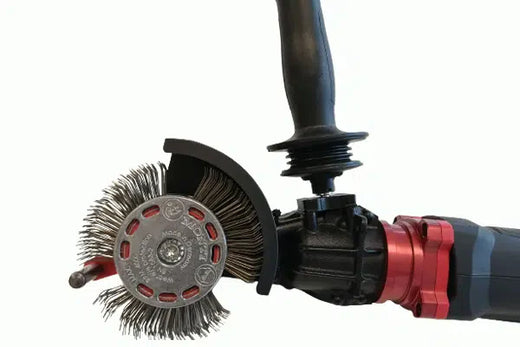
Bristle blasting uses a rotating belt of hardened steel wire bristles that an accelerator bar releases so the tips strike the surface — removing rust, mill scale, and existing coating while simultaneously creating an anchor profile. The Bristle Blaster® is a hand-held tool that, in documented tests, produces cleanliness comparable to ISO 8501-1 Sa 2½ / SSPC-SP 10 (and Sa 3 / SP 5) with a 65–85 µm Rz anchor profile on standard steel, without abrasive media. Results vary with steel grade, rust grade, belt and technique.
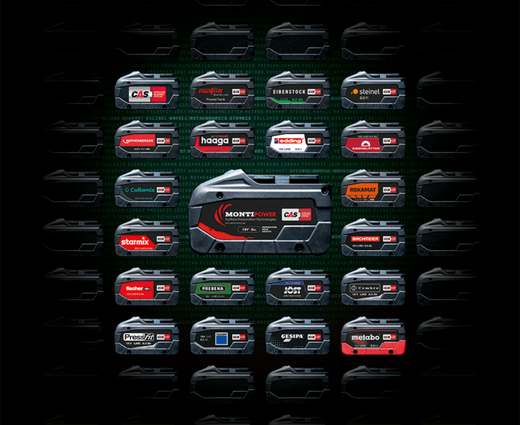
It is a primary alternative to sandblasting for in-service maintenance, ATEX zone 1 environments, spot repair, confined spaces, and pipeline field joints. It runs from mains electricity, compressed air or an 18 V battery and requires no blast containment or media management. Grit-free is not dust-free: removed rust and coating still become particles and need appropriate controls. The fully pneumatic Bristle Blaster® Pneumatic has an ATEX 2014/34/EU conformity evaluation as Category 2 equipment for zone 1 gas (IIA) and zone 21 dust.
Power tool cleaning (angle grinder, flap disc, needle gun, wire brush)
Results from conventional power tools vary by tool type. Power wire brushes remove loose and partially adherent contamination but tend to leave and polish tightly adherent mill scale — they typically reach SSPC-SP 3 (St 3). SSPC-SP 11 warns that power wire brushes or sanding discs used alone may not produce the required profile. Grinding discs can reach bare metal but leave a shallow, directional profile and remove sound steel. Impact tools such as needle guns and rotary impact flaps are named in SSPC-SP 11 as impact media and can reach SP 11 on suitable surfaces, but the profile must be measured rather than assumed. SP 3 preparation is adequate only for lower-specification work — maintenance coatings in mild environments, temporary protection, or surface-tolerant systems specifically qualified for power tool-cleaned surfaces.
Hand tool cleaning (wire brush, scraper)
Hand wire brushing and scraping achieve SSPC-SP 2 (St 2) — loose contamination only. This is not a preparation method for high-performance industrial painting. It is useful for temporary protection of surfaces that cannot be mechanically prepared immediately, or as a pre-cleaning step before mechanical preparation. A coating system applied over SP 2 preparation in an industrial or marine environment should be expected to fail prematurely.
Chemical preparation (degreasing, phosphating, acid pickling)
Chemical methods address specific contamination types. Solvent cleaning (SSPC-SP 1) removes oil and grease and should precede other preparation methods — mechanical preparation tends to smear oil contamination across the surface rather than removing it. Phosphoric acid wash converts light surface rust and provides a conversion layer that improves paint adhesion on lightly corroded surfaces — but it does not remove heavy rust or mill scale, and it does not create an anchor profile. Acid pickling (hydrochloric or sulphuric acid) removes mill scale in controlled industrial plants but is not a field method and introduces hydrogen embrittlement risk in high-strength steels. Chemical methods supplement mechanical preparation; on heavy rust and mill scale, they do not replace it.
Water jetting
High- and ultra-high-pressure water jetting removes existing coating, rust, and soluble contamination through hydraulic force, graded WJ-1 to WJ-4. On previously blasted steel it can re-expose the original anchor profile. It does not create a new primary anchor profile on bare, unprofiled steel, and it generates contaminated water that requires collection and disposal. For stripping large areas of coating prior to re-preparation, water jetting followed by a profiling method (blasting or Bristle Blaster®) is an effective two-step approach.
Choosing the right preparation method for your project
| Situation | Recommended method | Typical result |
|---|---|---|
| New-build fabrication, blast room available | Abrasive blasting | SP 10 / SP 5 |
| In-service maintenance, ATEX zone 1 | Bristle Blaster® Pneumatic (ATEX-evaluated) | SP 11; comparable to SP 10 / Sa 2½ in documented tests |
| Spot repair — no blast infrastructure, no containment | Bristle Blaster® | SP 11; comparable to SP 10 / Sa 2½ |
| Confined space — ventilation restricted | Bristle Blaster® | SP 11; comparable to SP 10 / Sa 2½ |
| Pipeline field joint — girth weld coating | Bristle Blaster® (single or double belt) | Comparable to SP 10 / Sa 2½ (Sa 3 where specified) |
| Large area coating strip before re-profiling | Water jetting + Bristle Blaster® | Comparable to SP 10 after profiling |
| Heavily corroded surface before Bristle Blaster® | Two-step: Tercoo® + Bristle Blaster® | Comparable to SP 10 / Sa 2½ |
| Oil / grease contamination (any surface) | Solvent clean (SSPC-SP 1) first — then mechanical preparation | Enables the specified grade after the mechanical step |
| Mild environment, lower-tier maintenance coating | Power tool clean (wire brush / grinder) | SP 3 / St 3 |
The most common surface preparation mistakes — and what they cost
Painting over mill scale
Mill scale looks clean. It is smooth, blue-grey, and passes a casual visual inspection. It is also electrochemically cathodic to the base metal and, once cracked by thermal cycling or flexing, lets moisture reach the steel beneath — and the scale disbonds, taking the coating with it. Painting over intact mill scale is a common cause of premature coating failure on new structural steel, and it is preventable. Paint applied to hot-rolled steel that has not been blasted, bristle blasted or otherwise descaled to a bare-metal grade is going onto mill scale.
Skipping the salt test
Visible rust is removed. The surface looks clean. The coating is applied. A few years later, the coating is blistering. The cause: chloride salts that were present under the rust, invisible after mechanical cleaning, sealed beneath the coating film. Osmotic blistering driven by those salts is not a coating defect — it is a preparation defect. A Bresle patch test takes minutes and costs little. Skipping it on any surface with a history of marine or industrial atmospheric exposure is a gamble with the coating system's full service life.
Applying coating outside the dew point window
Coating applied when the steel temperature is less than 3 °C above the dew point risks surface condensation — often invisible — between the steel and the coating. The film cures over a layer of moisture, adhesion is compromised from day one, and disbondment accelerates once in service. Temperature, humidity and dew point must be measured and recorded immediately before coating application, not assumed. In morning conditions the window can close quickly.
Leaving too long between preparation and coating
Freshly prepared steel re-rusts. The rate depends on humidity, temperature, and atmospheric contamination — on an outdoor site in humid conditions, flash rust can appear within hours of preparation. Many coating specifications set a maximum interval of around 4 hours between preparation and coating, or require coating before any visible re-rusting. Preparing large areas in advance of the coating crew without monitoring routinely results in re-rusted surfaces that must be re-prepared.
Using SP 3 preparation for SP 10-specified coatings
This happens because the right tool — abrasive blasting or Bristle Blaster® — is not available on site, and the angle grinder or wire brush that is available gets used instead. The coating is applied, the inspection does not look closely at preparation grade, and the failure begins from the first day. If the coating specification says SP 10, the preparation must meet SP 10 or an equivalent accepted in writing by the specifier. No coating system compensates for inadequate surface preparation — thicker coats, more coats, and higher-specification coatings all fail early on an SP 3 surface that was supposed to be SP 10.
Before you paint: the preparation checklist
Before any coating is applied to industrial steel, verify each of the following:
- Oil and grease removed. Solvent clean (SSPC-SP 1) before any mechanical preparation. If oil is present after mechanical preparation, clean again and re-prepare.
- Cleanliness grade confirmed. Visual assessment against ISO 8501-1 reference photographs or SSPC-VIS 1 / VIS 3. Surface meets or exceeds the grade specified in the coating specification.
- Anchor profile measured and recorded. ASTM D4417 (Method C replica tape or Method B depth micrometer), with the number of readings set by SSPC-PA 17 or the specification. Results within the profile range in the coating product data sheet.
- Soluble salt test completed and recorded. Bresle patch per ISO 8502-6 with conductivity per ISO 8502-9. Result at or below the specified maximum (often 20 mg/m²). If above, clean and re-test before proceeding.
- Weld geometry checked. All spatter removed. Sharp edges rounded to the specified radius (ISO 8501-3 / ISO 12944-3 commonly reference a minimum 2 mm radius).
- Surface temperature and dew point checked. Steel temperature at least 3 °C above dew point. Ambient temperature and relative humidity within coating product data sheet limits.
- Time since preparation recorded. Coating applied within the specified interval and before visible re-rusting.
- All records documented. Operator, date, location, preparation grade, profile readings, salt readings, temperature/dew point at time of coating. Required for warranty and QA/QC compliance.
Frequently asked questions
What is the most important step in preparing metal for painting?
Reaching the cleanliness grade the coating specification requires — often SSPC-SP 10 / Sa 2½ for industrial work — is the most critical step. It means removing mill scale, rust and contamination to that grade. Anchor profile and salt testing are also essential: oil or salts under a coating will cause failure however good the profile is.
Can I paint over rust on steel?
Not with a high-performance industrial coating. Rust under a coating remains an active corrosion site, and the coating disbonds from beneath. Rust converters stabilise surface rust but do not remove it or create an anchor profile, and major coating manufacturers do not accept them as a substitute for mechanical preparation to the specified grade.
Do I need special equipment to prepare metal for painting?
For bare-metal grades with an anchor profile, yes. Abrasive blasting or an impact power tool such as the Bristle Blaster® is needed; wire brushes reach SP 3 at best. The Bristle Blaster® is hand-held, uses no loose media, needs no blast containment, and its pneumatic model is ATEX-evaluated for zone 1.
How long after surface preparation can I apply paint?
Many coating specifications set a maximum of around 4 hours between completing surface preparation and starting coating, and all require coating before visible re-rusting. In humid or coastal conditions flash rust can appear sooner, in which case the surface must be re-prepared. Always check the coating product data sheet and project specification.
What is anchor profile and why does it matter?
Anchor profile is the surface roughness, measured as peak-to-valley height in µm, created by surface preparation. It gives the coating mechanical grip on the steel. Many high-build epoxy systems specify about 40–75 µm. The Bristle Blaster® produces 65–85 µm Rz on standard carbon steel in documented tests, depending on steel, belt and technique.
What is the difference between Sa 2½ and SP 10?
Both describe near-white metal blast cleaning and are generally treated as comparable. SSPC-SP 10 / NACE No. 2 is the North American standard and limits staining to 5% of each unit area. ISO 8501-1 Sa 2½ is the international grade, defined by a written description and reference photographs. Check which one the specification names.
Related resources
- How to Remove Mill Scale from Steel: Tools, Methods, and Specifications — Why mill scale must go and which tools actually remove it.
- What is Bristle Blasting? How It Works, Standards It Achieves, and When to Use It — The hand-held, grit-free alternative to sandblasting: how it works and how to specify it.
- Alternatives to Sandblasting Steel: Complete Method Comparison — Every method compared across ATEX suitability, standards and production rate.
MontiPower®'s technical team advises on method selection, tool configuration, and compliance for any substrate, environment, and coating specification.
→ Talk to a Surface Prep SpecialistSources
- SSPC-SP 11, Power Tool Cleaning to Bare Metal (bare-metal definition, minimum 25 µm profile, impact media, warning on wire brushes and sanding discs). glavin.net
- SSPC-SP 3, Power Tool Cleaning (adherent mill scale, rust and paint not intended to be removed). glavin.net
- KTA-Tator, Industry Standards for Surface Preparation (SP 1–SP 15 and ISO 8501-1 grades). kta.com
- Corrosion Alliance, Surface Preparation Standards. corrosionalliance.com
- ISO 8501-1 (rust and preparation grades), ISO 8502-4 (condensation / dew point), ISO 8502-6 and 8502-9 (soluble salts), ASTM D4417 and SSPC-PA 17 (profile measurement), ISO 12944-3 (design, edge radius). Standards as published.
- MontiPower®, Bristle Blaster® technical data sheet and ATEX conformity evaluation (Category 2; zone 1 gas IIA, zone 21 dust).