Short answer: “Dustless blasting” usually means wet abrasive blasting, where water suppresses the dust but abrasive is still used. The Bristle Blaster® takes a different route: a rotating belt of sharpened wire bristles cleans and profiles steel with no abrasive or water. It is grit-free rather than dust-free — removed rust and coating still become particles — so extraction and PPE remain part of the job.
Dust is one of the biggest problems with traditional abrasive blasting: spent media and pulverised coating fill the air, need containment and end up as waste. This article explains what “dustless blasting” really means, how the MontiPower® Bristle Blaster® prepares steel without any blast media, how much dust is actually left, and which Bristle Blaster® model suits which job.
What do we mean by “dustless blasting”?
The term is used for two quite different things. Most often it describes wet abrasive blasting — also called vapour or slurry blasting — in which water is mixed into the abrasive stream. The water keeps most of the dust down, but the process still uses abrasive, still creates a slurry that has to be collected and disposed of, and leaves wet steel that can flash rust before it is coated.
Dustless blasting with the Bristle Blaster® means something else: surface preparation with no loose abrasive and no water at all. The Bristle Blaster® uses a specially designed belt of angled spring-steel wire with sharpened tips. An accelerator bar holds the bristles back and releases them, so the tips strike the surface rather than drag across it. Each impact fractures and ejects rust, coating and mill scale, then the tip rebounds, leaving a fresh, micro-indented surface. The drive turns the belt at a controlled speed — for example 2,300 rpm (±5%) on the Ultimate Electric and 2,200 rpm on the Ultimate Cordless — because a belt that runs too fast scrapes instead of striking.
Because there is no blast media, there is no abrasive cloud and no spent grit to sweep up. What does come off is the material you remove: rust, scale and old coating, which leave the surface as particles and chips. Those particles are easy to collect with a vacuum or a dust extractor, but they are not nothing — which is why we describe the method as grit-free and low-dust, not dust-free.
MontiPower’s patented dustless blasting machine: the Bristle Blaster®
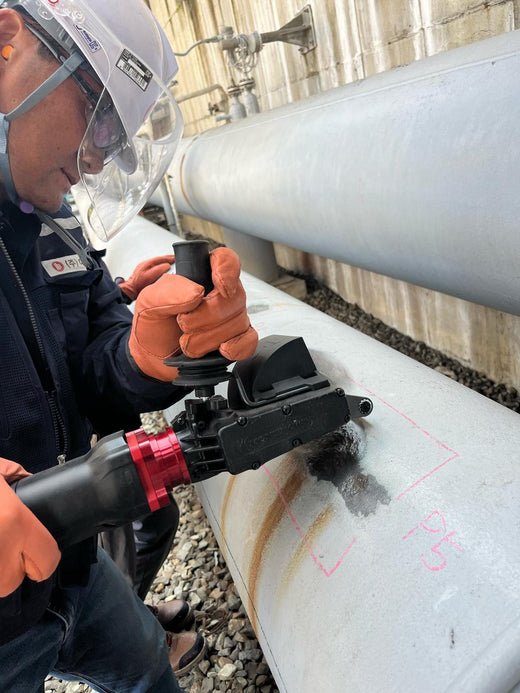
The Bristle Blaster® is a hand-held power tool that replaces abrasive blasting on maintenance, repair and field work. Fitted with a protective cover connected to a suitable vacuum unit or dust extractor, it captures most of the removed particles at the source. The Bristle Blaster® Pneumatic is supplied with Dust Control, and portable extraction is used for jobs such as removing coatings that may contain hexavalent chromium.
One of the key features that sets this tool apart from wire brushes and grinders is that it creates an anchor profile while it cleans. In documented tests on API 5L steel, the Bristle Blaster® produces cleanliness comparable to ISO 8501-1 Sa 2½ / SSPC-SP 10 and a 65–85 µm Rz (2.6–3.3 mil) anchor profile, with up to 120 µm Rz possible. A controlled, consistent profile is what gives a new coating mechanical grip, so the coating adheres firmly and lasts longer. Results on any job vary with steel grade, rust grade, belt choice and technique.
What the Bristle Blaster® does not do is use water or blasting agents. It works dry, on cold steel, without heat input, so there is no slurry to manage and no water to cause flash rust before coating.
What are the benefits of dustless blasting?
Dustless blasting, sometimes called sandless sandblasting, offers several advantages over open abrasive blasting. With the Bristle Blaster® they are:
- Lower dust exposure: with no abrasive in the air, airborne dust is limited to the removed rust and coating particles — a fraction of the load from open blasting. That reduces the respiratory risk for operators and bystanders. Where abrasives or substrates contain crystalline silica, exposure limits are strict: OSHA sets a permissible exposure limit of 50 µg/m³ (8-hour TWA) with an action level of 25 µg/m³, and EU Directive 2017/2398 sets a binding limit of 0.1 mg/m³. Respiratory and eye protection are still required with any mechanical method.
- Less environmental impact: no spent abrasive means no media waste stream, no blast enclosure and much less material escaping to the surroundings. That makes the method a practical choice in sensitive or occupied areas and where environmental rules are strict. Removed coating debris still has to be collected and disposed of correctly, especially if it contains lead or chromates.
- Time saved on set-up and clean-up: there is no blast pot, compressor train, hose run or containment to set up, and no grit to recover afterwards. On small repairs this often saves more time than the preparation itself.
- Versatility: the Bristle Blaster® prepares carbon and structural steel, weld seams, edges and areas around bolts. With stainless-steel belts and accelerator bars it is also used on stainless steel and aluminium without contaminating the surface.
Bristle Blaster® models to choose from
MontiPower offers a range of Bristle Blaster® drives. Every drive reaches the same surface result from the same belts; the drive decides where you can work.
The Bristle Blaster® Ultimate Electric is the standard model, powered from 230 V or 120 V mains for consistent all-day performance. The Ultimate Electric Double runs two belts side by side, reaching around 3 m² per hour on flat surfaces, which makes it the choice for larger areas or when time is short.
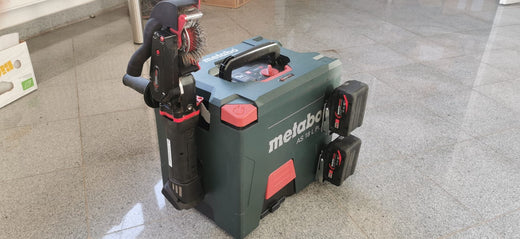
The Bristle Blaster® Ultimate Cordless offers freedom of movement without a power cord. On the 18 V Cordless Alliance System (CAS) platform it gives approximately 25 minutes of surface preparation per 8 Ah battery, so it suits work at height, in confined spaces and at remote sites without mains power — carry spare batteries for longer shifts.
The Bristle Blaster® Pneumatic uses compressed air (6.2 bar / 90 psi and about 0.5 m³/min) to drive the belt. It has no electrical parts and has been evaluated under ATEX 2014/34/EU for zone 1 explosive gas and zone 21 explosive dust, making it the model for refineries, offshore platforms and petrochemical sites. A Pneumatic Double version covers larger areas inside hazardous zones.
Finally, the Bristle Blaster® Axial is designed for areas that are difficult to reach, such as door rabbets, roof joints, wheel housings, weld seams, corners and flanges. Its slim axial form makes it a complement to the other Bristle Blaster® systems. For preparation below the waterline there is also the hydraulic Bristle Blaster® Subsea.
Less dust, no grit: the bottom line
Dustless blasting with the Bristle Blaster® replaces the abrasive, not the need for good practice. With a suitable vacuum unit or dust extractor attached, the tool keeps airborne dust low, removes the spent-media waste stream and cuts the clean-up that comes with blasting. Ask your MontiPower distributor which extraction set-up, including battery-powered options, fits your tool and job.
The patented design of the Bristle Blaster® delivers a blast-comparable finish in a hand-held tool: cleanliness comparable to Sa 2½ and an anchor profile that improves coating adhesion. That combination is why it is used in industrial maintenance, construction, pipelines, marine and offshore work, and on vehicles and rolling stock. For a comparison with the health and cost risks of open abrasive blasting, read what are the dangers of sandblasting.
Frequently asked questions
What is dustless blasting?
Dustless blasting usually refers to wet abrasive blasting, where water is added to the abrasive stream to suppress dust. It still uses abrasive and produces slurry. Bristle blasting with the Bristle Blaster® is a dry, media-free alternative: rotating wire bristles strike and rebound from the steel, cleaning and profiling it without abrasive or water.
Is the Bristle Blaster® completely dust-free?
No. It is grit-free, not dust-free. There is no abrasive cloud, so airborne dust is far lower than with open blasting, but the rust and coating you remove still become particles. Use a vacuum unit or dust extractor, plus respiratory and eye protection, and treat coatings containing lead or chromates with extra care.
What surface finish does the Bristle Blaster® give?
In documented tests on API 5L steel, the Bristle Blaster® gives cleanliness comparable to ISO 8501-1 Sa 2½ / SSPC-SP 10 and a 65–85 µm Rz anchor profile, with up to 120 µm Rz possible. Results vary with steel grade, rust grade, belt and technique, so verify the profile with replica tape on each job.
Which Bristle Blaster® can be used in hazardous areas?
The Bristle Blaster® Pneumatic and Pneumatic Double. They are fully air-driven with no electrical parts and have been evaluated under ATEX 2014/34/EU for zone 1 explosive gas and zone 21 explosive dust. The site permit system still decides whether work may proceed in a classified area.
Sources
- OSHA 29 CFR 1926.1153, Respirable crystalline silica. osha.gov
- Directive (EU) 2017/2398 on carcinogens and mutagens at work (respirable crystalline silica). stopcarcinogensatwork.eu
- R. J. Stango et al., Fundamentals of Bristle Blasting Process for Removing Corrosive Layer, NACE CORROSION 2009. AMPP abstract
- MontiPower technical data sheets and manuals: Bristle Blaster® Ultimate Electric, Ultimate Cordless, Pneumatic (incl. ATEX conformity evaluation) and Axial.