Short answer: Pitting corrosion is localised attack that forms small, deep cavities, usually driven by chlorides. It matters for surface preparation because pits hold corrosion products and soluble salts that blasting does not reliably remove, and coatings are thin over pit walls. Address it by assessing depth, removing heavy crusts, cleaning and profiling, washing out salts, and stripe-coating or filling deep pits.
This article explains what causes pitting corrosion, where it occurs, why it is a specific problem for coating work, and a five-step approach to preparing pitted steel. Pitting is one of the most damaging forms of localised corrosion in industrial steel structures. Unlike uniform corrosion, which reduces steel thickness gradually over a broad area, pitting concentrates attack into small, deep cavities that can perforate a section while the average metal loss is still small. For surface preparation, pitting creates a challenge that standard blast grades do not fully resolve: pits survive blast cleaning as geometric defects in the steel, and the contamination and corrosion products within them continue to threaten the applied coating's adhesion and long-term integrity.
What causes pitting corrosion?
Pitting corrosion is an electrochemical process that starts where a protective surface film — a passive oxide film on stainless steel and aluminium, or mill scale, corrosion product or coating on carbon steel — is locally broken, typically in the presence of aggressive anions, most commonly chloride ions. A typical sequence on steel is:
- Chloride ions concentrate at a surface defect, inclusion, coating break or gap in mill scale, disrupting the surface film
- An anodic site forms: iron dissolves within the developing pit
- The pit geometry creates a differential aeration cell — the pit interior becomes oxygen-depleted and stays anodic, while the surrounding surface (or adjacent mill scale) acts as the cathode
- The pit chemistry becomes progressively more acidic and chloride-rich as reaction products hydrolyse, further accelerating corrosion within the pit
- A corrosion product cap often forms over the pit mouth, which can hide the pit while corrosion continues beneath
In practical terms, pitting is self-reinforcing. Once initiated, a pit creates the chemical conditions that accelerate its own growth. This is why pitting can progress quickly in aggressive environments — offshore, marine, chemical processing, and high-chloride atmospheres — and why early detection and treatment matter. For the general mechanisms, see What Is Corrosion? Types, Causes and How Surface Preparation Stops It.
Where pitting corrosion occurs in industrial assets
- Offshore structures — splash zone and tidal zone on jacket legs; topsides at areas of coating breakdown where chloride deposition is high
- Marine vessels — ballast tanks (particularly at low points where saline water accumulates), cargo hold structures, hull plating at coating defects
- Pipelines — external surface at disbonded coating locations; internal surface in sweet and sour service where CO₂ and H₂S promote localised attack
- Storage tanks — internal floor plates and lower shell courses in contact with process fluids, and tank bottoms where water accumulates
- Heat exchangers and pressure vessels — surfaces in contact with chloride-containing process fluids or cooling water
- Mining structures — process vessels, structural steel, and piping in contact with acidic process fluids and chloride-rich process water
Why pitting creates surface preparation challenges
Standard abrasive blast cleaning — even to SSPC-SP 10 / Sa 2½ (near-white metal) — addresses contamination and anchor profile on the general steel surface, but does not fully resolve the problems that deep pitting creates. The power tool bare-metal standards recognise this explicitly: SSPC-SP 11 and SP 15 permit residues of rust and coating in the bottom of pits where the original surface is pitted.
1. Pits retain corrosion products after blasting
Blast media strikes the surface at high velocity, but the geometry of a deep, narrow pit limits how well media cleans its interior. Corrosion products — iron oxides, iron chlorides and iron sulphates — can remain in the lower part of pits even when the surrounding steel meets Sa 2½. These residues continue to corrode the steel beneath a subsequently applied coating and contribute to osmotic blistering through their soluble salt content.
2. Pits retain soluble salt contamination
Chloride salts are hygroscopic — they attract moisture. Once chloride-rich corrosion products accumulate in pits, they draw water through any overlying coating by osmosis. This is the mechanism of osmotic blistering: the salt concentration in the pit creates a local driving force that pulls water through the coating film, building pressure until the coating blisters and delaminates. Dry blasting alone does not reliably remove soluble salts from pit interiors. Water washing or high-pressure water jetting (SSPC-WJ grades) is generally more effective at removing salt-laden corrosion products from pitted steel.
3. Deep pits create coating thickness deficiencies
A coating film follows the contour of the steel surface. Over a deep pit, coverage at the base and walls can be much thinner than over the surrounding steel, and on narrow pits the coating may bridge the pit mouth — leaving a void beneath an apparently intact film. These thin-film areas and voids are often the first to fail in service.
4. Pitting reduces effective section thickness
While not strictly a surface preparation issue, pitting that has reduced steel below the minimum acceptable thickness must be identified before coating and may require repair (for example by welding or plate replacement) before coating application. Ultrasonic thickness measurement across pitted areas and pit-depth gauging are standard practice for fitness-for-service assessment in the energy and marine sectors.
How to address pitting corrosion in surface preparation
Step 1: Assess pit depth and extent
Before selecting a preparation method, characterise the pitting: depth, diameter, density (pits per unit area), and the presence of corrosion product crusts covering pit mouths. This determines whether blast or power tool cleaning alone is enough, or whether a preliminary heavy-removal step is needed.
Step 2: Remove bulk corrosion from heavily pitted areas — Tercoo®
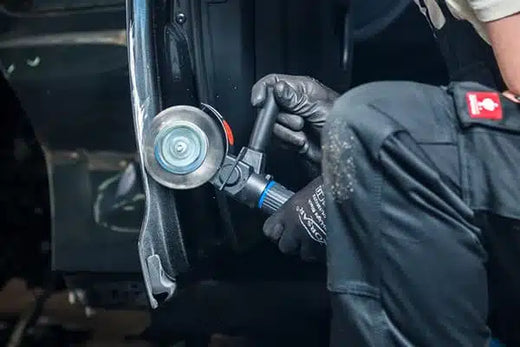
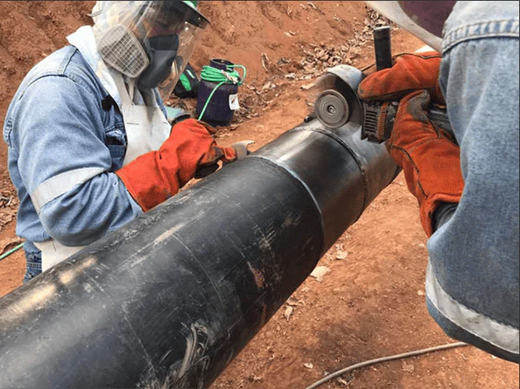
For steel with laminar corrosion, thick corrosion product crusts, or heavy pitting with intact corrosion product over the pit mouths, removing the bulk corrosion before final preparation is the technically correct approach. Tercoo® tungsten-carbide pin discs are designed for this: they strip heavy rust, laminar scale and existing coating, exposing the steel beneath the corrosion crust and opening pit mouths for subsequent cleaning.
Step 3: Achieve target cleanliness and profile — Bristle Blaster® or abrasive blasting
After bulk corrosion removal, the surface is brought to the target cleanliness grade and anchor profile:
- Abrasive blasting gives the highest production rate and the most consistent result across large areas.
- The Bristle Blaster® produces cleanliness comparable to ISO 8501-1 Sa 2½ / SSPC-SP 10 and a 65–85 µm Rz anchor profile on standard steel in documented tests, without loose abrasive. Results vary with steel grade, rust grade, belt and technique. It suits confined spaces, remote locations, spot repairs and — with the pneumatic, ATEX-evaluated model — zone 1 hazardous areas where blasting is not viable. As with any tool, inspect pit bottoms closely; the guide on how to treat corroded pinholes shows the technique on localised pitting.
The combined sequence is described in The Two-Step MontiPower® Method: From Heavy Corrosion to SSPC-SP10.
Step 4: Control soluble salt contamination
On pitted steel with a history of chloride exposure, soluble salt testing before coating is essential. Measure by Bresle patch (ISO 8502-6) and conductivity (ISO 8502-9). Limits are set by the specification: many offshore specifications use 20 mg/m² (2 µg/cm²), and the IMO Performance Standard for Protective Coatings for ballast tanks sets a maximum of 50 mg/m² as sodium chloride. If results exceed the limit, wash with clean water or use water jetting, allow the surface to dry, re-prepare any flash rust, and confirm with a repeat test before priming. See Soluble Salt Contamination and Coating Failure.
Step 5: Stripe coat or fill deep pits
Deep pits may need a stripe coat of the primer worked into the pit by brush, or filling with a compatible filler or surface-tolerant material, before the full coating system is applied, so that film thickness at the pit base and walls is adequate. The method and materials must be compatible with the coating system and written into the project specification — consult the coating manufacturer's product data sheet.
Key takeaways
- Pitting corrosion concentrates attack in localised deep cavities, usually driven by chloride-induced breakdown of a protective surface film. It is self-reinforcing: the pit chemistry accelerates its own growth.
- Blast cleaning to Sa 2½ / SSPC-SP 10 does not fully resolve deep pitting: corrosion products and soluble salts can remain in pit interiors after blasting.
- On heavily pitted steel, an effective approach is two-step preparation: Tercoo® for bulk corrosion and crust removal, followed by Bristle Blaster® or abrasive blasting to reach the target cleanliness and anchor profile.
- Soluble salt control is critical for pitted steel — chloride-rich corrosion products in pits drive osmotic blistering. Test and treat before coating.
- Pitting that has reduced steel below minimum thickness requires structural assessment and repair before coating — coating cannot restore lost section.
Frequently asked questions
What causes pitting corrosion on steel?
Pitting starts where a protective film, mill scale or coating is locally broken, usually in the presence of chlorides. The pit becomes a small anode surrounded by a large cathode, and its interior turns acidic and chloride-rich, which accelerates further attack. Marine, offshore and chemical environments are the most aggressive.
Does abrasive blasting remove corrosion from pits?
Not completely. Blasting cleans the open surface well, but corrosion products and soluble salts can remain at the bottom of deep, narrow pits even when the surrounding steel meets Sa 2½. SSPC-SP 11 and SP 15 explicitly allow residue in pit bottoms. Water washing and salt testing are needed on pitted, chloride-exposed steel.
What is an acceptable soluble salt level before coating pitted steel?
The coating specification sets the limit. Many offshore specifications use 20 mg/m² (2 µg/cm²) measured by Bresle patch and conductivity, and the IMO ballast tank standard allows up to 50 mg/m² as sodium chloride. If the result is higher, wash or water-jet the surface and test again.
Should deep pits be filled before coating?
Deep pits usually need a brushed stripe coat of primer, and sometimes a compatible filler, so the coating reaches the pit base at adequate thickness. Pits that have reduced the steel below minimum thickness need structural assessment and repair first. Follow the coating manufacturer's data sheet.
Related articles
Sources
- Corrosion Alliance, Principles of Corrosion. corrosionalliance.com
- SSPC-SP 11, Power Tool Cleaning to Bare Metal (residue permitted in the bottom of pits). glavin.net
- SSPC-SP WJ-1 / NACE WJ-1, Waterjet Cleaning of Metals — Clean to Bare Substrate. glavin.net
- IMO Resolution MSC.215(82), Performance Standard for Protective Coatings for Dedicated Seawater Ballast Tanks (soluble salts ≤ 50 mg/m² NaCl; Sa 2½, 30–75 µm profile). dl.defelsko.com
- KTA-Tator, Industry Standards for Surface Preparation. kta.com