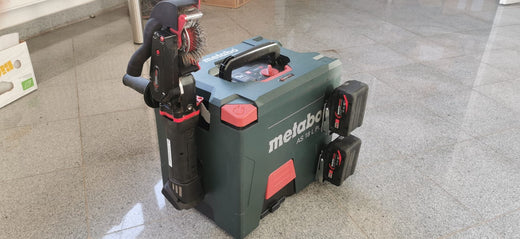
In brief: In September 2019 MontiPower® introduced the Subsea Bristle Blaster®, a hydraulic underwater surface preparation tool with a water drive. It was shown as a fully self-contained unit in operation: a pump unit with a 600-litre water tank and a 50-metre hose, plug and play. The tool brings grit-free bristle blasting below the waterline.
The Subsea Bristle Blaster® is MontiPower®'s new hydraulic underwater device with a unique water drive, shown here as a fully self-contained unit in operation. The pump unit has a 600-litre water tank and a 50-metre hose: plug and play.
What the Subsea Bristle Blaster® is
The Bristle Blaster® Subsea applies the same patented bristle blasting principle as the electric, pneumatic and cordless Bristle Blaster® tools, but is driven by water pressure instead of electricity or compressed air. A powerful, serviceable water motor turns the belt; torque and speed are adjusted at the high-pressure unit. The tool is connected to its power unit by a single high-pressure hose.
As with the other Bristle Blaster® drives, forward-angled wire bristle tips are held back by an accelerator bar, released, and strike the surface before rebounding. The impacts remove corrosion, coatings, scale and adhesive residue and leave a micro-indented anchor profile. MontiPower specifies the Subsea for cleanliness comparable to ISO 8501-1 Sa 2½ and Sa 3 and an anchor profile of 65–85 µm Rz (up to 120 µm Rz) on standard steel; results vary with steel grade, rust grade, belt and technique, and conditions underwater add their own variables.
Why underwater surface preparation matters
Coating repairs below the waterline, on ship hulls, port infrastructure, subsea pipelines and offshore structures, depend on the same two things as repairs above water: a clean surface and an anchor profile that the repair material can bond to. Underwater, conventional abrasive blasting is difficult to control and loose media cannot be recovered. A grit-free, hand-held tool that cleans and profiles in a single action gives divers a controlled, inspectable preparation step for repair coatings, pipeline composite reinforcements and subsea welding activities.
The development builds on research into bristle blasting as surface preparation for underwater corrosion protection, summarised on our page on the 2016 underwater surface preparation study.
What happened next
Later updates covered the first series of water-driven units leaving the factory (New Subsea leaves the factory) and a DNV offshore hydro unit built to power several Subsea tools at once. Independent research has since tested the tool on a robot arm as the preparation step of an ROV-based repair process: see Fraunhofer IGP's ROV coating repair research.
Where to learn more
For applications, specifications and project enquiries, see Subsea preparation and our marine and offshore industry page. The Subsea is supplied project-specifically, with belts and an offshore case available on request.
Frequently asked questions
How is the Subsea Bristle Blaster® powered?
Hydraulically, by water. A water motor in the tool is driven by a high-pressure unit through a single hose, and torque and speed are adjusted at that unit. The unit introduced in 2019 was a self-contained set with a 600-litre water tank and a 50-metre hose, so no electrical supply is taken underwater.
What surface result does the Subsea Bristle Blaster® produce?
MontiPower specifies cleanliness comparable to ISO 8501-1 Sa 2½ and Sa 3 and an anchor profile of 65–85 µm Rz, up to 120 µm Rz, on standard steel. Results vary with steel grade, rust grade, belt and technique, and underwater conditions add further variables, so the profile should be verified on each job.
What is the Subsea Bristle Blaster® used for?
Preparing steel below the waterline before repair coatings, pipeline composite reinforcements and subsea welding, for example on ship hulls, port infrastructure, subsea pipelines and offshore structures. It removes corrosion, coatings, scale and adhesive residue without loose abrasive, so there is no blast media to contain or recover.
Sources
- MontiPower, Bristle Blaster® Subsea product specifications (surface cleanliness, anchor profile, drive).
- R. J. Stango et al., Fundamentals of Bristle Blasting Process for Removing Corrosive Layer, NACE CORROSION 2009. AMPP abstract