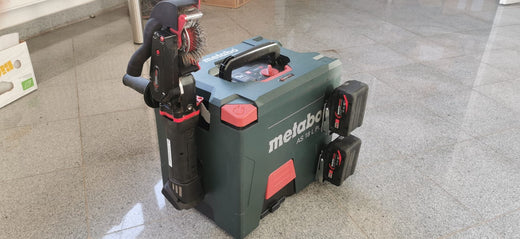
The most environmentally friendly way to remove mill scale is the method that produces the least secondary waste for the grade you need. Abrasive blasting generates spent abrasive mixed with the removed scale and coating; acid pickling generates spent acid; water jetting generates contaminated water. Impact power tools such as bristle blasting add no media at all, so the waste is essentially the removed scale and coating plus worn consumables, and they also create the anchor profile coatings need. They are grit-free, but not dust-free.
"Environmentally friendly" gets used loosely in surface preparation. This guide makes it measurable. It compares mill scale removal methods by what they leave behind (waste streams, emissions and worker exposure) and by whether they still deliver a surface the coating can rely on. A method that saves waste but leaves mill scale under the coating is not sustainable; the steel will need preparing again much sooner.
What makes a mill scale removal method environmentally better
- Secondary waste. Anything added to the process (abrasive, acid, water) becomes contaminated by what you remove and has to be collected and disposed of. Less added material means less waste.
- Hazardous classification. Removed material containing lead, chromates or other regulated substances can turn the whole waste stream hazardous. The bigger the stream, the bigger the problem.
- Worker exposure. Respirable dust and silica, acid handling, noise and fume.
- Energy and logistics. Compressors, pump units, containment, transport of media in and waste out.
- Coating life. A surface that holds its coating longer avoids repeat preparation, repeat waste and repeat coating. This is often the largest environmental factor of all.
Mill scale removal methods compared on environmental impact
Abrasive blasting
Effective and fast on large areas, but every tonne of abrasive used becomes waste mixed with the removed scale and coating, unless it is a recyclable metallic abrasive in a closed recovery system. Containment is needed to stop dust and debris escaping. Where silica-containing abrasive is used or silica-containing substrates are blasted, exposure is regulated: OSHA's permissible exposure limit for respirable crystalline silica is 50 µg/m³ (8-hour TWA), and the EU binding limit under Directive (EU) 2017/2398 is 0.1 mg/m³. See the dangers of sandblasting and abrasive blasting.
Acid pickling
Pickling dissolves mill scale in a bath of acid. It is efficient in steel mills and shops with acid recovery, but it is not a field method. The spent acid is a regulated waste: in the US, spent pickle liquor from steel finishing is listed hazardous waste K062. Pickled steel has no anchor profile, and high-strength steels carry a hydrogen embrittlement risk.
Water jetting
No abrasive and no dust, and very effective at removing soluble salts. But the water picks up everything removed and must be contained and treated, and the equipment is a large, fuel- or power-hungry pump unit. Water jetting at WJ-1 does not allow mill scale to remain, yet the standard states it "does not provide the primary anchor pattern", so new mill-scaled steel normally needs a profiling step as well. See water jetting standards.
Laser ablation
No media and no water. The removed material is turned into fume and particulate that must be extracted. KTA-Tator notes that laser ablation "will not productively remove intact mill scale", which limits its role here.
Flame cleaning
No media, but it burns fuel, is hot work, can distort thin steel and does not create a profile. It has largely been replaced by mechanical methods.
Impact power tools (bristle blasting)
No abrasive, no acid and no water are added. The waste is the scale and coating you remove plus worn belts. A single operator carries the equipment to the work, so there is no blast pot, no media delivery and no containment structure. The surface gets an anchor profile at the same time: 65–85 µm Rz (2.6–3.3 mil) on standard API 5L steel in documented tests, with cleanliness comparable to Sa 2½ / SSPC-SP 10. Results vary with steel, rust grade, belt and technique.
Because the process itself introduces no hazardous materials, MontiPower's surface preparation guide gives the example of steel bridges being bristle blasted while passenger trains continue to run. (What you remove is a separate question; see below.) On a small-area repair, Wales & West Utilities recorded 45 person-minutes in total with bristle blasting against 260 with grit blasting, much of the difference being set-up and clean-up of the blast operation (field trial).
Waste and exposure at a glance
| Method | Added material | Waste stream | Main exposure | Creates profile |
|---|---|---|---|---|
| Abrasive blasting | Abrasive | Spent abrasive + removed scale/coating | Dust; silica where present | Yes |
| Acid pickling | Acid | Spent acid (US: K062) | Acid, fume | No |
| Water jetting | Water | Contaminated water | High-pressure water, noise | No primary profile |
| Laser ablation | None | Captured fume and particulate | Fume, laser radiation | Limited |
| Flame cleaning | Fuel gas | Removed scale; combustion products | Heat, fire | No |
| Bristle blasting | None | Removed scale/coating + worn belts | Dust from removed material, noise, sparks | Yes |
Grit-free is not dust-free
Mechanical methods remove the abrasive, not the material. The mill scale, rust and coating you take off still become particles, and MontiPower manuals state that "the parts rubbed-off while working are detrimental to health" and require a dust mask. To reduce exposure:
- Fit extraction where available. The Bristle Blaster® Pneumatic accepts a dust exhaust attachment (ZU-021) with a 35.5 mm vacuum connection.
- Select respiratory protection from the coating, substrate and site risk assessment. Old coatings containing lead or chromates need specific controls; see chromium 6.
- Collect removed material and worn belts and dispose of them under local waste rules. If the removed coating is hazardous, the collected debris is too, but the volume is a fraction of a blast waste stream.
- Keep combustibles away from the work: working on steel can throw sparks.
Checklist for an environmentally sound mill scale removal method statement
- State the required grade and profile from the coating data sheet (for example SSPC-SP 11 with a minimum 25 µm profile).
- Choose the method that meets that grade with the least added material.
- Identify hazardous constituents in any existing coating before work starts.
- Plan extraction, collection and disposal of removed material and consumables.
- Set respiratory, hearing and eye protection from the risk assessment.
- Verify cleanliness, profile and, where specified, soluble salts before coating, so the work is done once.
Related reading: Understanding Mechanical Descaling for Mill Scale, How to Remove Mill Scale from Small Steel Areas, The Complete Guide to Blasting Alternatives for Steel and MontiPower's approach to sustainability.
Cutting waste on a coating project?
Tell us the steel condition, the existing coating and the site constraints. We'll recommend a grit-free method and the controls to go with it.
Frequently asked questions
What is the most eco-friendly way to remove mill scale?
For coating work, an impact power tool such as bristle blasting adds no abrasive, acid or water, so its waste is limited to the removed material and worn belts, and it creates the anchor profile in the same pass.
Is acid pickling environmentally friendly?
Pickling is efficient in a mill with acid recovery, but the spent acid is a regulated waste (K062 in the US), it is not practical in the field, and it leaves no anchor profile.
Is dustless blasting environmentally friendly?
Wet and vacuum blasting reduce airborne dust, but they still use abrasive, and the abrasive becomes waste mixed with water or recovered for reuse. See dustless blasting and vacuum blasting.
Does bristle blasting produce dust?
Yes. It produces no abrasive dust, but the removed scale, rust and coating become airborne particles. Use extraction where available and the respiratory protection your risk assessment requires.
Sources
- OSHA 29 CFR 1926.1153, Respirable crystalline silica. osha.gov
- Directive (EU) 2017/2398, respirable crystalline silica limit value. stopcarcinogensatwork.eu
- US EPA hazardous waste code K062. Code list
- SSPC-SP WJ-1/NACE WJ-1, Clean to Bare Substrate. Copy of standard
- KTA-Tator, Surface Preparation of Steel by Laser Ablation. kta.com
- MontiPower, Surface Preparation Guide (MON230602); Dust Exhaust BB technical data sheet (2020-09-22); manuals 52552, 52555, 52615.
- MontiPower, Peak Times Moments: Wales & West Utilities field trial.