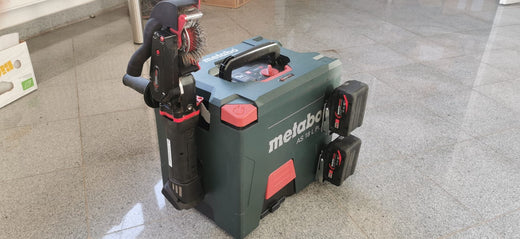
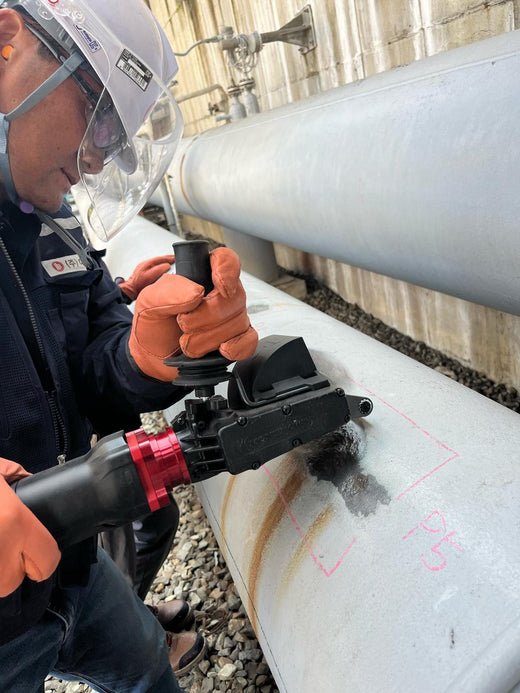
Short answer: To get a surface comparable to SSPC-SP 10 / ISO 8501-1 Sa 2½ without sandblasting, use an impact power tool such as the Bristle Blaster®: assess the rust grade, remove heavy corrosion first, bristle-blast in overlapping passes, then verify cleanliness against ISO 8501-1, profile with replica tape (typically 65–85 µm Rz on standard steel) and soluble salts before coating within the recoat window.
Reaching surface cleanliness comparable to Sa 2½ (ISO 8501-1) / SSPC-SP 10 without abrasive blasting is an operational necessity for teams working on installed structures, in hazardous areas, on pipeline field joints or anywhere conventional blasting is impractical, not permitted or disproportionately expensive.
This guide sets out how to do it with the Bristle Blaster®: when the method fits, the step-by-step procedure, the equipment, how the inspector verifies the result, and the documented field evidence. Blast grades are written for blast cleaning, so a power tool result is described as comparable to SP 10 and accepted against the project specification by the responsible inspector.
When is sandblasting not the answer?
There are four common situations where abrasive blasting is unavailable or inappropriate:
- Hazardous (ATEX) areas. On operating refineries, offshore platforms, LNG terminals and petrochemical plants, open abrasive blasting is usually excluded or tightly restricted by the site's zoning, risk assessment and permit-to-work system, because abrasive impact on steel can produce sparks. Equipment used in these zones must be suitable for the zone; the ATEX Directive 2014/34/EU governs that equipment, while the site operator decides what work may proceed. See our guide to surface preparation in ATEX Zone 1.
- No containment possible. Blasting needs containment of abrasive and dust: enclosures, vacuum shrouds or temporary sheeting. For a weld repair on a bridge, a structural repair in an operating plant or a pipe repair in an enclosed space, days of scaffolding and sheeting make blasting disproportionate to the job.
- Pipeline field joints. Each field joint (the bare steel zone either side of a girth weld) must be prepared and coated before burial. Mobilising full blast equipment for a 300–600 mm preparation zone at every joint is logistically and economically difficult in field conditions.
- Abrasive contamination risk. Where stray abrasive would contaminate adjacent process equipment, such as in pharmaceutical, food-processing or aerospace maintenance environments, a grit-free method is often the practical option regardless of area size.
The method: Bristle Blaster® for SSPC-SP 10-comparable cleanliness
The Bristle Blaster® produces surface cleanliness comparable to SSPC-SP 10 through high-velocity wire-tip impact. Hardened steel wire tips on a rotating belt (Ultimate drive units run at 2,300 rpm ±5%) are held back by an accelerator bar and released to strike the surface, then rebound. Each strike removes corrosion and leaves a micro-crater, so the result is a clean surface with an angular, blast-like anchor profile. No abrasive media is used, although the rust and coating removed still become particles that need extraction and respiratory protection.
The Bristle Blaster® Pneumatic is fully air-driven with no electrical parts and has been ATEX-evaluated for zone 1 explosive gas and zone 21 explosive dust; the ATEX marking (II 2G c IIA T4 X) applies to specified belts used on the original Pneumatic drive unit. The Ultimate Electric (230 V / 120 V) delivers the same surface result in non-hazardous areas without a compressed-air supply, and the Ultimate Cordless (18 V CAS) does so without a cable.
Step-by-step procedure
Step 1: Assess the substrate
Before preparation, identify the steel's initial rust grade according to ISO 8501-1:
- Grade A: steel surface largely covered with adhering mill scale, with little if any rust
- Grade B: steel that has begun to rust and from which the mill scale has begun to flake
- Grade C: steel on which the mill scale has rusted away or can be scraped off, with slight pitting visible under normal vision
- Grade D: steel on which the mill scale has rusted away and general pitting is visible under normal vision
On grade A and B steel, a single systematic Bristle Blaster® pass is often enough to reach cleanliness comparable to SSPC-SP 10. Grade C and D steel with heavy loose rust may need a preliminary bulk-removal pass (Step 2).
Step 2: Remove heavy corrosion (if required)
For grade C or D steel with thick, loose or flaking rust, or thick old coating, make a first pass with a Tercoo® heavy-removal disc before switching to the Bristle Blaster® belt. Tercoo® takes off bulk rust, old coating, tar and epoxy without generating heat, which reduces the load on the belt and makes the final SP 10-comparable result more consistent. In the MontiPower Two-Step Method both steps run on the same Bristle Blaster® drive unit; changeover takes well under a minute, depending on tool configuration.
If no heavy corrosion is present (grade A or B), go directly to Step 3.
Step 3: Set up the Bristle Blaster®
Select the drive unit for your environment:
- Hazardous areas: Bristle Blaster® Pneumatic with the specified belts. Supply air at 6.2 bar (90 psi), about 0.5 m³/min (17.5 cfm), through the supplied air pressure regulator. Make sure the compressor sits outside the classified zone or is itself suitable for it, and that the site permit covers the work.
- Non-hazardous areas: Bristle Blaster® Ultimate Electric (230 V or 120 V) or Ultimate Cordless. Keep the power cable clear of the work area and the guard in place.
Inspect the belt before starting. A worn belt produces a lower and less consistent profile. Replace it if the tips are noticeably rounded or if it has reached the end of its service life.
Step 4: Apply the Bristle Blaster®
Work in overlapping passes with roughly 50% lateral overlap at a controlled, steady pace. Avoid dwelling in one spot (overtreatment and local heat) or moving too fast (incomplete coverage). Let the bristle tips do the work rather than pressing hard.
On pipe, work circumferentially in overlapping bands; on plate or structural steel, work in a systematic pattern of parallel passes. Hold the tool square to the surface: a tangential angle reduces profile depth and consistency.
On pipeline field joints, prepare the full bare-steel zone plus the overlap onto the factory coating that the field joint coating manufacturer specifies, so the joint coating can bond across the transition. The Two-Step MontiPower Method case study shows the full sequence.
Step 5: Inspect and verify cleanliness
After preparation, remove loose debris with clean, dry, oil-free compressed air, a vacuum or a soft brush. Do not touch the prepared surface with bare hands; skin oils contaminate the steel.
Compare the surface with the Sa 2½ reference photograph for the matching initial rust grade in ISO 8501-1, in good diffuse daylight or equivalent artificial light. Sa 2½ allows only slight traces of contamination as stains in the form of spots or stripes; SSPC-SP 10 limits staining to no more than 5% of each unit area. The surface should show the matte grey of clean, impact-profiled steel with no mill scale lustre.
Step 6: Measure the anchor profile
Use Testex Press-O-Film® X-Coarse replica tape (range 38–115 µm / 1.5–4.5 mil) to ASTM D4417 Method C:
- Press the tape onto the prepared surface and burnish it firmly and completely with the burnishing tool until the foam is uniformly compressed.
- Remove the tape and read it in a spring micrometer.
- Subtract the 50 µm (2.0 mil) incompressible film, or pre-set the gauge to minus 50 µm, to obtain the profile value.
- Take the number of readings per area that ASTM D4417 and the project specification require. Record all readings and the mean.
Expected result on API 5L pipeline steel in documented tests: 65–85 µm Rz. Compare the measured value with the coating manufacturer's data sheet. ASTM D4417 also allows a depth micrometer (Method B) where the specification permits it.
Step 7: Measure soluble salt contamination
Fix a Bresle patch (ISO 8502-6) to the prepared surface and inject distilled or deionised water (about 3 ml for a standard patch). Cycle the water in and out of the patch several times to dissolve the surface salts, withdraw the extract and measure its conductivity with a calibrated meter (ISO 8502-9). Convert the reading to µg/cm² sodium chloride equivalent.
Compare the result with the limit in the coating data sheet or project specification. Limits vary; values around 3–5 µg/cm² are common in marine, offshore and pipeline specifications. If the value exceeds the limit, wash the surface with fresh water, let it dry and repeat from Step 4.
Step 8: Coat within the recoat window
Coat the prepared surface before flash rust forms. The maximum time between preparation and coating is set by the coating manufacturer's data sheet and the project specification; it is shorter in humid or coastal conditions. Monitor the steel temperature and dew point, and only coat while the steel is at least 3 °C above the dew point.
Step 9: Document the inspection
Record the following for the project quality file:
- Date, time and location of the prepared area
- Initial rust grade and preparation method
- Cleanliness assessed (comparable to Sa 2½ against ISO 8501-1)
- Profile readings (method, tape grade, individual values, mean)
- Salt test results (method, value, limit)
- Ambient conditions (temperature, relative humidity, dew point, steel temperature)
- Inspector identification
Documented field results
| Project | Substrate | Cleanliness reported | Salt result |
|---|---|---|---|
| Total E&P Bolivia, pipeline field joints | Pipeline steel, high altitude | Comparable to Sa 3 / SSPC-SP 5, 68 µm roughness | 1.4 µg/cm² |
| GASNORP, Piura, Peru: gas distribution network (training of applicators) | Pipeline steel | Comparable to Sa 2½ / SSPC-SP 10 | Within acceptance |
| ASC Shipbuilding, Adelaide: trials published at Corrosion & Prevention 2018 | Naval shipbuilding steels | Profile 50–80 µm, consistently above 50 µm | Not reported |
What will the inspector measure, and what should you expect?
An inspector verifying SP 10-comparable cleanliness on a Bristle Blaster®-prepared surface uses the same instruments and criteria as for a blasted surface. There is no separate inspection protocol for grit-free preparation. The inspector will:
- Compare the surface visually with the ISO 8501-1 Sa 2½ reference photographs, expecting a clean, matte grey surface with angular texture
- Read the profile with X-Coarse replica tape, typically finding 65–85 µm Rz on API 5L or structural steel (results vary with steel grade, rust grade, belt and technique)
- Run a Bresle salt test where specified. Residual values depend on the initial contamination and on whether the surface was washed or pre-treated; some specifications require repeated extractions on profiled steel because a single extraction can underestimate the salt load
For the full SSPC-SP 10 requirements, see our SSPC-SP 10 complete technical guide. For a parameter-by-parameter comparison with conventional sandblasting, see Bristle Blaster® vs. sandblasting.
Frequently asked questions
How many passes does the Bristle Blaster® need to reach cleanliness comparable to SSPC-SP 10?
On rust grade A or B steel, one systematic pass with about 50% overlap is often enough, but the inspector's comparison against ISO 8501-1 decides. On grade C or D steel with heavy rust or pitting, remove the bulk first with a heavy-removal disc such as Tercoo®, then bristle-blast. Results vary with steel grade, rust grade, belt and technique.
How long does a Bristle Blaster® belt last?
MontiPower gives an average belt life of about one hour of work, roughly 1–1.5 m² of surface. On easier work such as uncoated construction steel or plain weld seams, up to about 3 m² per belt has been reported. Inspect the tips before each new area: worn, rounded tips give a lower and less consistent profile.
What anchor profile does bristle blasting produce?
In documented tests on standard API 5L steel, the Bristle Blaster® produces 65–85 µm Rz (2.6–3.3 mil), with up to 120 µm Rz reported in some conditions. Measure it on every job with replica tape or a depth micrometer to ASTM D4417 and compare the reading with the coating manufacturer's data sheet.
Can the Bristle Blaster® be used in confined spaces?
Yes, where the tool body and operator can reach the surface. The Ultimate Cordless removes the cable and air hose for tight or elevated access. Confined-space rules still apply: monitor oxygen and flammable gas, provide ventilation and extraction, and follow the site permit system before and during the work.
MontiPower® technical team: Bristle Blaster® configuration, grit-free surface preparation comparable to SSPC-SP 10, and project-specific verification support.
→ Request technical consultationSources
- KTA-Tator, Industry Standards for Surface Preparation (SSPC-SP 5, SP 10, SP 11 definitions). kta.com
- ISO 8501-1 rust grades A–D and preparation grades, as summarised by FITZ Coatings, Blast it! ISO 8501-1 (2021). fitz-coatings.com
- DeFelsko, Testex Replica Tape grades and ranges. defelsko.com
- Testex, Press-O-Film operating instructions (minus 2.0 mil / 50 µm pre-set). PDF
- R. Dankiw, D. Fosdike, Defining Mechanical Surface Preparation Standards with Power Tools, Corrosion & Prevention 2018. PDF
- MontiPower®, Bristle Blaster® technical data sheets and product FAQ (belt service life, drive specifications, ATEX evaluation).