This guide explains what flash rust is, why it forms, how to assess it, and how to prevent it — or avoid it entirely.
What Is Flash Rust?
Flash rust is a thin layer of iron oxide that forms rapidly on carbon steel surfaces when they are wetted — by waterjetting, wet abrasive blasting, rain, condensation or high humidity — and then exposed to air. It is a form of oxidation, not structural corrosion, but it occurs on the prepared metal surface before coating is applied, and it can significantly affect coating adhesion if not managed correctly.
The process is simple chemistry: bare iron in contact with water and oxygen forms iron oxide (rust). On a freshly prepared steel surface, the exposed metal is highly reactive — far more so than the surface under an existing coating — and oxidation begins almost immediately upon contact with moisture.
Why Flash Rust Is Primarily a Problem After Wet Preparation Methods
Flash rust is inherent to water-based surface preparation methods:
- UHP water jetting (WJ-1 through WJ-4): Water is the cleaning medium, so the surface is always wet at the end of jetting. Flash rust begins forming as the surface dries.
- Wet abrasive blasting: Water is added to the abrasive blast stream to suppress dust. The wetted surface flashes rust as it dries.
- Vapour blasting: Similar to wet abrasive blasting — water-abrasive mixture leaves the surface wet.
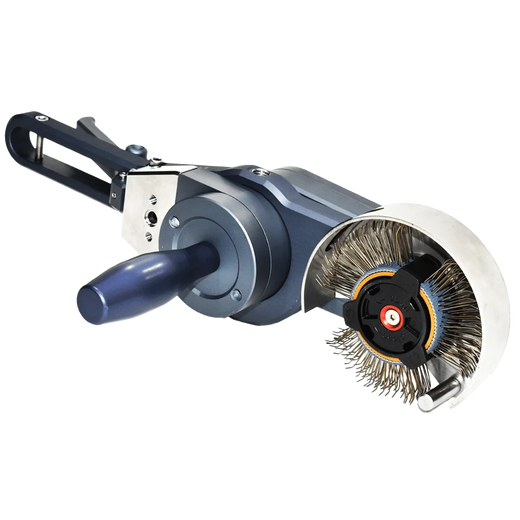
Dry surface preparation methods — abrasive grit blasting, dry mechanical tools — do not cause flash rust, because they do not wet the steel. The Bristle Blaster® and other dry power tools produce a surface that is immediately ready for inspection and priming, without flash rust management.
The Four Flash Rust Levels
Flash rust is classified into four levels, defined in NACE/SSPC standards for waterjetted surfaces and assessed against the photographic reference panels in NACE VIS 7 / SSPC-VIS 4:
| Level | Appearance | Typical Acceptability |
|---|---|---|
| None (N) | No visible oxidation. Surface retains the bare metal appearance of the freshly cleaned steel. | Always acceptable. |
| Light (L) | Light, uniform discolouration — a slight yellow-brown haze that does not obscure the steel surface texture or anchor profile. | Acceptable per most coating TDS requirements for atmospheric and industrial service. |
| Moderate (M) | Visible rust that partially obscures the steel surface. The anchor profile is still visible through the rust layer. | Typically the maximum acceptable for surface-tolerant epoxy mastics. Not acceptable for most high-performance systems without re-preparation. |
| Heavy (H) | Dense rust that completely obscures the steel surface and anchor profile. May include loose rust particles. | Not acceptable. Re-preparation required before coating application. |
Does Flash Rust Affect Coating Performance?
Yes — but the extent depends on the flash rust level and the coating system.
Light flash rust (Level L) consists of a very thin, tightly adherent iron oxide layer. Most high-performance coating systems — epoxies, zinc-rich primers, polyurethanes — bond well over light flash rust, and coating manufacturers typically accept it in their product TDS. There is no evidence that light flash rust significantly reduces the long-term performance of a compatible coating system applied over it within the time limits specified.
Moderate flash rust (Level M) begins to create a discontinuous interface between the coating and the steel substrate. The rust layer is thicker, less uniform and less tightly bonded. Whether this is acceptable depends entirely on the coating system — surface-tolerant systems are specifically formulated to penetrate and wet through this level of contamination; conventional high-build epoxies are not.
Heavy flash rust (Level H) is a structural problem. The rust layer is thick enough to act as a weak boundary layer, reducing coating adhesion and providing a reservoir of moisture and ionic contamination under the film. Re-preparation is always required.
Factors That Accelerate Flash Rust Formation
- High relative humidity: The higher the humidity, the faster flash rust forms and the more severe it becomes. Above 85% RH, flash rust progression from light to heavy can occur within 30–60 minutes on a waterjetted surface.
- High air temperature: Warm temperatures accelerate oxidation kinetics. Hot, humid conditions are the worst-case scenario for flash rust management.
- Soluble salt contamination: Chlorides and sulphates on the steel surface are hygroscopic — they attract moisture from the air and accelerate localised corrosion. Even at low humidity levels, high salt contamination can drive rapid flash rust formation.
- Steel temperature near dew point: When steel temperature is within 3°C of the air dew point, condensation occurs on the surface. Flash rust follows rapidly.
- Time elapsed after jetting: The longer a waterjetted surface is left unprimed, the more severe the flash rust becomes. Time from jetting to primer application must be controlled and specified.
Managing Flash Rust After Waterjetting
1. Specify the maximum acceptable flash rust level before work begins
The project specification must define the maximum flash rust level acceptable at the time of coating application — not at the time of waterjetting. This must be matched to the specific coating product's TDS requirements. Do not allow coating applicators to make this judgment in the field without a written criterion.
2. Minimise the time between jetting and priming
The most effective way to control flash rust is to reduce the window between surface preparation and primer application. Many projects operate in sections — jetting and priming in the same working cycle rather than jetting an entire area and then coating. Project scheduling must account for this workflow.
3. Control environmental conditions
Monitor and record relative humidity, air temperature and steel temperature continuously during jetting and coating operations. Do not jet in conditions where flash rust will develop faster than the priming operation can follow. Establish stop-work criteria in the specification: for example, suspend operations when RH exceeds 85% or steel temperature is within 3°C of dew point.
4. Use flash rust inhibitors with caution
Some UHP waterjetting operations use flash rust inhibitors added to the water — typically inhibited fresh water or proprietary chemical inhibitors. These can slow flash rust formation and extend the window for priming. However, inhibitor selection must be carefully matched to the coating system: some inhibitors are incompatible with specific primer chemistries, particularly zinc-rich primers and inorganic zinc silicates. Always obtain coating manufacturer approval before using flash rust inhibitors.
5. Re-prepare if Heavy flash rust develops
There is no coating system approved for application over Heavy (H) flash rust. If heavy flash rust develops before priming, the surface must be re-prepared — mechanically or by re-jetting — to at least the Light level before coating application. Factor re-preparation risk into project scheduling and cost estimates for jetting operations in high-humidity or high-salinity environments.
How to Avoid Flash Rust Entirely
The simplest way to eliminate flash rust from the surface preparation equation is to use dry mechanical preparation methods. Tools that prepare steel without water — including needle guns, rotary flap wheels and the Bristle Blaster® — produce surfaces that do not flash rust, because the steel is never wetted.
For maintenance projects on operating assets where waterjetting is not logistically necessary (i.e., soluble salt levels are within acceptable limits and the primary goal is rust and coating removal), dry mechanical preparation with the Bristle Blaster® achieves SP11-equivalent cleanliness with a defined anchor profile — without flash rust, water management or time pressure on coating application.
Where salt contamination is confirmed as a concern and waterjetting is preferred for salt removal, a combined approach is effective: waterjet to remove salts and loose contamination, verify salt levels, then mechanically prepare with the Bristle Blaster® to restore anchor profile and allow flash rust to be managed through mechanical abrasion before priming.
Key Takeaways
- Flash rust is iron oxide that forms rapidly on wet steel surfaces after waterjetting or wet abrasive blasting. It is not structural corrosion but can significantly affect coating adhesion if unmanaged.
- Four levels are defined: None, Light, Moderate and Heavy. Most high-performance coating systems accept Light flash rust as a maximum.
- The maximum acceptable flash rust level must be specified in the project documentation and matched to the coating TDS — it cannot be left to field judgment.
- Managing flash rust requires controlling the time between jetting and priming, environmental conditions, and the use of inhibitors where appropriate and compatible.
- Dry mechanical surface preparation methods eliminate flash rust entirely by avoiding steel wetting — making them preferable for maintenance projects where salt removal is not the primary driver.