Short answer: the main alternatives to abrasive blasting for steel are hand and power tool cleaning, impact power tools (needle scalers, rotary impact flaps and bristle blasting), water jetting, laser ablation and chemical methods. They are not interchangeable. Only some of them remove tightly adherent mill scale and create an anchor profile, which is what most protective coating specifications require. The required standard, not the tool, should drive the choice.
Abrasive blasting is still the reference method for preparing steel before coating. But it needs containment, a compressor and blast pot, an abrasive supply and a waste route, and on many jobs those are the expensive part. Spot repairs, weld zones, live plant, confined spaces and occupied sites are where specifiers start looking for something else.
This article covers the seven things worth knowing before you choose. For the full method-by-method comparison, read The Complete Guide to Blasting Alternatives for Steel.
1. The coating specification decides, not the tool
Every alternative has to be judged against the surface preparation grade written into the coating specification. The common grades split into three bands:
- Loose material only — SSPC-SP 2 (hand tool) and SSPC-SP 3 (power tool) / ISO 8501-1 St 2 and St 3. Tightly adherent mill scale, rust and paint may remain. SP 3 states it is not intended that adherent mill scale be removed by the process.
- Bare metal by power tool — SSPC-SP 15 (commercial grade) and SSPC-SP 11 (bare metal). Both require removal of mill scale and a minimum 25 µm (1 mil) surface profile. SP 15 allows staining on up to 33% of each unit area; SP 11 allows none.
- Blast-cleaned grades — SSPC-SP 6 / Sa 2, SSPC-SP 10 / Sa 2½ and SSPC-SP 5 / Sa 3. These are written for abrasive blasting.
If the coating data sheet asks for St 3, almost any power tool will do. If it asks for SP 11 or an SP 10-equivalent finish, most will not. See our complete guide to surface preparation standards for the full ladder.
2. Most power tools clean, but do not profile
Removing visible contamination and creating an anchor profile are two different jobs. SSPC-SP 11 says it directly: "Power wire brushes or sanding discs when used alone may not produce the required surface profile and may remove or degrade an existing profile to an unacceptable level." The same standard warns that rotary power tools can burnish an existing profile.
Independent shipyard testing shows the gap. Dankiw and Fosdike (ASC Shipbuilding, Corrosion & Prevention 2018) measured 30–40 µm with a #36 grit grinder and a #40 flap disc, against 50–80 µm, consistently above 50 µm, with a bristle blasting tool on the same steels.
3. Impact methods are the ones that reach bare-metal grades
SSPC-SP 11 recognises two families of power tool media: grinding media with bonded abrasive grains, and impact media that repeatedly strike the surface. It names "rotary flap, cutter bundle, needle gun, wire bristle impact, and hammer flail assemblies" as impact tools.
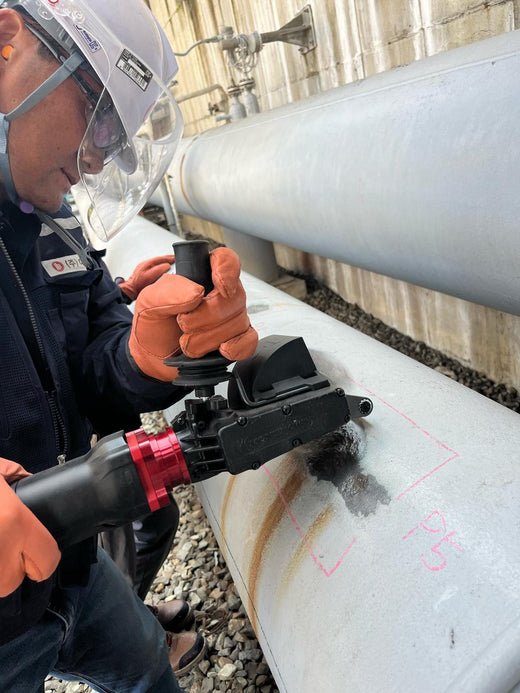
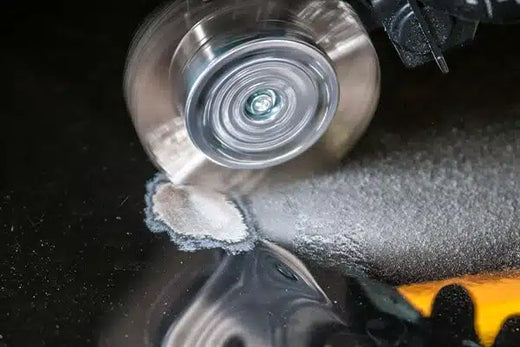
Impact matters for mill scale because scale is a brittle oxide on a ductile steel. A sharp impact fractures and ejects the scale and leaves a crater in the steel. Rubbing tends to polish it. That is the principle behind bristle blasting, where hardened wire tips held back by an accelerator bar are released to strike the surface. How rotating tools differ is covered in Rotating Tools for Blast-Free Steel Preparation.
4. Water jetting and laser have a mill scale and profile gap
Both are real alternatives, but neither replaces blasting on new, mill-scaled steel:
- Water jetting (70 MPa / 10,000 psig and above, per SSPC-SP WJ-1/NACE WJ-1) removes coatings, rust and soluble salts well. The standard states that waterjet cleaning "does not provide the primary anchor pattern". It is a recoat method for steel that already has a profile. More in our water jetting standards guide.
- Pulsed laser ablation now has its own AMPP documents (SP21511-1 and Guide 21611). KTA-Tator notes it "will not productively remove intact mill scale."
5. "Comparable to" is the honest wording
Blast grades such as Sa 2½ and SSPC-SP 10 are defined for blast cleaning. A power tool result is therefore described as comparable to a blast grade, and accepted against the project specification by the responsible inspector.
That comparison is well documented for bristle blasting. Jotun has published a surface preparation code for bristle blast cleaning (BIPoT, Bristle Impact Power Tool cleaning) with grades muA to muD mapped to Sa 3, Sa 2½, Sa 2 and Sa 1, and a typical profile of 50–85 µm. On standard API 5L steel in documented tests, the Bristle Blaster® produces 65–85 µm Rz (2.6–3.3 mil). Results on any given job vary with steel grade, rust grade, belt and technique.
6. Grit-free is not dust-free, and a tool does not replace a permit
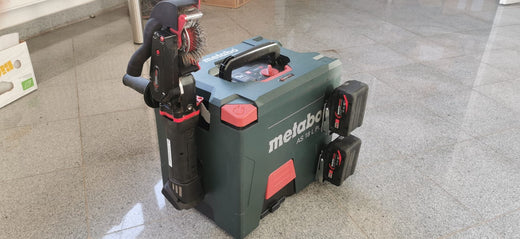
Removing abrasive from the process removes the abrasive waste stream and the containment it needs. It does not remove the material you take off the steel. MontiPower manuals state that "the parts rubbed-off while working are detrimental to health" and require a dust mask. Extraction is available, for example a dust exhaust attachment for the Bristle Blaster® Pneumatic, but it reduces exposure rather than eliminating it.
The same applies to ignition. Mechanical preparation on steel can produce sparks. An ATEX marking (II 2G c IIA T4 X) applies to specific Bristle Blaster® belts in combination with the original Bristle Blaster® Pneumatic drive unit only. Whether work can proceed in a classified area is decided by the site operator's zoning, risk assessment and permit system. See surface preparation safety.
7. Blasting still wins on large, open, new-build areas
Hand-held alternatives are slower per square metre than a blast nozzle. On large continuous surfaces in a blast shop or yard, blasting is usually the right call. The alternatives win where mobilisation, containment and clean-up dominate the cost: spot repairs, weld seams, field joints, in-service assets and areas blasting cannot reach.
Wales & West Utilities measured this on a small-area corrosion repair: 45 person-minutes in total with bristle blasting against 260 person-minutes with grit blasting, mostly because of set-up and clean-up (read the field trial).
Quick selection guide
| Required result | Methods that can meet it |
|---|---|
| St 2 / St 3, SSPC-SP 2 / SP 3 (loose material only) | Hand tools, wire brushes, grinders, flap discs, needle scalers |
| SSPC-SP 15 or SP 11 (bare metal, ≥ 25 µm profile) | Impact power tools: bristle blasting, rotary impact flaps, needle guns (profile must be verified) |
| Result comparable to Sa 2½ / SSPC-SP 10 with an anchor profile, without abrasive | Bristle blasting, against documented results and inspector acceptance |
| Recoat of previously blasted, profiled steel | Water jetting (WJ-1 to WJ-4), bristle blasting |
| Large-area new-build with mill scale | Abrasive blasting |
Not sure which method your specification allows?
Send us the coating data sheet and the substrate condition. We'll tell you which preparation grade is realistic without blasting.
Frequently asked questions
What is the best alternative to sandblasting steel?
It depends on the required grade. For bare-metal grades with an anchor profile (SSPC-SP 11, or a result comparable to Sa 2½ / SP 10), impact tools such as bristle blasting are the closest alternative. For loose rust and paint only, conventional power tools are enough.
Can a power tool achieve SSPC-SP 10?
SSPC-SP 10 is a blast cleaning standard, so a power tool result is assessed as comparable to SP 10 rather than as SP 10 itself. Bristle blasting has documented results comparable to Sa 2½ / SP 10 with a 65–85 µm Rz profile on API 5L steel. Acceptance is set by the coating specification and the inspector.
Does water jetting remove mill scale?
SSPC-SP WJ-1 does not allow mill scale to remain, but water jetting does not create a primary anchor profile. On new, mill-scaled steel it is normally combined with, or replaced by, a profiling method.
Is grit-free surface preparation dust-free?
No. Grit-free methods remove the abrasive waste stream, but the rust, scale and coating you remove still become airborne particles. Use extraction where available and select respiratory protection from the site risk assessment.
Sources
- SSPC-SP 11, Power Tool Cleaning to Bare Metal, sections 1, 4 and 8. Copy of standard
- SSPC-SP 3, Power Tool Cleaning. Copy of standard
- KTA-Tator, Industry Standards for Surface Preparation (SP 15 and SP 11 definitions). kta.com
- SSPC-SP WJ-1/NACE WJ-1, Clean to Bare Substrate. Copy of standard
- KTA-Tator, Surface Preparation of Steel by Laser Ablation. kta.com
- R. Dankiw, D. Fosdike, Defining Mechanical Surface Preparation Standards with Power Tools, Corrosion & Prevention 2018, Paper 74. PDF
- Jotun, Surface Preparation Code and Standard for Bristle Blast Cleaning and Profiling Process. PDF
- MontiPower, Bristle Blaster® Belts Steel technical data sheet (2020-09-09) and product manuals 52552, 52555, 52615.