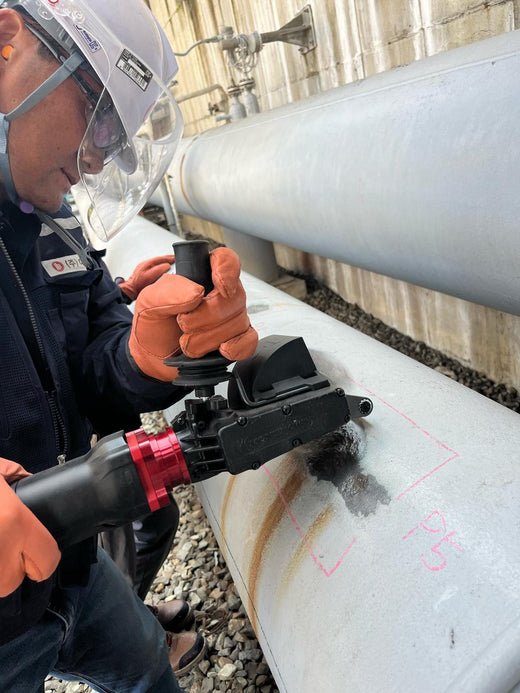
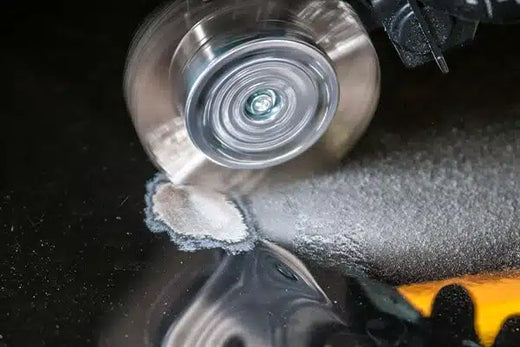
Rotating tools for blast-free steel preparation fall into three groups. Rubbing tools (wire wheels, cup brushes, non-woven discs) clean loose rust and paint to SSPC-SP 3 / St 3. Cutting tools (grinding, flap and fibre discs) reach bare metal but leave a shallow profile. Impact tools (bristle blasting and rotary impact flaps) remove adherent mill scale and create an anchor profile, so they can meet SSPC-SP 11 and give results comparable to blast cleaning. Pick the group by the grade the coating needs.
Most maintenance crews already own rotating tools: a grinder, a wire cup brush, a box of flap discs. The question is which of them can stand in for abrasive blasting when the coating specification asks for a blast-quality surface, and which only make the steel look ready.
This guide classifies rotating surface preparation tools by how they act on steel, what they can achieve against the standards, and where each fits. For why impact matters, see also how rotating rust removal tools replace sandblasting.
What the standard says about rotating tools
SSPC-SP 11 (power tool cleaning to bare metal, minimum 25 µm / 1 mil profile) divides power tool media into two families:
- Surface cleaning and grinding media with bonded abrasive grains: "abrasive cloths, discs, wheels, or flaps".
- Impact media that repeatedly collide with the surface: "rotary flap, cutter bundle, needle gun, wire bristle impact, and hammer flail assemblies".
It also carries two warnings that apply to every rotating tool: "Rotary power tools can cause a burnishing of profile previously imparted to steel or of the existing profile, thereby reducing that profile," and "power wire brushes or sanding discs when used alone may not produce the required surface profile."
Rotating tools, group by group
Rubbing tools: wire wheels, cup brushes and non-woven discs
Twisted-knot and crimped wire brushes run their wires across the surface. They are quick on loose rust, flaking paint and loose mill scale, and good for cleaning between coats. They do not remove tightly adherent mill scale and they polish steel rather than profile it. Non-woven abrasive discs behave similarly: useful for cleaning and finishing, not for creating profile. Expect SSPC-SP 2 or SP 3 / St 2 or St 3. Compare options on the rotary wire brush tools and surface conditioning tools pages.
Cutting tools: grinding, flap and fibre discs
Bonded and coated abrasives cut through rust, coating and mill scale by removing the steel surface. They can reach bare metal, but the scratch pattern is shallow and runs in one direction. In ASC Shipbuilding trials (Dankiw and Fosdike, Corrosion & Prevention 2018), a #36 grit grinder and a #40 flap disc each measured 30–40 µm. They are the right tools for weld dressing, spatter, sharp edges and local defects, and the wrong tools for profiling large areas: they remove sound steel and leave low spots.
Impact tools: rotary impact flaps
Flexible flaps carrying bonded hard shot strike the surface as they rotate. They are listed in SSPC-SP 11 as impact media and can produce bare metal with profile on suitable steel. Output depends on flap wear, speed and pressure, so measure the profile on each job.
Impact tools: bristle blasting
A belt of hardened wire bristles rotates past an accelerator bar that holds the bristles back and then releases them. The tips strike the steel rather than sweep across it, fracturing rust, coating and mill scale and leaving overlapping craters. This is the mechanism studied by Prof. Robert Stango at Marquette University and published through NACE from 2008 onwards. See bristle blasting fundamentals.
- Documented results: 65–85 µm Rz (2.6–3.3 mil) on standard API 5L steel and cleanliness comparable to Sa 2½ / SSPC-SP 10 in documented tests. Dankiw and Fosdike measured 50–80 µm, consistently above 50 µm. Jotun's bristle blast cleaning code (BIPoT) defines grades muA to muD against Sa 3 to Sa 1. Results vary with steel grade, rust grade, belt and technique.
- Drive units: Bristle Blaster® Pneumatic (6.2 bar / 90 psi, about 0.5 m³/min / 17.5 cfm), Ultimate Electric (910 W, 2,300 rpm ±5%) and Ultimate Cordless (CAS 18 V, 700 W, 2,300 rpm ±5%). On the Ultimate platform the speed is preset and held under load.
- Belts: 110 mm diameter, 23 mm or 11 mm wide, carbon spring steel (red inner ring) or stainless steel (white inner ring), operating speed 2,300 rpm ±5%, maximum 4,000 rpm to EN 1083-2. Match the accelerator bar to both belt width and wire material. See Bristle Blaster® belts and the belt selector.
Heavy-removal discs
Thick coatings, tar and layered rust clog bristles and flaps. A rotating heavy-removal disc such as Tercoo® takes off the bulk, and an impact tool then profiles the steel. This is the MontiPower Two-Step Method; see the two-step case study.
Cleaning belts and drill attachments: MBX® and Decapower®
MBX® belts (100 mm, in coarse, medium and fine grades, carbon steel or stainless) are designed for cleaning, coating and rust removal, especially on thinner material, bodywork and detail areas, rather than for creating an industrial anchor profile. Speed control depends on the model: pneumatic units are trigger-variable and the Ultimate Electric Variomatic has six settings, while the Ultimate Electric and Cordless run at a fixed 2,300 rpm. The Decapower® Bristle Head mounts an MBX belt on a drill or impact driver (advised 2,500–3,500 rpm, never above 3,500 rpm) and leaves a clean, roughened surface. For how MBX and Bristle Blaster® differ, see MBX vs Bristle Blaster.
Comparison table
| Tool | Action on steel | Adherent mill scale | Profile | Typical ceiling |
|---|---|---|---|---|
| Wire wheel / cup brush | Rubbing | Remains, often polished | None; can degrade existing profile | SP 3 / St 3 |
| Non-woven disc | Rubbing / light abrasion | Remains | None | Cleaning only |
| Grinding / flap / fibre disc | Cutting | Removed with steel | Shallow, directional (30–40 µm measured) | Bare metal, often below profile spec |
| Rotary impact flap | Impact | Removed | Yes; verify on each job | SP 11 |
| Bristle blasting | Impact | Removed | Yes (65–85 µm Rz documented on API 5L) | SP 11; comparable to Sa 2½ / SP 10 in documented tests |
| Heavy-removal disc (Tercoo®) | Bulk removal | Pre-step | Follow with impact tool | Pre-treatment |
| MBX® / Decapower® | Bristle cleaning | Light scale and coatings | Cleaning and roughening | Cleaning, bodywork, detail |
Choosing the right rotating tool
- Coating needs SP 11 or a blast-comparable surface: bristle blasting or rotary impact flaps. Verify the profile.
- Loose rust and paint only, St 3 accepted: wire brushes are enough.
- Welds, spatter, sharp edges: grind or needle-scale first, then profile with an impact tool. See weld seams and HAZ.
- Mill scale on repairs and new steel: impact tools; see How to Remove Mill Scale from Small Steel Areas.
- Thick coatings and heavy rust: Tercoo® then an impact tool.
- Stainless steel: stainless belts and accelerator bars only, kept separate from carbon steel tools. See stainless.
Technique that protects the result
- Switch the tool on before contact and guide it with both hands.
- Use light contact pressure. MontiPower manuals state that excessive pressure limits performance and damages belts and drive parts.
- Work edges lengthways only, and keep moving to avoid local heat and over-working.
- Run belts and brushes only on the drive units specified in their manuals and never above the maximum speed marked on them.
- Stop immediately if sudden vibration or unusual noise appears, and check the belt.
- Wear eye, hand, hearing and respiratory protection; removed material is harmful to breathe and working on steel can throw sparks. See surface preparation safety.
For the full set of non-blasting methods, including water jetting and laser, read The Complete Guide to Blasting Alternatives for Steel.
Choosing between rotating tools for a coating job?
Send us the specification and the steel condition. We'll match the tool, belt and verification method.
Frequently asked questions
Can a rotating tool replace sandblasting?
An impact rotating tool can, where the specification allows a power tool grade such as SSPC-SP 11 or accepts a result comparable to a blast grade. Wire brushes and grinding discs alone usually cannot, because they leave tight mill scale or too little profile.
Which rotating tool creates an anchor profile?
Impact tools: bristle blasting and rotary impact flaps. Bristle blasting has documented results of 65–85 µm Rz on API 5L steel.
Why does a wire wheel not meet SSPC-SP 11?
Wire wheels rub rather than strike. SSPC-SP 11 notes that power wire brushes used alone may not produce the required profile and can degrade an existing one.
What speed should a bristle blasting tool run at?
At the speed set by the drive unit. Bristle Blaster® belts have an operating speed of 2,300 rpm ±5% and a maximum of 4,000 rpm to EN 1083-2. The Ultimate Electric and Cordless are preset to 2,300 rpm.
Sources
- SSPC-SP 11, Power Tool Cleaning to Bare Metal. Copy of standard
- KTA-Tator, Industry Standards for Surface Preparation. kta.com
- R. Dankiw, D. Fosdike, Defining Mechanical Surface Preparation Standards with Power Tools, Corrosion & Prevention 2018, Paper 74. PDF
- Jotun, Surface Preparation Code and Standard for Bristle Blast Cleaning and Profiling Process. PDF
- R. J. Stango et al., Fundamentals of Bristle Blasting Process for Removing Corrosive Layer, NACE CORROSION 2009. AMPP abstract
- MontiPower technical data sheets: Bristle Blaster® Pneumatic, Ultimate Electric Single, Ultimate Cordless, Bristle Blaster® Belts Steel, MBX® Belts; manuals 52609, 52612, 52618, 52625.