Blasting alternatives for steel are surface preparation methods that clean steel before coating without propelling loose abrasive. They fall into five groups: hand and power tool cleaning, impact power tools, water jetting, laser ablation, and chemical or thermal methods. They differ on two things that decide coating performance: whether they remove tightly adherent mill scale, and whether they create an anchor profile. Only impact power tools such as bristle blasting reliably do both.
This guide compares every practical alternative to abrasive blasting for carbon steel. For each one it sets out what the method removes, which standard it can meet, whether it produces a profile, what waste it leaves and where it fits. It is written for coating specifiers, maintenance engineers and inspectors who need to put a method into a specification and defend it.
If you only need the headline points, start with What to Know About Blasting Alternatives for Steel.
Why projects look for an alternative to blasting
Abrasive blasting gives a predictable, inspectable result. The cost sits around it:
- Containment and waste. Spent abrasive mixed with removed coating has to be contained, collected and disposed of. Where old coatings contain lead or chromates, that waste stream can be classified as hazardous.
- Worker exposure. Where silica-containing abrasive is used, or silica-containing substrates are blasted, exposure is regulated. In the US, OSHA sets a permissible exposure limit for respirable crystalline silica of 50 µg/m³ (8-hour TWA) with an action level of 25 µg/m³. In the EU, Directive (EU) 2017/2398 sets a binding limit of 0.1 mg/m³.
- Mobilisation. Compressor, blast pot, hoses, abrasive supply and containment take time to set up and clear down. On a small repair they can cost more than the preparation itself.
- Access and live operations. Confined spaces, congested pipe racks, live plant, occupied buildings and running railways often cannot accept a blast operation next to them.
For the health side of blasting in more depth, see the dangers of sandblasting.
The standards every alternative is measured against
The method you choose has to deliver the grade in the coating specification. These are the grades that matter for alternatives:
| Standard | ISO 8501-1 reference | Mill scale | Profile requirement |
|---|---|---|---|
| SSPC-SP 2 Hand tool cleaning | St 2 | Loose only; tight scale may remain | None |
| SSPC-SP 3 Power tool cleaning | St 3 | Loose only; not intended to remove adherent scale | None |
| SSPC-SP 15 Commercial grade power tool cleaning | — | Removed; stains on up to 33% of each unit area | Minimum 25 µm (1 mil) |
| SSPC-SP 11 Power tool cleaning to bare metal | — | Removed, except in the bottom of pits | Minimum 25 µm (1 mil) |
| SSPC-SP 10 / NACE No. 2 Near-white blast | Sa 2½ | Removed; stains on up to 5% of each unit area | Set by the coating specification |
| SSPC-SP 5 / NACE No. 1 White metal blast | Sa 3 | Removed; no stains | Set by the coating specification |
Two points from the standards shape everything below. First, SP 3 states that "it is not intended that adherent mill scale, rust, and paint be removed by this process." Second, SP 11 warns that "power wire brushes or sanding discs when used alone may not produce the required surface profile." A method that only reaches SP 3 is not an alternative to blasting on a specification that calls for bare metal. More detail in our guides to SSPC-SP 11 and the mechanical preparation standards.
Every alternative, method by method
Hand tool cleaning
Wire brushes, scrapers, chipping hammers and abrasive paper. Hand tools remove loose rust, loose paint and loose mill scale to SSPC-SP 2 / St 2. They do not remove tight mill scale and do not create a meaningful profile. Use them for low-exposure maintenance or as a first pass, not as a blasting substitute.
Power wire brushing
Cup and wheel brushes on grinders or drills. Fast on loose rust and old paint, but the bristles rub rather than strike, and SSPC-SP 11 warns that wire brushing alone may degrade an existing profile. Power wire brushing on mill-scaled steel tends to polish the scale, which can look clean while leaving it intact. Typical ceiling: SSPC-SP 3 / St 3. Compare tool types on our rotary wire brush tools page.
Grinding discs, flap discs and fibre discs
Bonded and coated abrasives cut through mill scale and remove steel with it. They can reach bare metal, but the profile is shallow and directional. In shipyard trials, Dankiw and Fosdike measured 30–40 µm with a #36 grit grinder and a #40 flap disc. Grinding is also easy to overdo: it removes sound steel, creates low spots and burnishes edges. Use it for weld dressing, spatter and local defects, then profile separately if the specification needs it.
Needle scalers
A bundle of hardened needles driven pneumatically against the surface. Needle guns are named in SSPC-SP 11 as impact tools and are effective on heavy rust, scale on welds and irregular geometry. They leave a peened, irregular surface, so the profile must be measured rather than assumed. Production on flat areas is slow.
Rotary impact flaps
Flexible flaps with bonded hard shot that strike the surface as they rotate. SSPC-SP 11 lists rotary flap assemblies among impact media. They can reach bare metal with a profile on suitable steel. Performance depends on flap condition, speed and pressure, so the profile should be verified on every job.
Bristle blasting
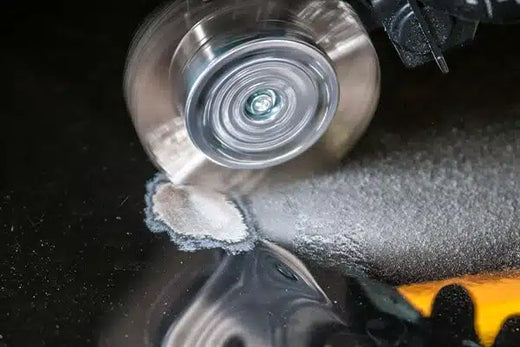
Bristle blasting uses a rotating belt of hardened wire bristles. An accelerator bar holds the bristles back and releases them so that the tips strike the steel rather than rub across it. Each impact fractures and ejects rust, coating and mill scale and leaves a small crater, which is what builds the anchor profile. Research by Prof. Robert Stango (Marquette University), published through NACE from 2008 onwards, describes the resulting surface as resembling grit blasting in cleanliness and roughness. See bristle blasting fundamentals.
Documented results:
- Profile: 65–85 µm Rz (2.6–3.3 mil) on standard API 5L steel in documented tests. Dankiw and Fosdike measured 50–80 µm, consistently above 50 µm, on three shipbuilding steel grades, with less pull-off adhesion variation than grinding discs (about 2–3 MPa against about 5 MPa), all above the 5 MPa minimum.
- Cleanliness: comparable to Sa 2½ / SSPC-SP 10 in documented tests. Jotun's surface preparation code for bristle blast cleaning (BIPoT) defines grades from muA (Sa 3) to muD (Sa 1).
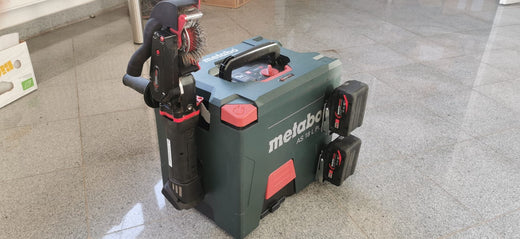
- Equipment: pneumatic, electric and cordless drive units. The Bristle Blaster® Ultimate Electric runs at 2,300 rpm (±5%) at 910 W; the Bristle Blaster® Pneumatic needs 6.2 bar (90 psi) and about 0.5 m³/min (17.5 cfm) of air. Belts are 110 mm in diameter, 23 mm or 11 mm wide, in carbon spring steel or stainless steel.
Results on any job vary with steel grade, rust grade, belt selection and technique. Acceptance is set by the coating specification and the responsible inspector. Product details: Bristle Blaster® and Bristle Blaster® belts.
Heavy-removal rotating discs, then profiling
Thick coatings, tar, heavy rust scale and pack rust load up bristles and slow any profiling tool down. A rotating heavy-removal disc such as Tercoo® takes off the bulk first, and a profiling tool finishes the surface. This is the MontiPower Two-Step Method, shown in the two-step case study and in how to remove heavy rust without sandblasting.
Water jetting
Water at 70 MPa (10,000 psig) or more, graded WJ-1 to WJ-4 under the joint SSPC/NACE standards. Water jetting is very good at removing coatings and soluble salts, and WJ-1 does not allow mill scale to remain. But the standard is explicit that waterjet cleaning "does not provide the primary anchor pattern". It suits recoating of previously blasted steel. It needs a large pump unit, water containment and flash rust control. See our water jetting standards guide.
Laser ablation
Pulsed lasers vaporise coatings, oxides and contamination. The method now has AMPP SP21511-1 and AMPP Guide 21611. It produces no secondary media, but the equipment is costly, and KTA-Tator notes that laser ablation "will not productively remove intact mill scale." Best suited to coating removal on sensitive or high-value components.
Chemical stripping and pickling
Paint strippers remove coatings; acid pickling dissolves mill scale. Pickling is a controlled-bath process for mills and fabrication shops, not a field method. It produces spent acid (in the US, spent pickle liquor from steel finishing is a listed hazardous waste, K062), leaves no anchor profile and carries a hydrogen embrittlement risk on high-strength steels.
Flame cleaning
A torch heats the surface so that scale cracks off by differential expansion, followed by wire brushing. It is hot work, it can distort thin sections, and it does not create a profile. It has largely been replaced by mechanical methods.
Comparison matrix
| Method | Removes adherent mill scale | Creates anchor profile | Typical ceiling | Secondary waste |
|---|---|---|---|---|
| Hand tools | No | No | SP 2 / St 2 | Removed material |
| Power wire brush | No (tends to polish) | No; can degrade existing profile | SP 3 / St 3 | Removed material, worn brushes |
| Grinding / flap disc | Yes, with metal loss | Shallow, directional (30–40 µm measured) | Bare metal; profile often below spec | Removed material, abrasive dust, discs |
| Needle scaler | Yes, on welds and edges | Irregular; verify | SP 11 possible | Removed material |
| Rotary impact flaps | Yes | Yes; verify | SP 11 | Removed material, worn flaps |
| Bristle blasting | Yes | Yes (65–85 µm Rz documented on API 5L) | SP 11; comparable to Sa 2½ / SP 10 in documented tests | Removed material, worn belts |
| Water jetting | Yes at WJ-1 | No primary profile | WJ-1 to WJ-4 | Contaminated water |
| Laser ablation | Not productively | Limited | Per AMPP SP21511-1 | Fume, captured particulate |
| Pickling | Yes (bath only) | No | Shop process | Spent acid |
| Flame cleaning | Partly | No | Below bare metal | Removed material, combustion |
Choosing by situation
- Spot repairs and damaged areas: bristle blasting or rotary impact flaps to SP 11, feathering into sound coating. See How to Remove Mill Scale from Small Steel Areas and spot repair.
- Weld seams and heat-affected zones: needle scaler or grinder for spatter and slag, then bristle blasting for profile. See weld seams and HAZ.
- Pipeline field joints: bristle blasting where a blast operation is impractical on the right-of-way. See field joint preparation.
-
Live plant and hazardous areas: a method and configuration that the site operator's zoning, risk assessment and permit system will accept. An ATEX marking (
II 2G c IIA T4 X) applies to specific Bristle Blaster® belts on the original Bristle Blaster® Pneumatic drive unit only, for gas atmospheres. It does not replace the site permit. - Heavy corrosion or thick coatings: Tercoo® first, then a profiling tool.
- Recoat of previously blasted steel: water jetting, especially where soluble salts are the concern.
- Large-area new-build steel: abrasive blasting remains the most productive option.
Verifying the result
An alternative method has to pass the same inspection as a blasted surface:
- Cleanliness against ISO 8501-1 reference photographs or the SSPC written definition in the specification.
- Profile by replica tape or depth micrometer to ASTM D4417. See our anchor profile measurement field guide and the M-TESTCO range.
- Soluble salts where specified, by Bresle patch and conductivity to ISO 8502-6 and ISO 8502-9. See soluble salt contamination.
Writing an alternative into a specification
Name the outcome, not just the tool. A defensible clause states the required cleanliness (for example SSPC-SP 11, or a result comparable to Sa 2½), the minimum and maximum profile from the coating data sheet, the measurement method, and the acceptance authority. Our guide on how to write a surface preparation specification covers the structure.
Specifying grit-free preparation on a live project?
Share the coating system, steel condition and access constraints. We'll recommend a method and the verification to go with it.
Frequently asked questions
Which blasting alternative gives an anchor profile?
Impact power tools: bristle blasting, rotary impact flaps and, less predictably, needle scalers. SSPC-SP 11 and SP 15 both require at least 25 µm (1 mil). Water jetting and wire brushing do not create a primary profile.
Can I replace blasting with power tools on a whole structure?
Technically yes on many coating systems, if the specification allows SP 11 or a documented equivalent. Commercially, blasting is usually faster on large open areas. Power tools pay off where mobilisation, containment and access dominate the cost.
Is bristle blasting accepted by coating manufacturers?
Jotun has published a surface preparation code for bristle blast cleaning with grades mapped to ISO 8501-1. Always confirm acceptance for the specific coating system with the manufacturer and the project inspector.
What is the difference between SSPC-SP 11 and SSPC-SP 15?
Both require bare metal by power tool and a minimum 25 µm profile. SP 11 allows no staining; SP 15 allows staining on up to 33% of each unit area.
Sources
- SSPC-SP 11, Power Tool Cleaning to Bare Metal. Copy of standard
- SSPC-SP 3, Power Tool Cleaning. Copy of standard
- KTA-Tator, Industry Standards for Surface Preparation. kta.com
- SSPC-SP WJ-1/NACE WJ-1, Clean to Bare Substrate. Copy of standard
- KTA-Tator, Surface Preparation of Steel by Laser Ablation. kta.com
- OSHA 29 CFR 1926.1153, Respirable crystalline silica. osha.gov
- Directive (EU) 2017/2398 on carcinogens and mutagens at work (respirable crystalline silica). stopcarcinogensatwork.eu
- US EPA hazardous waste code K062, spent pickle liquor from steel finishing. Code list
- R. Dankiw, D. Fosdike, Defining Mechanical Surface Preparation Standards with Power Tools, Corrosion & Prevention 2018, Paper 74. PDF
- Jotun, Surface Preparation Code and Standard for Bristle Blast Cleaning and Profiling Process. PDF
- R. J. Stango et al., Fundamentals of Bristle Blasting Process for Removing Corrosive Layer, NACE CORROSION 2009. AMPP abstract
- MontiPower technical data sheets: Bristle Blaster® Pneumatic (2020-09-02), Bristle Blaster® Ultimate Electric Single (2023-08-15), Bristle Blaster® Belts Steel (2020-09-09); manual 52609.