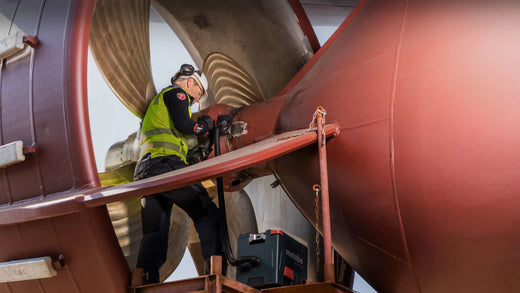
Short answer: Mechanical surface preparation covers far more than carbon steel: stainless steel, aluminium, zinc and galvanised coatings, brass, magnesium, titanium and non-metallic substrates such as wood, stone, concrete, plastics and composites. The right approach depends on two choices: the substrate's sensitivities (heat, contamination, softness) and the action needed, from derusting and descaling to deburring, cleaning and polishing.
Surface preparation is often discussed one substrate at a time: steel here, aluminium there. In the field, one crew and one tool platform usually has to cover a much wider range of materials and actions in a single week. This reference sets out the materials in scope, the actions the work involves, what each substrate is sensitive to, and how the MontiPower® platform is matched to each combination.
Which materials does mechanical surface preparation cover?
Beyond carbon steel and stainless steel, mechanical surface preparation tools are routinely used on aluminium, tin, zinc, brass, magnesium, precious metals and titanium, and on non-metallic substrates including rubber, stone, concrete, plastics, ceramics and wood. Each has its own sensitivities:
- Aluminium and magnesium are soft and need controlled contact with little heat, to avoid smearing the surface and loading the tool.
- Stainless steel and other corrosion-resistant alloys must not be touched with carbon-steel tools. The Specialty Steel Industry of North America warns that carbon-steel particles become embedded in the stainless surface and advises that only nonmetallic or stainless-steel material be used to clean it.
- Wood and stone need a gentler touch aimed at cleaning and smoothing rather than aggressive profiling.
- Precious metals are usually about polishing and shine rather than removal.
Substrate quick reference
The table below is a starting point, not a specification. The coating or adhesive manufacturer's data sheet sets the required cleanliness and profile, and unfamiliar combinations should always be trialled on a test area.
| Substrate | Main sensitivity | Typical MontiPower® approach |
|---|---|---|
| Carbon and structural steel | Mill scale, rust, old coating; needs cleanliness and anchor profile | Bristle Blaster® with carbon-steel belt; Tercoo® first on heavy rust or thick coating |
| Stainless steel | Iron contamination from carbon-steel tools; heat tint at welds | Bristle Blaster® or MBX® with stainless belts and stainless accelerator bar |
| Aluminium | Soft; smears and loads abrasives; contamination from carbon steel | Stainless belts; MBX® for paint, primer, sealant and corrosion removal on thin sheet |
| Galvanised steel and zinc coatings | Thin zinc layer that should not be removed unintentionally | Light, controlled passes; test the setting on a sample area first |
| Magnesium, titanium, brass, tin | Reactive or soft metals; contamination and heat sensitivity | Stainless belts and low contact pressure; trial first and follow the coating maker's instructions |
| Painted panels, trim, glass-reinforced plastics | Remove film and adhesive without damaging the paint below | Vinyl Zapper® (limited suitability on water-based paints and GRP) |
| Wood, stone, concrete | Clean without tearing fibres or exposing aggregate unnecessarily | Gentle cleaning and roughening; concrete has its own preparation standards |
| Composites and gelcoat | Roughen for bonding without cutting fibres | Controlled roughening with low-impact media; verify by adhesion test |
Which actions does the work involve?
The work spans a wider set of actions than "blast and profile":
- Derusting, descaling and depainting to bare substrate, including removal of mill scale.
- Cleaning of oxides, dirt, sealants, adhesives and old gaskets.
- Removing sand and shot residue after casting or forging.
- Deburring and grinding to remove sharp edges, weld spatter and defects.
- Edge rounding (filleting) for safety and so the coating can build to full thickness on edges.
- Polishing, shining and smoothing for cosmetic or precision finishes.
Many real jobs combine two or three of these in one application. A weld seam on a stainless vessel, for example, may need spatter removal, heat-tint cleaning and a light profile before coating; see weld cleaning. Decorative finishing often has to clean and degrease before a topcoat goes on.
Cleaning is not the same as profiling
The most important distinction across all of these substrates is whether the job needs a clean surface or a clean and profiled one. Rubbing tools such as wire wheels, cup brushes and non-woven pads clean loose material but create little or no anchor profile, and on mill-scaled steel they tend to polish the scale. Cutting tools such as grinders and flap discs reach bare metal but leave a shallow, directional scratch pattern. Impact tools strike the surface and leave a crater profile.
The Bristle Blaster® is an impact tool: hardened wire tips, held back by an accelerator bar, strike the surface and rebound, removing corrosion and leaving an anchor profile in one pass. On standard steel, documented tests show cleanliness comparable to ISO 8501-1 Sa 2½ / Sa 3 and a 65–85 µm Rz profile; results vary with steel grade, rust grade, belt and technique.
Steel, stainless steel and aluminium
On carbon and structural steel, the usual target is a cleanliness grade and profile written into the coating specification. Heavy rust, pack rust and thick old coatings are best removed first with a Tercoo® tungsten-carbide pin disc, which strips paint, bitumen, epoxy and heavy rust without generating heat. A bristle-blasting pass then profiles the clean steel. This is the MontiPower Two-Step Method.
On stainless steel and aluminium, the same drive units are used with Bristle Blaster® belts and accelerator bars made of stainless steel. MontiPower specifies these exclusively for non-ferrous metals such as aluminium and stainless steel, to prevent contamination of the prepared surface and the contact corrosion it would cause. Keep stainless belts separate from those used on carbon steel.
Thin panels, bodywork and aerospace parts
Car body panels, truck cabs, rail vehicles and aircraft skins are too thin for aggressive profiling. The MBX® system uses flexible-wire belts in a patented housing to remove rust, paint, underseal, sealants, adhesives and gaskets with no heat and no warping. Colour-coded belts match the job: black (coarse) for underseal, ochre (medium) for rust, green (fine) for paint, and blue stainless belts for non-ferrous metals. MBX® is a cleaning technology for panels; it is not intended for preparing structural steel to a coating profile.
Where the task is removing film rather than corrosion, the Vinyl Zapper® removes vinyl, stickers, decals, reflective foils, double-sided tape and adhesive residue from acrylic paint on metal, bright metals, wood, aluminium and trim panels without damaging the paint. MontiPower notes that it is suitable only to a limited extent on water-based paints and glass-fibre-reinforced plastics.
Non-metallic substrates: wood, stone, concrete and composites
Non-metallic substrates are usually about cleaning and controlled roughening rather than deep profiling. Wood can be cleaned and roughened for recoating; stone and concrete can be cleaned of stains and residues; composites and gelcoat can be roughened for bonding. Each needs a light setting, a trial area and verification by the method the coating or adhesive system specifies, such as a pull-off adhesion test. Concrete has its own contaminants and tests; see our guide to surface preparation of concrete.
Edges, welds and difficult geometry
Edges, flanges, bolt patterns and weld toes are where coatings usually fail first, because liquid coatings pull thin over sharp edges as they cure. Deburring and rounding edges before coating lets the film build to its full thickness. ISO 8501-3 grades the preparation of welds, edges and other areas with imperfections, and many protective-coating specifications call up its higher grades. Slim tools such as the Bristle Blaster® Axial and MBX® Axial reach weld seams, corners and flanges that a full-width tool cannot.
Why does one platform, consistently applied, work better?
Running this many material-and-action combinations through separate dedicated tools gets complex and expensive quickly: more tools to buy and maintain, more operator training, and more variation in the result. MontiPower®'s approach is a single platform covering the range of substrates and actions above: Bristle Blaster®, MBX®, Tercoo®, Vinyl Zapper® and the automated Prepper® range for large, repeatable areas. The same grit-free, measurable approach applies whichever material is on the bench that day, with the belt and setting changed to suit the substrate. See the full system or find your substrate directly via the Belt Selector.
Practical rules for mixed-substrate work
- Read the data sheet first. The coating or adhesive manufacturer sets the cleanliness and profile; the tool choice follows.
- Segregate consumables. Keep stainless belts and accelerator bars for non-ferrous and stainless work only.
- Trial on unfamiliar materials. Test the belt and contact pressure on a small area of galvanised, soft or exotic substrates before production work.
- Control heat. Keep the tool moving; dwelling in one spot with any rotating tool generates local heat.
- Control dust. Grit-free is not dust-free. The removed rust, paint and coating become particles, so use extraction where available and the respiratory protection your risk assessment requires, especially where old coatings may contain lead or chromates.
- Verify. Check cleanliness visually, measure profile with replica tape or a depth gauge where a profile is specified, and record the result.
Frequently asked questions
Can the same tool prepare steel and aluminium?
The same drive unit can, but not the same belt. Use carbon-steel Bristle Blaster® belts on carbon steel and stainless-steel belts with a stainless accelerator bar on aluminium and stainless steel. Mixing them embeds iron particles in the non-ferrous surface, which can cause staining and contact corrosion under the coating.
What is the difference between cleaning and profiling a surface?
Cleaning removes rust, scale, paint and contaminants. Profiling creates the anchor pattern of peaks and valleys that a coating keys into. Rubbing tools such as wire brushes mainly clean; impact tools such as the Bristle Blaster® clean and profile in one pass. The coating data sheet states which result, and how much profile, you need.
Which MontiPower® tool removes adhesives and decals without damaging paint?
The Vinyl Zapper®. Its patented natural-rubber eraser belt removes vinyl, stickers, decals, reflective foil, double-sided tape and adhesive residue from acrylic paint on metal, bright metals, wood, aluminium and trim panels, leaving the paintwork undamaged. It runs at up to 3,200 rpm on MBX® electric, pneumatic or cordless drives.
Why do edges need special preparation before coating?
Coatings pull thin over sharp edges as they cure, so edges, flanges and weld toes are where coating breakdown usually starts. Deburring and rounding edges before coating lets the film build to full thickness. ISO 8501-3 grades the preparation of welds, edges and surface imperfections, and many specifications call for its higher grades.
Sources
- Specialty Steel Industry of North America (SSINA), Care and Use in Shop: preventing iron contamination of stainless steel. ssina.com
- R. J. Stango et al., Fundamentals of Bristle Blasting Process for Removing Corrosive Layer, NACE CORROSION 2009. AMPP abstract
- KTA-Tator, Industry Standards for Surface Preparation. kta.com
- MontiPower®, product documentation and FAQs for Bristle Blaster® (stainless belts and accelerator bars), MBX® belts and Vinyl Zapper®.