Short answer: To remove Schneller AerFilm® LHR® or flex® laminates, warm the film (about 65–100 °C for PSLHR adhesive, above 110 °C for HA211) and peel it, or lift it with the Vinyl Zapper® rubber eraser wheel. Then strip the remaining adhesive with the Vinyl Zapper® at lower pressure instead of solvent, vacuum and wipe clean. Always test composites on a scrap panel first.
Schneller’s AerFilm® decorative laminates are used across aircraft interiors. This application note — based on Schneller’s technical bulletin — sets out how the MONTI Vinyl Zapper® removes AerFilm® LHR® and AerFilm® flex® laminates and their pressure-sensitive (PSLHR) and heat-activated (HA211) adhesives from metal and composite parts without solvents. It covers the tools and protective equipment you need, the three-step procedure and how the removal routes compare on time and risk.
Where it applies
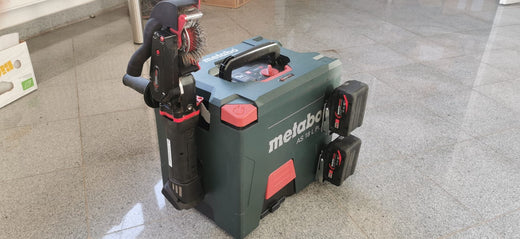
The procedure covers removal of AerFilm® decorative laminates after application, on different substrates including metals (aluminium, steel) and composites (glass- or carbon-fibre). The Vinyl Zapper® is a patented natural-rubber eraser wheel on a 23 mm adaptor, driven by an MBX® electric or pneumatic drive unit at up to 3,200 rpm. On painted metal it removes film and adhesive without damaging the paint; on fibre-reinforced plastics and water-based paints MontiPower® rates it as suitable only to a limited extent, which is why the trial step below matters. For the wider range of aircraft surface preparation, see aerospace and aviation.
Tools and materials
- MONTI electric or pneumatic tool fitted with the Vinyl Zapper® wheel.
- Non-abrasive, lint-free cloth.
- Soft solvent for cleaning: isopropyl alcohol, ethyl acetate or acetone.
- Finish-cleaning agents such as a citrus-based industrial cleaner or a safe strip remover.
Health & safety: work gloves or gauntlets, safety glasses, safety shoes, hearing protection, and a P1 dust mask for overhead, confined-space or prolonged use (Schneller’s bulletin states that the AerFilm® / Vinyl Zapper® dust is REACH-conform).
Procedure
Step 1 — Remove the AerFilm® laminate
Heated removal: warm the laminate (approximately 65–100 °C for PSLHR, or above 110 °C for HA211) with a heat gun or heated chamber, then peel it off by hand; striping the laminate into bands a few tens of centimetres wide is easier than lifting large pieces.
With the Vinyl Zapper®: using slight pressure and a scanning motion on a ~10 cm line perpendicular to the wheel direction, start the laminate lifting and then progress backwards along the wheel direction to strip band-shaped areas. This works on metallic and composite parts. Do not apply too much pressure or dwell in one spot — especially on composites — as this can damage the surface. Always test on a scrap panel or a non-apparent area first, particularly for new panel constructions.
Step 2 — Remove adhesive residue
Remaining PSLHR or HA211 adhesive can be soaked with a solvent (e.g. MEK, acetone). As a solvent-free alternative, the Vinyl Zapper® removes the residue directly — the same technique as Step 1 but with lower pressure and a faster scanning speed over a ~20 cm line.
Step 3 — Finish cleaning
Vacuum larger particulate and dust, then wipe with a non-abrasive cloth lightly dampened with a cleaning agent or soft solvent and rinse off any fine residue. The part is then ready for a new decorative film.
How the removal routes compare
Schneller’s technical bulletin gives a qualitative ranking (five stars = best) of the removal routes on a standard sidewall panel:
| Removal route | Solvent-free / eco | Ease / low damage risk | Speed, large areas | Speed, small areas | Est. time |
|---|---|---|---|---|---|
| Heat + solvent (common) | ★ | ★★★★ | ★★★ | ★★★ | ~90 min |
| Heated removal + Vinyl Zapper® residue + finish | ★★★★ | ★★★★ | ★★★★★ | ★★★★ | ~70 min |
| Vinyl Zapper® full removal + finish | ★★★★ | ★★ | ★★ | ★★★★★ | ~120 min |
The time estimates are Schneller’s for one standard sidewall panel; actual times depend on panel size, laminate type, adhesive age and operator experience. The same eraser-wheel technique is used outside aviation to remove vinyl decals from vehicles and equipment.
Before using the Vinyl Zapper® on production parts, read the operator’s manual and contact MontiPower® for trials and training.
Frequently asked questions
Can AerFilm® laminates be removed without solvents?
Yes. Schneller’s bulletin describes two solvent-free routes: heat the laminate and peel it, or lift it with the Vinyl Zapper®, then remove the remaining PSLHR or HA211 adhesive with the Vinyl Zapper® instead of MEK or acetone. Only a light wipe with a soft solvent or cleaning agent is used for final cleaning.
Is the Vinyl Zapper® safe on composite aircraft panels?
It can be used on glass- and carbon-fibre composites, but with care. Use slight pressure and a constant scanning motion, never dwell in one spot, and test on a scrap panel or hidden area first, especially for new panel constructions. Excess pressure or dwell time can damage the composite surface.
What temperature is needed to remove AerFilm® laminates with heat?
According to Schneller’s bulletin, laminates with pressure-sensitive PSLHR adhesive release at approximately 65–100 °C, while heat-activated HA211 adhesive needs more than 110 °C. Use a heat gun or heated chamber, and peel the laminate in bands a few tens of centimetres wide rather than in large pieces.
Which removal route is fastest?
On Schneller’s standard sidewall panel, heated removal followed by Vinyl Zapper® adhesive removal was fastest at about 70 minutes, against about 90 minutes for heat plus solvent and about 120 minutes for full removal with the Vinyl Zapper®. Full Vinyl Zapper® removal scores best on small areas.
Sources
- Schneller, Removal procedure for AerFilm® decorative laminates with the MONTI Vinyl Zapper® tool (metal and composite parts), technical bulletin. Document on file with MontiPower.
- Schneller, aircraft interior decorative laminates and thermoplastics. schneller.com
- MontiPower technical data sheets: Vinyl Zapper® Electric and Vinyl Zapper® Pneumatic (natural-rubber base, 23 mm adaptor, up to 3,200 rpm).