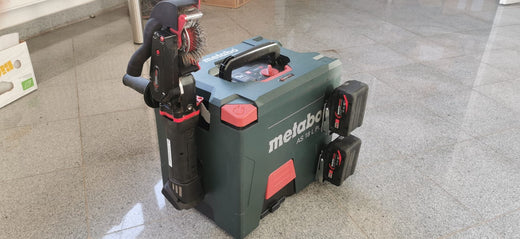
Mechanical descaling removes mill scale by physical force rather than by acid or heat. There are three mechanisms: abrasion (grinding and sanding cut through the scale and the steel), impact (needle guns, rotary flaps, bristle blasting and shot strike the scale until it fractures), and rubbing (wire brushes, which mostly remove loose scale and polish what remains). Impact methods are the most effective on adherent mill scale because the scale is a brittle oxide on a ductile steel, and they are the only power-tool methods that also create an anchor profile.
Mill scale is the dark blue-grey oxide layer that forms on steel during hot rolling. It consists of wüstite (FeO), magnetite (Fe₃O₄) and haematite (Fe₂O₃). It is cathodic to steel, so breaks in it concentrate corrosion on the exposed steel underneath, and coatings applied over it bond to the scale instead of the steel. Every bare-metal surface preparation grade requires its removal.
This article explains how mechanical descaling works, why some tools remove mill scale and others only appear to, and how to choose and verify a mechanical method. For the practical procedure on repairs, see How to Remove Mill Scale from Small Steel Areas.
Mechanical descaling in the mill and in the field
The term is used in two places. In steel production, scale is removed between processes so it does not get rolled into the surface: high-pressure water descaling during hot rolling, and mechanical methods such as reverse bending on wire rod before drawing, which cracks the brittle scale off the ductile wire. Strip and plate are often shot blasted or acid pickled before further processing.
Coating work deals with the scale that is still on the steel when it arrives at the fabricator or the site. That is where the choice of mechanical method decides whether the coating lasts.
Three mechanisms, three different results
1. Abrasion: cutting through scale and steel
Grinding wheels, flap discs and fibre discs use bonded or coated abrasive grains to cut material away. They remove mill scale by removing the steel surface beneath it. The result is bare metal with a shallow, directional scratch pattern. In ASC Shipbuilding trials, a #36 grit grinder and a #40 flap disc each produced 30–40 µm of profile. Abrasion is hard to control on large areas: it removes sound steel, leaves low spots, and can burnish the surface it has just exposed.
2. Impact: fracturing the scale
Impact tools strike the surface repeatedly. SSPC-SP 11 groups them as impact media and names "rotary flap, cutter bundle, needle gun, wire bristle impact, and hammer flail assemblies." Mill scale is harder and more brittle than the steel under it, so a sharp impact cracks and ejects the scale while the steel deforms into a small crater. Those overlapping craters are the anchor profile.
Bristle blasting is the clearest example. A rotating belt of hardened wire bristles is held back by an accelerator bar and then released, so the tips strike the surface rather than drag across it. Research by Prof. Robert Stango at Marquette University, published through NACE, describes the result as resembling grit blasting in both cleanliness and roughness. See bristle blasting fundamentals.
3. Rubbing: removing what is loose, polishing what is not
Power wire brushes run their bristles across the surface. They are fast on loose rust and flaking paint, and they remove loose mill scale. Tight scale stays and is often polished to a sheen. SSPC-SP 11 warns that "power wire brushes or sanding discs when used alone may not produce the required surface profile and may remove or degrade an existing profile to an unacceptable level." This is why wire brushing is the typical route to SSPC-SP 3 / St 3, and why SP 3 says it is "not intended that adherent mill scale, rust, and paint be removed by this process."
How the mechanisms compare on mill scale
| Mechanism | Typical tools | Adherent mill scale | Profile | Steel removal |
|---|---|---|---|---|
| Abrasion | Grinding discs, flap discs, fibre discs | Removed with the steel surface | Shallow, directional (30–40 µm measured) | High |
| Impact | Bristle blasting, rotary impact flaps, needle guns, shot | Fractured and removed | Crater profile (bristle blasting 50–85 µm in published tests) | Low |
| Rubbing | Wire wheels and cup brushes, non-woven pads | Mostly remains, often polished | None; may degrade existing profile | Very low |
The bristle blasting profile range combines the published sources: 50–80 µm measured by Dankiw and Fosdike, 50–85 µm in Jotun's bristle blast cleaning code, and 65–85 µm Rz (2.6–3.3 mil) on standard API 5L steel in MontiPower's documented tests. Results on any job vary with steel grade, rust grade, belt and technique.
The standards that define "descaled"
Whether mechanical descaling has worked is decided by the grade in the specification:
- SSPC-SP 2 / SP 3 (St 2 / St 3): loose mill scale removed; adherent scale may remain. The SSPC dull putty knife test decides what counts as adherent.
- SSPC-SP 15: mill scale removed, staining allowed on up to 33% of each unit area, minimum 25 µm (1 mil) profile.
- SSPC-SP 11: free of all visible mill scale, rust and coating except in the bottom of pits, minimum 25 µm (1 mil) profile.
- Blast grades (SP 10 / Sa 2½, SP 5 / Sa 3): written for abrasive blasting. A mechanical result is described as comparable to these grades and accepted by the inspector against the specification. Jotun's code for bristle blast cleaning maps its grades muA to muD onto Sa 3 to Sa 1.
For the full standards picture, see mechanical preparation standards and SSPC-SP 11 explained.
Side effects worth knowing
- Residual stress. Impact methods cold-work the surface. Stango's NACE research on bristle blasting (Compressive Residual Stress Generated by Bristle Blasting Process with Implication upon SCC, 2014) reported compressive residual stress in the near-surface layer, a condition associated with delaying stress corrosion cracking. See residual stress and bristle blasting.
- Embedded contamination. Carbon steel bristles or abrasives used on stainless steel can leave iron contamination. Use stainless belts with a stainless accelerator bar and keep tools dedicated to stainless work. See stainless steel preparation.
- Pits and pack rust. No power tool reaches the bottom of deep pits as well as abrasive; SP 11 and SP 15 both allow residue there. Heavy, layered rust over scale is faster to remove with a heavy-removal disc such as Tercoo® before profiling.
- Heat. Impact methods are cold-working processes and avoid the distortion of flame descaling, but dwelling in one spot with any rotating tool generates local heat.
Verifying mechanical descaling
- Visual: no blue-grey scale remaining outside pit bottoms; compare with ISO 8501-1 reference photographs where the specification uses them.
- Profile: replica tape or depth micrometer to ASTM D4417. A reading below the specification minimum on mill-scaled steel usually means the scale was polished, not removed. See the anchor profile measurement field guide.
- Adhesion, where required: pull-off testing on a trial area. Dankiw and Fosdike's trials all exceeded the 5 MPa minimum, with bristle blasting showing less variation (about 2–3 MPa) than grinding discs (about 5 MPa).
Related reading: Environmentally Friendly Mill Scale Removal Guide and mill scale removal with the Bristle Blaster®.
Need to specify mechanical descaling?
Send the steel grade, rust grade and coating data sheet. We'll recommend the method and the acceptance checks.
Frequently asked questions
What is mechanical descaling?
Removing mill scale or other oxide scale by physical means (abrasion, impact or brushing) instead of acid pickling or heat.
Which mechanical method removes mill scale best?
Impact methods. Because mill scale is brittle and the steel beneath it is ductile, impact fractures the scale and leaves a crater profile in the steel. Bristle blasting, rotary impact flaps and needle guns are named as impact media in SSPC-SP 11.
Is mechanical descaling better than pickling?
For coating work in the field, usually yes. Pickling needs a controlled acid bath, produces spent acid, leaves no anchor profile and carries a hydrogen embrittlement risk on high-strength steel. Pickling remains common in steel mills and shops.
Does wire brushing count as mechanical descaling?
For loose scale, yes. Tight mill scale generally remains, which is why wire brushing typically meets SSPC-SP 3 / St 3 rather than a bare-metal grade.
Sources
- SSPC-SP 11, Power Tool Cleaning to Bare Metal. Copy of standard
- SSPC-SP 3, Power Tool Cleaning. Copy of standard
- KTA-Tator, Industry Standards for Surface Preparation. kta.com
- R. Dankiw, D. Fosdike, Defining Mechanical Surface Preparation Standards with Power Tools, Corrosion & Prevention 2018, Paper 74. PDF
- Jotun, Surface Preparation Code and Standard for Bristle Blast Cleaning and Profiling Process. PDF
- R. J. Stango et al., Fundamentals of Bristle Blasting Process for Removing Corrosive Layer, NACE CORROSION 2009. AMPP abstract
- R. J. Stango, Compressive Residual Stress Generated by Bristle Blasting Process with Implication upon SCC, NACE CORROSION 2014. Semantic Scholar
- MontiPower, Bristle Blaster® Belts and Accelerator Bars technical data sheets.