In brief: MontiPower Brasil, with Dirk Pohlmann and his team, trained people from more than 22 companies at a Hempel coating workshop in Argentina, reported in June 2022. Participants came from coating contractors, coating application companies, surface preparation firms and Hempel sales partners. The shared message: preparation and coating go hand in hand, and common training prevents disputes over quality.
This news item reports on a coating workshop in Argentina, held with Hempel, in which the MontiPower® team from Brazil trained participants on surface preparation. Below: what happened, why joint training on preparation and coating matters, and where to learn more.
What happened
Education is key to making sure there is no disagreement over the quality of surface preparation and coating. At the Hempel coating workshop in Argentina, MontiPower Brasil, Mr. Dirk Pohlmann and his team trained people from more than 22 companies. The participants came from different backgrounds:
- coating contracting companies,
- coating application companies,
- surface preparation firms, and
- Hempel sales partners.
We thank Hempel for this opportunity. The feedback was very positive. For optimal quality, preparation and coating go hand in hand.
Why joint training on preparation and coating matters
A coating system is only as good as the surface beneath it. The coating manufacturer's product data sheet states the cleanliness and surface profile the product needs; the contractor has to produce that surface on site; and an inspector has to verify it. When these groups learn the requirements together, they use the same reference points and are far less likely to disagree about whether a surface is ready to coat.
Those reference points are international standards. ISO 8501-1 defines visual cleanliness grades such as Sa 2½ (very thorough blast cleaning) and St 3 (very thorough hand and power tool cleaning), and the SSPC/AMPP standards define equivalent grades, for example SSPC-SP 10 near-white metal blast and SSPC-SP 11 power tool cleaning to bare metal with a minimum 25 µm (1 mil) profile. Our complete guide to surface preparation standards explains how they relate. A shared understanding of these grades, and of how anchor profile is measured, is what turns "clean" from an opinion into a verifiable result.
The technology behind the training
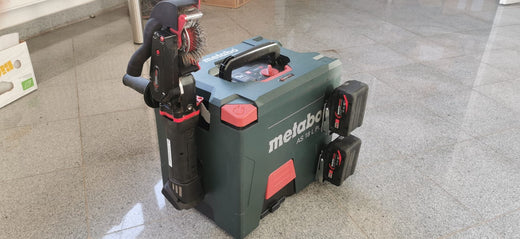
MontiPower's training centres on the Bristle Blaster®, a grit-free power tool that removes corrosion and coatings and creates an anchor profile in one step. Specially designed bristle tips strike the surface with kinetic energy comparable to grit blast media and then rebound, which removes corrosion and leaves micro-indentations that expose fresh metal. In documented tests on standard steel the result is cleanliness comparable to ISO 8501-1 Sa 2½ / SSPC-SP 10 with a 65–85 µm Rz (2.6–3.3 mil) anchor profile. Results vary with steel grade, rust grade, belt and technique, which is exactly why hands-on training matters.
Because no loose abrasive is used, the method suits work where blasting is difficult: spot repairs, maintenance in service, weld seams and areas where containment of spent grit would be costly. It is grit-free, not dust-free: the rust and coating removed still need appropriate extraction and PPE.
Where to learn more
MontiPower runs hands-on and online training through the Dr. Prepper® Academy, covering technique, ISO 8501 and SSPC standards and inspection-ready results. Crews can also book on-site operator training, and contractors who want to demonstrate a verified result can become MontiPower® certified applicators. Upcoming trade shows and demonstrations are listed on our events page.
Sources
- KTA-Tator, Industry Standards for Surface Preparation (SSPC-SP 10, SP 11 and related grades). kta.com
- R. Dankiw, D. Fosdike, Defining Mechanical Surface Preparation Standards with Power Tools, Corrosion & Prevention 2018, Paper 74. PDF
- MontiPower, Bristle Blaster® technical data sheets (cleanliness comparable to Sa 2½ / SSPC-SP 10; 65–85 µm Rz on standard steel in documented tests).